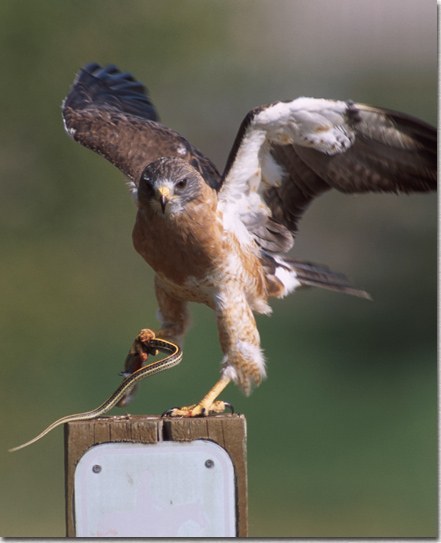
Swainson's Hawk
- Habitat
- Plains, prairies, arid regions; nests in shrubs/trees near wetlands, drainage ditches, or windbreaks in fields; perches on fence posts/telephone poles, notably tame
- Size
- 18–22 in
- Lifespan
- A long-distance migrant raptor; studied populations average roughly 9 years, though one banded bird reached 26 years.
- Diet
- Mostly small vertebrates, snakes, voles, insects, birds
About the Swainson's Hawk
The Swainson's Hawk is a large, elegant buteo built for endurance flight rather than quick maneuvering, with long, pointed wings that it holds in a shallow V while soaring on thermals. Typical birds show brown upperparts, white underparts, and a warm-brown breast band across the chest that contrasts with a paler belly, plus a finely banded tail. The species is also unusually variable in color: alongside this typical "light morph," darker rufous and nearly all-dark melanistic individuals occur, so plumage alone is not always a reliable guide compared with its flight silhouette and habits. It is notably tame for a raptor, often allowing close approach while perched on a fence post or telephone pole scanning the ground for prey.
Swainson's Hawks are birds of open country -- plains, prairies, and arid grasslands -- where they nest in isolated shrubs or trees near wetlands, drainage ditches, or windbreaks bordering cultivated fields. From these elevated perches they watch for small vertebrates, snakes, voles, insects, and occasionally other birds, dropping to the ground to seize prey rather than pursuing it in flight. Where cultivation and irrigation have replaced native grassland, the species has adapted reasonably well, often nesting in shelterbelts and hunting over adjacent hayfields and pastures, provided at least some undisturbed perch sites and prey-rich ground remain nearby.
Their diet shifts markedly with the seasons: during the breeding season they hunt more rodents, snakes, and small birds to feed growing young, but on their wintering grounds they become heavily insectivorous, following agricultural machinery and grass fires to catch swarms of grasshoppers and crickets flushed into the open. Birds will sometimes gather by the dozens around a single active tractor or a smoldering grass fire, walking on the ground almost like large gulls behind a fishing boat, snapping up insects that would otherwise be far harder to catch on the wing. That reliance on insects made the species tragically vulnerable in the 1990s, when pesticide use on the South American pampas caused mass die-offs of wintering Swainson's Hawks, an episode that helped spur international cooperation on raptor conservation and led to changes in pesticide application practices in affected wintering areas.
Few North American raptors migrate as far as the Swainson's Hawk, which travels from the Great Plains and western prairies all the way to the grasslands of Argentina, a round trip of many thousands of miles. Along the way it gathers into enormous migrating flocks, sometimes numbering in the thousands, riding rising columns of warm air called thermals to conserve energy over the long journey; these flocks, sometimes called "kettles," can form dramatic, swirling columns of birds spiraling upward on a single thermal before gliding off together toward the next one, a strategy that lets the hawks cover enormous distances while expending relatively little flight energy of their own.
Banding studies of these long-distance travelers show an average lifespan of around 9 years, though at least one banded individual lived an extraordinary 26 years, underscoring how much variation exists beneath the average for a species that faces so many hazards along its migratory route. Pairs generally return to the same general nesting territory in successive years, and both parents share in defending the nest against intruders, though the species' close association with open, unforested country also leaves nests more exposed to weather and predators than the well-hidden nests of many forest-dwelling hawks.
Frequently asked questions
How does a Swainson's Hawk fly differently from other hawks?
It soars with its long, pointed wings held in a shallow V shape, riding thermals rather than flapping.
What does a Swainson's Hawk eat?
Mostly small vertebrates such as voles and snakes plus insects and birds, with insects like grasshoppers making up much more of its diet in winter.
How far does the Swainson's Hawk migrate?
It makes one of the longest migrations of any North American raptor, traveling between the Great Plains and the pampas of Argentina.
How long do Swainson's Hawks live?
Studied populations average roughly 9 years, though one banded individual reached 26 years.
Why do Swainson's Hawks sometimes follow tractors or grass fires?
Both flush large numbers of insects like grasshoppers into the open, and the hawks take advantage by walking or hovering nearby to snap them up.
Where to find it
This species favors grassland habitat. See real Oklahoma locations on the Habitats map.