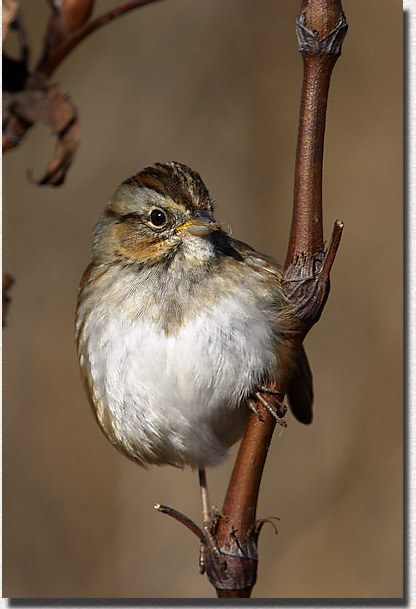
Swamp Sparrow
- Habitat
- Marshes, wet meadows, and swamps with dense low vegetation
- Size
- Length about 5.9 in (15 cm), wingspan around 7.5 in (19 cm)
- Lifespan
- Banding records suggest individuals can live upward of 8 years in the wild, though most likely live considerably fewer
- Diet
- Insects in the warmer months, seeds through fall and winter
About the Swamp Sparrow
The Swamp Sparrow shows rich rufous wings, a gray face and breast, a dark line through the eye, and a streaked crown that often shows a rufous cap, especially in breeding adults. Its overall coloring is warmer and more richly patterned than many other streaked sparrows, and it tends to skulk low in dense vegetation, making brief appearances rather than sitting out in the open. Its call is a hard, sharp chip note, and its song is a slow, even, single-pitched trill. Nonbreeding and immature birds show a duller, browner cap and less crisply defined face pattern than breeding adults, which can make winter birds a bit less striking than the description above suggests.
The species breeds across wetlands of the northern United States and Canada, favoring cattail marshes, sedge meadows, and other dense wet habitats. It winters across much of the southeastern United States and into Oklahoma, where it is primarily encountered from fall through spring in marshy edges, wet ditches, and reedy pond margins rather than as a breeding bird. Because it depends so specifically on standing water and dense low cover together, suitable wintering habitat in Oklahoma tends to be patchy, concentrated around the edges of ponds, marshes, and slow-moving creeks rather than spread evenly across the landscape.
Its diet shifts seasonally: insects dominate during the breeding season when protein demands are high for raising young, while seeds become the mainstay through fall and winter when insects are scarce. It forages low, often at the very edge of the water or even wading briefly into shallow water to pick up food items, staying close to the cover that dense marsh vegetation provides. Unlike some sparrows that will venture into open fields or lawns, Swamp Sparrows rarely stray far from wetland vegetation, and a bird flushed from cover typically flies only a short distance before dropping back into cover rather than crossing open ground.
On its northern breeding grounds, the Swamp Sparrow builds its nest low in marsh vegetation, typically just above the waterline, using grasses and sedges woven into a cup. Males defend breeding territories vigorously with that distinctive slow trill, often singing from a low emergent perch such as a cattail stalk or shrub at the marsh edge, and pairs typically raise their brood entirely within the dense cover of the marsh, rarely venturing to more open habitat even to forage.
This close association with standing water throughout its life cycle, both for nesting sites and foraging habitat, ties the species tightly to wetland health, and its numbers can serve as one indicator of marsh condition across its range. Because the Swamp Sparrow depends so completely on wetland vegetation at every stage of its annual cycle, from breeding to migration stopovers to wintering grounds, the draining or degradation of marshes and sedge meadows anywhere along its range has an outsized effect on the species compared with more habitat-flexible sparrows that can shift into drier, more disturbed ground when wetlands disappear.
Three recognized subspecies of Swamp Sparrow differ subtly in overall darkness and the extent of rufous coloring, with some coastal populations showing a notably darker, more saturated plumage than birds from the interior of the breeding range, a pattern seen in a number of other marsh-dependent songbirds as well. In Oklahoma, careful observers scanning wintering marsh edges will often find Swamp Sparrows mixed in with other wintering sparrows such as Song Sparrows and Lincoln's Sparrows, and separating the three takes practice with subtle differences in face pattern, breast streaking, and overall color tone, since all three species share the same skulking habits and similar brushy wetland edges during the colder months.
Frequently asked questions
Is the Swamp Sparrow present year-round in Oklahoma?
No, it is mainly a fall-through-spring winter visitor to the state's marshes rather than a year-round resident.
What does a Swamp Sparrow sound like?
Its song is a slow, even trill given on a single pitch, distinct from the more varied songs of many other sparrows.
Where does the Swamp Sparrow breed?
In wetlands across the northern United States and Canada, where it builds its nest low in marsh vegetation just above the water.
What does a Swamp Sparrow eat?
Mostly insects during the breeding season and seeds in fall and winter, foraged low in dense marsh vegetation.
Does the Swamp Sparrow ever forage away from wetlands?
Rarely; unlike some sparrows, it stays close to marsh vegetation and standing water almost year-round rather than using open fields or lawns.
Where to find it
This species favors wetland habitat. See real Oklahoma locations on the Habitats map.