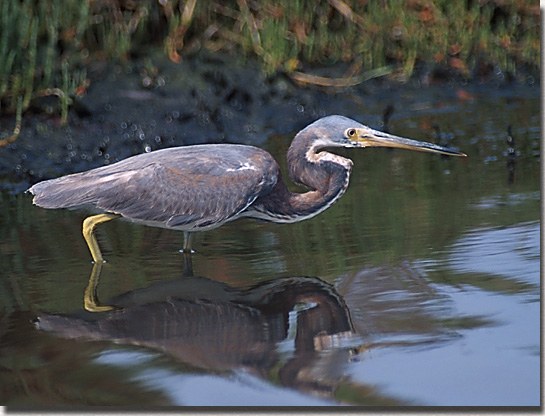
Tricolored Heron
- Habitat
- Coastal marshes, estuaries, and mangroves, with occasional inland wetland records
- Size
- Length about 24-26 in (61-66 cm), wingspan around 36 in (91 cm); a notably slender heron
- Lifespan
- Precise figures for this species are limited, though related herons have banding records reaching well into the teens of years
- Diet
- Primarily small fish, along with some crustaceans and aquatic insects
About the Tricolored Heron
The Tricolored Heron is a slim, long-necked, long-legged heron, dark blue-gray to purplish above with a contrasting white belly and a white stripe running down the front of the neck. This bright white underside sets it apart sharply from other similarly dark herons and egrets, which tend to be uniformly colored, and it is often the single easiest field mark for identifying the species at a distance. It was formerly known in North America as the Louisiana Heron. Breeding adults add fine plumes on the head, neck, and back along with brighter, more saturated leg and lore color, a temporary flush of color that fades again once the nesting season ends.
It is primarily a bird of the Gulf Coast and southern Atlantic coast, breeding and wintering in coastal marshes, estuaries, and mangrove-lined shorelines from the southeastern United States through parts of Central and South America. It is not an expected species in Oklahoma, occurring there only as an uncommon or rare visitor, most often when individuals disperse inland outside the breeding season, a pattern of post-breeding wandering shared by several other herons and egrets that nest along the Gulf Coast.
The Tricolored Heron is an active, energetic forager rather than a still, statuesque hunter. It runs, lunges, and stirs the water with its feet to flush small fish, and it will sometimes spread its wings over the water's surface, a behavior called canopy feeding, which is thought to reduce glare and make prey easier to spot, or possibly to attract fish seeking shade. This contrasts with the more patient, stand-and-wait hunting style used by many other herons, and an actively foraging Tricolored Heron can look almost frantic by comparison, dashing several steps at a time with wings half-raised for balance before stabbing at a fish it has startled into moving.
The species nests colonially, often alongside other herons and egrets in coastal rookeries, building stick nests in low trees, shrubs, or mangroves near water. Both parents share incubation and chick-rearing duties, and as in many colonial waders, nesting success can depend heavily on the safety of the rookery site itself, since a colony situated over open water or on a predator-free island tends to fare far better than one more easily reached by raccoons, snakes, or other ground-based predators.
Because it depends so heavily on coastal wetland habitat for both feeding and breeding, its presence and health are often used as one indicator of the condition of Gulf Coast estuarine systems. Habitat loss from coastal development, changes in water management, and the cumulative effects of storms and sea-level rise on marsh and mangrove habitat all bear directly on the species' long-term prospects, making the Tricolored Heron, despite its rarity in landlocked states like Oklahoma, a genuinely useful bellwether for the broader health of the coastal wetlands it calls home.
Juvenile Tricolored Herons show a duller, browner cast to the upperparts and a rustier neck than adults, gradually acquiring the crisp blue-gray and white adult pattern over their first year or two of life. The species is generally non-migratory or only a short-distance migrant across much of its range, with many populations remaining on or near their breeding coastline year-round rather than undertaking the long seasonal journeys typical of many other North American herons, though northernmost breeders do withdraw somewhat southward in the coldest months. Within mixed nesting colonies it can be picked out from Little Blue Herons and other dark waders by its slimmer build, longer neck, and that diagnostic white belly, a combination that, once learned, makes the Tricolored Heron one of the more straightforward herons to identify confidently even at a distance across open water.
Frequently asked questions
Is the Tricolored Heron common in Oklahoma?
No, it is primarily a Gulf Coast species and only an uncommon or rare visitor inland to Oklahoma.
What was this species' former name?
It was formerly known as the Louisiana Heron.
How does the Tricolored Heron catch fish?
It actively chases prey through shallow water and sometimes spreads its wings to create shade that reduces glare and helps reveal fish.
What makes the Tricolored Heron easy to identify?
Its bright white belly and neck stripe contrast sharply with its dark blue-gray body, unlike most other dark herons.
Why might a Tricolored Heron appear far from the coast?
Individuals, especially after the breeding season, sometimes disperse well inland from their usual Gulf Coast range, a wandering pattern shared with several other herons and egrets.
Where to find it
This species favors wetland habitat. See real Oklahoma locations on the Habitats map.