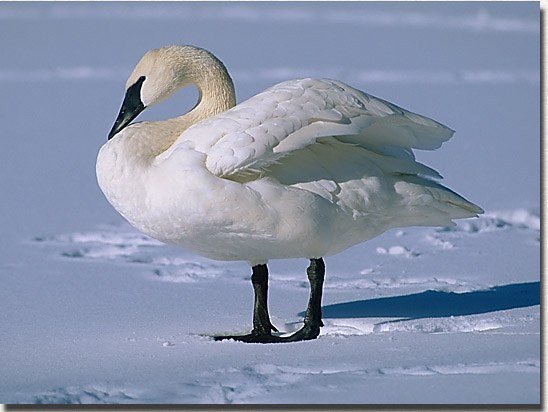
Trumpeter Swan
- Habitat
- Large lakes, rivers, and wetlands
- Size
- Length about 58-72 in (150-180 cm), wingspan up to 8 ft (2.4 m); the heaviest native North American waterfowl
- Lifespan
- Wild individuals commonly live into their 20s, with some banding records reaching over 24 years
- Diet
- Aquatic vegetation, with waste grain sometimes taken in winter
About the Trumpeter Swan
The Trumpeter Swan is an enormous, entirely white waterbird with an all-black bill that lacks the knob found at the base of a Mute Swan's bill, and often shows a thin reddish line, sometimes called a grin line, along the lower mandible. Its resonant, low-pitched trumpeting call, from which it takes its name, carries a considerable distance and is a distinctive sound wherever the species occurs. It is the largest native waterfowl species in North America by both length and weight, with adult males, called cobs, typically outweighing females, called pens, by a noticeable margin.
It breeds in Alaska, western Canada, and a number of reintroduced populations in the northern contiguous United States, generally on secluded lakes and wetlands, and winters somewhat further south. It is not an expected species in Oklahoma, appearing there only occasionally, usually during migration or winter on large reservoirs, sometimes as wanderers from restoration populations reestablished in the Midwest, and any individual seen in the state is generally treated as a notable sighting rather than a routine one.
Trumpeter Swans feed mainly by dabbling at the surface or upending to reach submerged aquatic plants in shallow water, and they also graze on land; in winter, where available, they will feed on waste agricultural grain in harvested fields near open water. Their long neck, proportionally longer relative to body size than that of most ducks and geese, lets them reach aquatic vegetation at depths other waterfowl on the same pond simply cannot access, reducing direct competition for food with smaller species sharing the water.
The species nearly disappeared from much of its range by the early twentieth century due to unregulated hunting and habitat loss, reaching a low point where only a small number of individuals were known to survive. Sustained conservation efforts, including protected breeding areas and reintroduction programs, have since allowed populations to recover substantially, though the species remains less numerous and more range-restricted than it once was. Restoration efforts have relied heavily on relocating eggs or young birds to historic range areas and on protecting quiet, undisturbed nesting lakes from development and excessive recreational boat traffic, since the species is sensitive to disturbance during the vulnerable incubation period.
Pairs form long-term bonds and build large nest mounds of vegetation near water, with both parents helping to guard the cygnets, which stay with their parents through their first migration south. Family groups often remain together as a unit well into the following winter, with cygnets learning traditional migration routes and wintering areas by following their parents on that first journey, a pattern of learned rather than purely instinctive migration that makes protecting historic family wintering sites an important part of ongoing recovery efforts for the species.
Cygnets hatch covered in gray down and take more than a year to acquire the fully white adult plumage, passing through a mottled gray-and-white subadult stage that can make young birds look almost like a different species when seen among a family group of clean white adults. Trumpeter Swans require a fairly long stretch of open water to become airborne, running and flapping across the surface for a considerable distance before lifting off, a physical demand of their sheer size that makes larger lakes and slow rivers more suitable habitat than small ponds. Once established, a breeding pair will often return to defend the very same territory year after year, aggressively driving off other waterfowl, including other swans, from the immediate vicinity of the nest, and the species' slow reproductive rate, typically producing only a handful of cygnets per pair per year at best, is part of why recovery from its early twentieth-century population crash has taken decades of sustained effort rather than happening quickly.
Frequently asked questions
Is the Trumpeter Swan native to Oklahoma?
It is not a regular breeder there, but individuals occasionally appear during migration or winter, sometimes from reintroduced populations elsewhere.
How can you tell a Trumpeter Swan from other swans?
Its all-black bill lacks the knob of a Mute Swan and it is larger overall than a Tundra Swan, with a distinctive low trumpeting call.
Was the Trumpeter Swan ever endangered?
Yes, overhunting and habitat loss nearly eliminated it by the early 1900s, though conservation and reintroduction efforts have since helped populations recover.
Do Trumpeter Swans mate for life?
Yes, they typically form long-term pair bonds.
How do young Trumpeter Swans learn their migration route?
Cygnets travel with their parents on their first migration south, learning traditional routes and wintering areas by following the family group rather than by instinct alone.
Where to find it
This species favors wetland habitat. See real Oklahoma locations on the Habitats map.