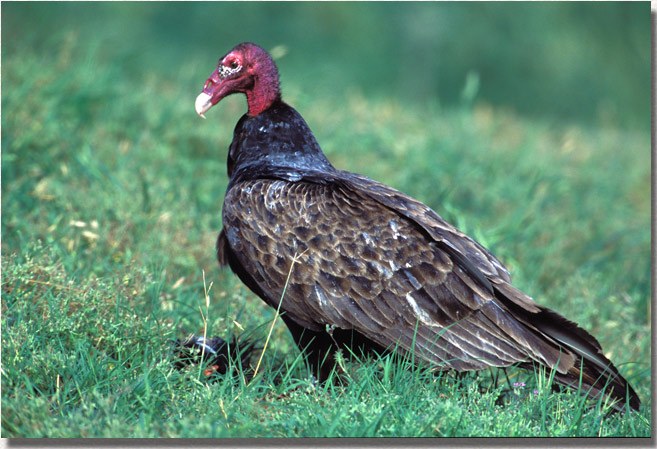
Turkey Vulture
- Habitat
- Open country, farmland, and woodlands across nearly all of North and South America
- Size
- Length about 26-32 in (66-81 cm), wingspan roughly 67-70 in (170-178 cm)
- Lifespan
- Wild individuals have been documented living into their mid-teens, with some banding records reported around 16 years
- Diet
- Almost exclusively carrion
About the Turkey Vulture
The Turkey Vulture is a large, dark bird best known for its small, featherless red head, an adaptation that likely stays cleaner than feathers would while the bird feeds inside carcasses. Juveniles have a gray rather than red head. In flight it holds its long wings in a shallow V shape, called a dihedral, and rocks unsteadily from side to side rather than gliding on a flat, stable plane; up close, the flight feathers appear pale silvery-gray against otherwise black wing linings, a pattern visible from below at a distance and one of the most reliable ways to identify the species even as a distant, wobbling silhouette.
It breeds across most of the United States, including all of Oklahoma, and is joined in winter by northern populations that migrate south, sometimes as far as Central and South America, while more southern populations tend to remain resident year-round. It is a familiar sight soaring over highways, farmland, and open woodlands, often in loose groups, and communal night roosts, sometimes shared with Black Vultures where the two species overlap, can host dozens of birds that disperse each morning to search their own individual foraging areas before regathering at dusk.
Unusually among birds, the Turkey Vulture has a well-developed sense of smell, which it uses along with sight to locate carrion, including carcasses hidden beneath a forest canopy that purely sight-hunting scavengers would miss. This gives it an advantage in wooded terrain, and it is often the first scavenger to arrive at a fresh kill in such settings, with other species sometimes following its lead to a carcass; competing scavengers, including Black Vultures that lack as strong a sense of smell, are known to watch circling Turkey Vultures and then follow them in to a find, occasionally displacing the smaller-billed Turkey Vulture from a carcass once it has done the work of locating it.
Turkey Vultures roost communally, sometimes in large numbers, and nest not in built structures but directly on the ground, in caves, hollow logs, or dense thickets, laying one to three eggs with minimal nest material. Because the nest offers so little physical protection, parent birds rely heavily on remaining still and using foul-smelling defensive vomit as a deterrent against approaching predators, a strategy that, unappealing as it sounds, is often effective at discouraging mammals from pressing an attack on eggs or flightless young.
They also practice urohidrosis, defecating on their own legs, which is thought to help cool the body through evaporation and may also kill bacteria picked up while feeding on carcasses. Despite their association with death, they pose no threat to living animals, feeding solely on animals already dead, and their digestive system is remarkably effective at destroying the bacteria and toxins commonly present in decaying flesh, letting them safely consume carrion that would sicken or kill most other animals, an ecological service that helps limit the spread of disease from carcasses left on the landscape.
Turkey Vultures are also strong, efficient soarers, exploiting rising thermal air currents to cover large foraging areas each day while flapping as little as possible, an energy-saving flight style well suited to a diet whose location and timing are inherently unpredictable. When threatened at the nest or roost, in addition to vomiting, they may also feign death or hiss and grunt, since they lack the vocal apparatus, called a syrinx, that lets most songbirds produce complex calls, leaving them with only these hisses, grunts, and low growls as their vocal repertoire. Widespread and adaptable, the species has expanded its range northward in recent decades in parts of North America, a shift some researchers attribute to warming winters and increased carrion availability from roadkill along the region's growing network of highways.
Frequently asked questions
How do Turkey Vultures find food?
They have an unusually strong sense of smell for a bird, letting them detect carrion even hidden under a forest canopy.
Why does the Turkey Vulture have a bald red head?
The featherless head likely stays cleaner while the bird feeds inside carcasses, reducing bacterial buildup.
Are Turkey Vultures dangerous?
No, they feed only on already-dead animals and pose no threat to living animals or people.
Why do they rock unsteadily while soaring?
Their shallow V-shaped wing posture, called a dihedral, gives efficient lift but less stability, producing a characteristic wobble.
Do other scavengers rely on Turkey Vultures to find carcasses?
Yes, species like Black Vultures, which have a weaker sense of smell, will sometimes watch circling Turkey Vultures and follow them to a carcass.
Where to find it
This species favors forest habitat. See real Oklahoma locations on the Habitats map.