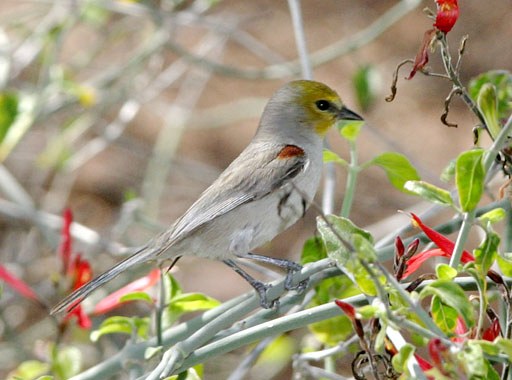
Verdin
- Habitat
- Desert scrub, mesquite thickets, and arid brushland
- Size
- Length about 4.5 in (11 cm), wingspan around 6.5 in (17 cm); one of the smallest North American songbirds
- Lifespan
- Not well documented in the wild; as a very small songbird its lifespan is likely just a few years on average
- Diet
- Small insects and spiders, along with some nectar and fruit
About the Verdin
The Verdin is a tiny, active songbird, mostly plain gray overall but with a bright yellow head and throat in adults and a small chestnut-colored patch at the bend of the wing, though this patch can be hard to see unless the bird is close or the wing is spread. Juveniles lack the yellow head, appearing uniformly gray, which can make them tricky to identify. Despite its small size, it moves with quick, acrobatic energy through thorny desert vegetation, often hanging upside down while gleaning food, an agility that helps it work small twigs and thorny branch tips other birds its size would struggle to reach.
It is a species of the arid Southwest, found from California and Arizona across to Texas and into Mexico, with its range reaching only the far western edge of Oklahoma, primarily the panhandle region, where suitable desert scrub habitat exists. Elsewhere in the state it is essentially absent, making it a specialty bird for observers in that corner of Oklahoma, and finding one typically requires a deliberate visit to that specific corner of the state rather than casual birding elsewhere.
Its diet consists mostly of small insects and spiders gleaned from twigs, leaves, and bark, supplemented at times with nectar from desert flowers and small fruits, giving it a broader diet than most small insectivorous songbirds. This dietary flexibility, including a willingness to take nectar, helps the Verdin cope with the boom-and-bust insect availability typical of desert environments, where a lean season for insects can sometimes be offset by flowering desert shrubs and cacti.
One of the Verdin's most distinctive behaviors is nest building: it constructs a compact, thorny, globe-shaped stick nest with a small side entrance, and unlike most small songbirds, it builds and uses these nests not just for breeding but also as roosting shelters outside the nesting season, providing protection from both predators and the extreme desert temperatures. A single Verdin may build and maintain several such nests through the year, using one for actual breeding while roosting in others, and the dense, thorny outer construction is thought to help deter snakes and other predators from easily reaching eggs or roosting adults inside.
This year-round nest-building habit is relatively unusual among small perching birds and reflects the demands of life in a harsh desert environment, where nighttime temperature swings and daytime heat both pose real physiological challenges for a bird this small. Because the enclosed nest structure insulates against both cold desert nights and scorching daytime heat, it functions almost like a portable microclimate shelter, letting the Verdin persist in open desert scrub habitat that offers little other cover from the elements.
Pairs typically remain together on a shared territory year-round rather than migrating, defending a patch of desert scrub against other Verdins in every season rather than only during the breeding period, an unusual degree of year-round territoriality for such a small songbird. The male often begins several candidate nests within the pair's territory, with the female inspecting and ultimately choosing, or substantially rebuilding, the one that will actually be used for eggs, a division of labor that lets construction proceed quickly once a location is settled on. Its thin, insect-like buzzy call notes and simple whistled song are easy to overlook amid the general background noise of a desert wash, and many observers first notice a Verdin by catching a flash of yellow head as the bird pauses briefly at the top of a thorny shrub before diving back into cover, a habit that rewards patient, quiet observation over quick, casual glances.
Frequently asked questions
Where in Oklahoma would you find a Verdin?
Only in the far western panhandle region, where desert scrub habitat at the edge of its range occurs.
What's unique about Verdin nests?
They build enclosed, thorny, globe-shaped nests, and some are used purely for roosting outside the breeding season, unusual among small songbirds.
What does a Verdin eat?
Mostly small insects and spiders, along with some nectar and fruit.
Is the Verdin closely related to chickadees?
It resembles them in behavior but belongs to a different family, the penduline tits, making the resemblance more superficial than close.
Does a single Verdin build more than one nest?
Yes, an individual may build and maintain several globe-shaped nests through the year, using one for breeding and others purely for roosting shelter.
Where to find it
This species favors grassland habitat. See real Oklahoma locations on the Habitats map.