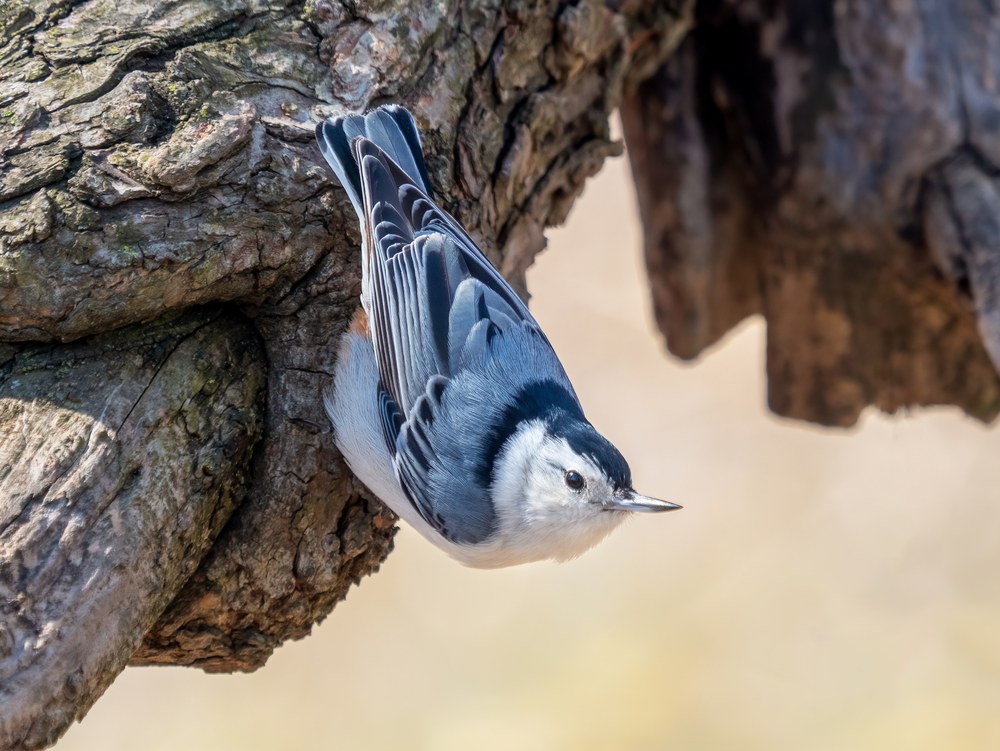
White-breasted Nuthatch
- Habitat
- Deciduous and mixed forests, suburbs, farm woodlots, towns, oak/ponderosa pine forests in the west
- Size
- 5–6 in
- Lifespan
- Usually lives several years in the wild; the oldest banded individual on record was nearly 10 years old.
- Diet
- Insects, spiders, acorns and nuts in winter
About the White-breasted Nuthatch
The White-breasted Nuthatch is a compact, big-headed bird with blue-gray upperparts, a clean white face and breast, and a black cap that covers the top of the head in males (females typically show a somewhat duller, grayer cap). A rusty wash often colors the lower belly and flanks, and a short tail combined with almost no visible neck gives the bird a distinctive, top-heavy silhouette as it clings to bark. Its straight, dagger-like bill is well suited to both probing bark crevices and hammering open nuts.
What draws the most attention in the field, though, is the nuthatch's signature method of moving down tree trunks headfirst — nearly unique among North American bark-foraging birds, most of which, like woodpeckers and creepers, climb upward. Moving downward is thought to let the nuthatch spot food that upward-climbing birds have overlooked, effectively dividing up the same tree trunk's resources between different species. It forages for insects and spiders through the warmer months, switching heavily to acorns and other nuts in winter, which it wedges into bark crevices and hammers open with its bill — a hammering, or "hatching," behavior that is the likely source of the bird's name.
White-breasted Nuthatches favor deciduous and mixed forests but adapt readily to suburbs, farm woodlots, and towns, and in the west they are strongly associated with oak and ponderosa pine woodlands. Pairs remain together on a shared territory year-round rather than separating after breeding, and in winter each bird typically roosts alone in its own cavity rather than huddling with its mate. During the colder months they often join mixed foraging flocks alongside chickadees, titmice, Downy Woodpeckers, and Brown Creepers, a loose alliance that likely improves each species' chances of spotting predators and finding food. Wild birds usually live several years, with the oldest banded individual on record reaching nearly 10 years old.
The species does not migrate, holding its territory through all four seasons, and its nasal, repeated "yank-yank" call is one of the more distinctive year-round sounds of deciduous woods across its range, often the first clue that a nuthatch is working its way down a nearby trunk. That steady, non-migratory presence, paired with its tameness around people, has made the White-breasted Nuthatch one of the more reliable and beloved feeder visitors across the eastern and central United States.
Frequently asked questions
Why does the White-breasted Nuthatch climb down trees headfirst?
This unusual habit is thought to help it spot food overlooked by birds like woodpeckers and creepers, which climb upward instead.
What does a White-breasted Nuthatch eat?
Insects and spiders for much of the year, switching heavily to acorns and other nuts, which it wedges into bark and hammers open, during winter.
Do White-breasted Nuthatch pairs stay together?
Yes, pairs remain together on a shared territory year-round, though each bird roosts alone in its own cavity in winter.
What other birds does the White-breasted Nuthatch associate with?
In winter it often joins mixed foraging flocks with chickadees, titmice, Downy Woodpeckers, and Brown Creepers.
Where to find it
This species favors forest habitat. See real Oklahoma locations on the Habitats map.