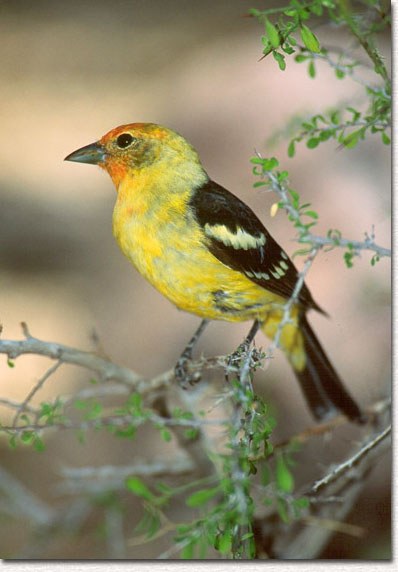
Western Tanager
- Habitat
- Open coniferous forests (Douglas fir, spruce, pine), mixed woodlands with aspen, oak-pinyon woodlands up to 10,000 ft; lowlands during migration
- Size
- 6–7½ in
- Lifespan
- Typically lives several years; the oldest banded individual on record was almost 7 years old.
- Diet
- Insects, fruit, a few buds
About the Western Tanager
Few North American songbirds are as startling to see for the first time as a male Western Tanager: a brilliant red-orange head sits atop a body of bright yellow, set off by solid black wings, back, and tail with pale wing bars. Unlike most red-plumaged birds, which manufacture red pigment from carotenoids in their food, the Western Tanager's red head coloring is thought to come from a rare pigment called rhodoxanthin that the bird obtains secondhand by eating insects that have themselves fed on plants containing it -- an unusual pigment pathway among North American songbirds. Females and immatures are far more subdued, showing yellow-green upperparts and plain yellow underparts, with no trace of red, and by late summer many adult males lose some of that red head color as fresh, duller feathers grow in, only to regain the brighter coloring the following spring.
The species breeds in open coniferous forest -- stands of Douglas fir, spruce, and pine -- as well as mixed woodlands with aspen and oak-pinyon habitat, ranging up mountain slopes to elevations near 10,000 feet. During migration it becomes far less habitat-specific, turning up in lowland woodlots, riparian corridors, and even suburban yards well outside its breeding range. Its diet reflects this flexibility: insects gleaned from foliage or caught in short flycatching sallies make up much of its food, supplemented by fruit and, occasionally, buds.
Western Tanagers nest well out on horizontal conifer branches, and the female -- responsible for building the nest and incubating the eggs -- is notably steady on the nest, reluctant to flush even when closely approached, a trait that can make an active nest surprisingly hard to spot despite the male's flamboyant coloring nearby. The species is also one of the northernmost-breeding tanagers in the world, with some populations nesting well into Canada before making the long return migration to winter in Mexico and Central America. Wild birds typically live several years, and the oldest banded individual on record reached almost 7 years old.
During migration, Western Tanagers sometimes turn up well outside their expected range, occasionally visiting backyard feeders offering fruit, suet, or sugar water, a treat for birders in areas the species does not normally frequent. Their bright, husky, robin-like song can carry through open conifer stands even when the singer itself is hidden by dense needles high in the canopy, making voice as valuable a clue to its presence as its unmistakable coloring.
Because the species breeds at such high elevations and in such open, park-like conifer stands, its distribution across a mountain range can be surprisingly patchy, tracking the specific mix of tree species and canopy openness a pair needs rather than simply following elevation alone. In Oklahoma, where suitable breeding habitat of this kind is essentially absent, the Western Tanager is known chiefly as a scarce but regular migrant or occasional winter visitor, most likely to be found working through wooded parks, river corridors, or well-planted yards during spring and fall passage, and any individual lingering into winter typically depends on a reliable source of fruit or a stocked feeder to survive the colder months this far from its normal winter range.
Spring migration tends to carry Western Tanagers north relatively late compared with many other songbirds, timed to the emergence of insect life at higher elevations, while fall migration can begin comparatively early, so an autumn sighting well east of the breeding range, as sometimes happens in Oklahoma, often involves a bird that departed the mountains before many other migrants had even begun their own journeys south. Like several other tanagers, this species was formerly classified in the tanager family proper but has since been reclassified by taxonomists into the cardinal family based on genetic evidence, a reminder that even a bird as visually striking and well studied as this one can still have its scientific classification revised as research methods improve.
Frequently asked questions
Why is the Western Tanager's red head color unusual?
It is likely produced by a pigment called rhodoxanthin obtained through diet, a different pathway than the carotenoid pigments most red songbirds use.
How can you tell a female Western Tanager from a male?
Females are yellow-green above and plain yellow below, lacking the male's red head and black wings and back.
What kind of forest does the Western Tanager prefer?
Open coniferous and mixed woodlands, including Douglas fir, spruce, pine, and oak-pinyon habitat up to about 10,000 feet.
What does a Western Tanager eat?
Mostly insects gleaned from foliage or caught in flight, along with fruit and occasional buds.
Is the Western Tanager expected in Oklahoma?
It is only a scarce but regular migrant or occasional winter visitor there, since the state lacks the high-elevation conifer forest it needs for breeding.
Where to find it
This species favors forest habitat. See real Oklahoma locations on the Habitats map.