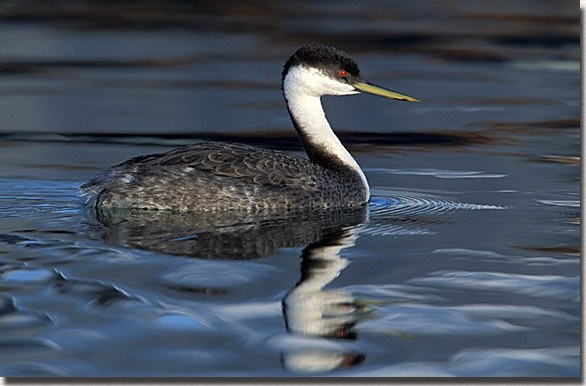
Western Grebe
- Habitat
- Large freshwater lakes and marshes for breeding; large lakes and reservoirs, and coastal waters, in winter
- Size
- Length about 25 in (64 cm), wingspan around 24 in (61 cm); a long, slender-necked waterbird
- Lifespan
- Specific figures are not well documented for this species
- Diet
- Primarily fish, caught by diving
About the Western Grebe
The Western Grebe is an elegant, long-necked waterbird with sharply contrasting black-and-white plumage, a long thin bill, and striking red eyes. Its black cap extends down to cover the eye, which is the key field mark separating it from the very similar Clark's Grebe, whose white face leaves the eye surrounded by pale feathering. Both species were once considered a single species due to their close resemblance and overlapping range, and even after being split they can still be difficult to separate with certainty except under good lighting and at reasonably close range, since bill color, a subtler and more variable clue, is the other main difference between the two.
Western Grebes breed on freshwater marshes and lakes across the western United States and Canada, and winter mainly along the Pacific coast as well as on some large inland lakes and reservoirs. In Oklahoma the species is an uncommon migrant and winter visitor, typically found on large reservoirs rather than smaller ponds, and it does not breed in the state, generally appearing as scattered individuals or small groups rather than in the large concentrations seen at favored western breeding lakes.
It is an accomplished diver, pursuing fish underwater with propulsion from lobed rather than webbed toes, a feature shared by grebes generally that improves underwater efficiency at some cost to walking ability on land. Because their legs are set so far back on the body, an adaptation that aids underwater pursuit, grebes generally are clumsy walkers and rarely come ashore except to nest, an awkwardness on land that stands in sharp contrast to their grace and speed once submerged.
The species is perhaps best known for its elaborate courtship displays, most famously a synchronized behavior called rushing, in which paired birds rise up together and run rapidly side by side across the water's surface with wings held back, a dramatic and visually striking performance that occurs during pair formation. A related display, sometimes called weed dancing, involves a pair diving together to gather strands of aquatic vegetation and then rising up breast to breast holding the weeds in their bills, a ritualized presentation thought to help cement the pair bond ahead of nesting. Nesting takes place in floating or emergent vegetation over water, in loose colonies, with both parents sharing incubation duties, and young are sometimes carried on a parent's back shortly after hatching, a common grebe behavior that offers chicks protection from cold water and predators while they are still too small to dive effectively themselves.
Because the species depends on large, relatively undisturbed lakes for both its dramatic courtship displays and its floating nests, disturbance from boat traffic and fluctuating water levels on reservoirs can directly affect nesting success in years when Western Grebes do attempt to breed at more southerly lakes near the edge of their range.
Outside the breeding season, Western Grebes often gather into loose rafts of dozens or more birds on open water, diving somewhat independently but staying loosely associated as a group, a pattern that may offer some protection from predators through sheer numbers even without the tight coordination seen in true flocking species. Chicks that are not currently being carried on a parent's back typically stay close beside the adult, diving alongside it as they gradually build the strength and skill needed for fully independent foraging, a learning period that can last several weeks before a young grebe is truly self-sufficient on the water.
Frequently asked questions
What's special about Western Grebe courtship?
Pairs perform a dramatic rushing display, rising up and running together across the water's surface in unison.
How can you tell a Western Grebe from the similar Clark's Grebe?
The Western Grebe's black cap extends down to cover the eye, while Clark's Grebe has a paler face with the eye surrounded by white.
Is the Western Grebe common in Oklahoma?
It is an uncommon migrant and winter visitor there, typically seen on large lakes and reservoirs rather than as a breeder.
How do Western Grebes catch fish?
They dive underwater and pursue fish, propelled by lobed rather than webbed toes.
Why are grebes so awkward on land?
Their legs are set far back on the body to aid underwater swimming, which makes walking clumsy and largely restricts them to water except when nesting.
Where to find it
This species favors wetland habitat. See real Oklahoma locations on the Habitats map.