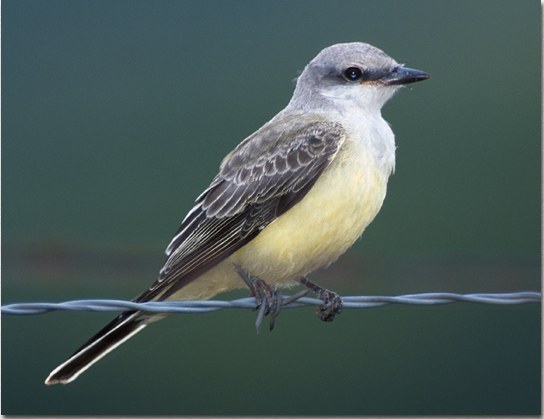
Western Kingbird
- Habitat
- Dry open country with scattered trees, agricultural regions, ranches, towns, riparian habitat, prairies; perches on wires/fence posts at low-moderate elevation
- Size
- 8–9 in
- Lifespan
- Typically lives several years; the oldest banded individual on record was almost 7 years old.
- Diet
- Insects and berries
About the Western Kingbird
The Western Kingbird is a boldly patterned flycatcher of open country, with an olive-brown back, gray head, pale gray throat and breast, bright yellow belly, and a blackish tail edged in white that helps identify it in flight. Hidden beneath the crown feathers is a patch of orange-red plumage that is normally invisible and only flashed briefly during territorial displays or courtship, a feature shared with other kingbird species and easy to miss unless the bird is agitated. Perched upright on a wire or fence post, it has an alert, watchful posture typical of flycatchers scanning for passing insects.
Western Kingbirds favor dry, open habitats with scattered trees for perching — ranches, agricultural land, prairies, riparian corridors, and small towns — where wires, fence posts, and isolated trees serve as lookout points at low to moderate elevation. From these perches they sally out to snatch flying insects out of the air, returning to the same or a nearby perch to eat, and they supplement this insect diet with berries, particularly outside the breeding season. Their hunting style, alternating stillness with quick aerial pursuits, is characteristic of tyrant flycatchers generally but is especially conspicuous in a species so fond of open, exposed perches.
What truly defines the Western Kingbird's reputation, though, is its aggression: it will fearlessly harass birds many times its size, including hawks and crows, chasing and diving at intruders that stray too close to its nest or territory, sometimes landing on the back of a much larger bird to peck at it in flight. Nests are bulky cups of twigs and grass lined with soft plant fibers, often built on utility poles, crossarms, or in isolated trees, and typically hold about four creamy white eggs marked with brown spots. The species winters in Central America and returns north each spring; banding records show it typically lives several years, with the oldest known individual reaching almost 7 years old.
As a member of the tyrant flycatcher family, one of the largest bird families in the Americas, the Western Kingbird shares its genus with several close relatives, including the Eastern Kingbird, and the two occasionally overlap where their ranges meet on the Great Plains. Dawn choruses on the breeding grounds often feature a rapid, chattering song delivered from an exposed perch, a vocal display that reinforces the pair's claim to a territory well before most other birds are active.
Frequently asked questions
Why is the Western Kingbird considered aggressive?
It fiercely defends its nest and territory, attacking much larger birds such as hawks and crows that venture too close.
What does a Western Kingbird eat?
Mostly flying insects caught from a perch, along with berries especially outside the breeding season.
Where do Western Kingbirds build their nests?
Often on utility poles, crossarms, or isolated trees in open country, using twigs and grass lined with plant fibers.
How many eggs does a Western Kingbird lay?
A typical clutch holds about four creamy white eggs with brown markings.
Where to find it
This species favors grassland habitat. See real Oklahoma locations on the Habitats map.