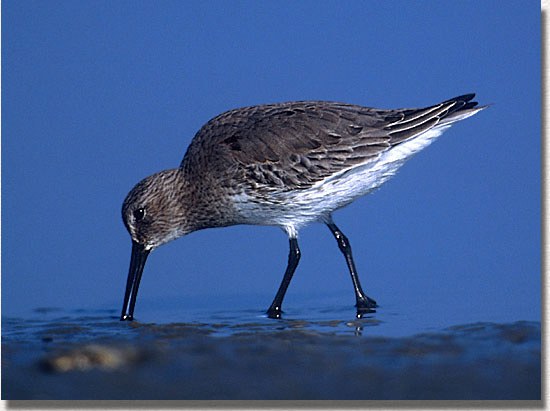
Western Sandpiper
Calidris mauri
- Habitat
- High arctic tundra (breeding); winters on beaches, mudflats, ponds, marsh creeks; migrates through inland muddy river/lake shores
- Size
- 5½–6¾ in
- Lifespan
- Can live nearly a decade; the oldest banded individual on record was just over 9 years old.
- Diet
- Aquatic insects, mollusks, worms, crustaceans; forages head-down near the tide line and water's edge
About the Western Sandpiper
One of the smallest shorebirds in North America, the Western Sandpiper is a compact "peep" that can be confused with several similar species but shows a few reliable clues: black legs, a bill that is often slightly longer than a Least Sandpiper's and droops almost imperceptibly at the tip, and, in breeding plumage, warm rufous tones on the crown, ear coverts, and scapulars that fade to plainer gray and white by the time birds move south in fall. The overall impression is of a small, quick, low-slung bird constantly in motion along the shoreline. Bill length varies noticeably between the sexes, with females typically showing a longer, more strongly drooped bill than males, a difference thought to let paired birds forage at slightly different depths in the same mud and reduce direct competition for food.
Western Sandpipers breed on the high Arctic tundra of western Alaska and the easternmost fringes of Siberia, a landscape far removed from the wintering grounds most people encounter them on. After the short Arctic breeding season, they undertake long migrations down both the Pacific coast and interior flyways, eventually wintering on beaches, mudflats, and coastal wetlands from the southern United States down through Central America and into South America. Along the way, and especially during migration, huge numbers concentrate at key stopover mudflats to refuel before continuing their journey.
Foraging Western Sandpipers walk the tide line and the muddy margins of ponds and marsh creeks, picking and probing rapidly for small aquatic insects, mollusks, worms, and crustaceans in a quick, mechanical pecking motion often likened to a sewing machine needle. This species is frequently described as the single most abundant shorebird in the Americas, and that abundance is on full display during migration, when flocks numbering in the thousands lift off mudflats together, wheeling and turning in tight unison -- a maneuver that likely helps confuse hunting falcons before the flock settles back down to feed.
Banding studies show Western Sandpipers can live close to a decade, with the oldest recovered individual just over 9 years old, a considerable lifespan for a bird that weighs barely as much as a few coins. Because so many pass through a relatively small number of critical stopover and wintering sites, the health of those individual mudflats and estuaries has an outsized effect on the species as a whole, making the Western Sandpiper something of a barometer for the condition of coastal wetlands along its migratory route.
Distinguishing a Western Sandpiper from the closely related Semi-palmated Sandpiper in nonbreeding plumage, when the rufous tones fade and both look plainer gray, is one of the classic challenges of shorebird identification, generally resolved only by close comparison of bill length and shape, leg proportions, and subtle differences in overall structure rather than by any single obvious field mark. Because the two species so often occur together in the same mixed flocks, learning to separate them reliably is considered something of a rite of passage among birders working on shorebird identification skills.
Juveniles show their own distinct plumage, with crisp pale-fringed feathers on the back and scapulars giving a scaly appearance quite different from the plainer gray of a nonbreeding adult, a pattern that fades within a few months as the young bird molts into its first winter plumage. Because Western Sandpipers begin their southbound migration well before the ice-free tundra season ends for other species, adults are often the first shorebirds to reappear at temperate mudflats in mid- to late summer, well ahead of the juveniles that follow a few weeks later, giving experienced observers another seasonal clue to help sort out which age class dominates a given flock at a given point in the migration calendar.
Frequently asked questions
Where does the Western Sandpiper breed?
On high Arctic tundra in western Alaska and the easternmost part of Siberia.
How can you identify a Western Sandpiper?
Look for black legs and a bill that is slightly longer than a Least Sandpiper's with a subtle droop at the tip; breeding birds also show rufous tones on the crown and back.
What does a Western Sandpiper eat?
Small aquatic invertebrates such as insects, mollusks, worms, and crustaceans, picked up by foraging head-down near the water's edge.
How long do Western Sandpipers live?
They can live nearly a decade; the oldest banded individual on record was just over 9 years old.
Why do male and female Western Sandpipers have different bill lengths?
Females typically have a longer, more strongly drooped bill than males, which may let paired birds forage at different depths in the mud and reduce competition for food.
Where to find it
This species favors wetland habitat. See real Oklahoma locations on the Habitats map.