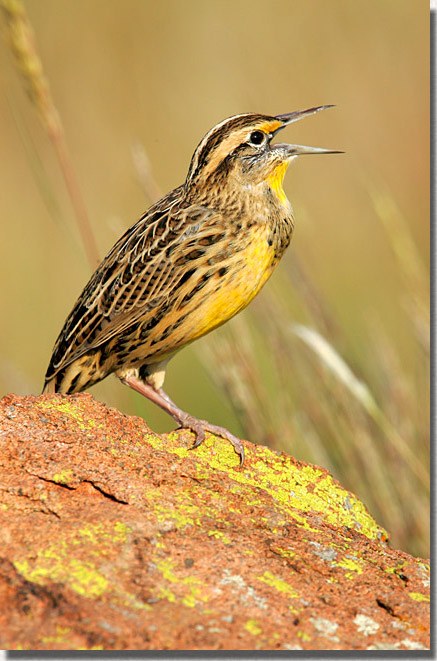
Western Meadowlark
- Habitat
- Pastures, meadows, grassy plains, prairies, foothills, open country, country roadsides; often perched on fence posts while singing
- Size
- 8½–11 in
- Lifespan
- Usually lives about 3-6 years in the wild; the oldest banded individual on record was roughly 6.5 years old.
- Diet
- Spiders, sowbugs, snails, grass seeds, forb seeds
About the Western Meadowlark
About the size of a robin, the Western Meadowlark is easy to overlook when perched thanks to streaked brown and buff upperparts that blend perfectly into dry grassland, but it becomes unmistakable the moment it turns to face an observer: bright yellow underparts crossed by a bold black V across the chest. In flight, flashes of white outer tail feathers add another useful field mark. The species spends much of its time walking or crouching low in grass rather than flying, relying on its camouflage to stay hidden from predators until it chooses to sing from an exposed perch.
Open grassland is essential habitat for the Western Meadowlark -- pastures, prairies, foothill meadows, and grassy roadsides where it forages on the ground for spiders, sowbugs, snails, and the seeds of grasses and forbs, along with insects such as grasshoppers that become especially important during the breeding season. Waste grain in agricultural fields also supplements its diet, particularly in fall and winter. Its highly camouflaged, dome-shaped nest is built directly on the ground, woven from grass with a roof and sometimes a tunnel-like entrance that hides it from view, a design that offers real protection in a habitat with almost no other cover.
Males are notably vocal, favoring fence posts and utility wires as song perches, and individual males can sing roughly a dozen distinct song variations -- a repertoire size unusual even among songbirds. Because the closely related Eastern Meadowlark looks almost identical, voice is the most reliable way to separate the two species where their ranges overlap, and in the zone where both occur across parts of Oklahoma, some individuals appear to learn elements of the other species' song, occasionally complicating identification for even experienced listeners.
Outside the breeding season Western Meadowlarks gather into large winter flocks, foraging together across open fields, sometimes joining mixed groups with blackbirds and starlings at especially productive feeding areas. The species is also one of the most widely honored birds in America politically, serving as the official state bird of six different states -- Oregon, Montana, Wyoming, Nebraska, Kansas, and North Dakota -- a reflection of how strongly its flutelike song is tied to the open grassland landscapes of the American West and Plains.
Wild birds typically live three to six years, though the oldest banded individual on record reached roughly 6.5 years, a modest lifespan that reflects the many hazards facing a ground-nesting bird of open country. Because both eggs and flightless young are entirely exposed to ground-based predators and to disturbance from mowing, grazing, and haying operations, nesting success in agricultural landscapes can depend heavily on the timing of farm activity relative to the bird's breeding schedule, making the Western Meadowlark a species whose fortunes are closely tied to how grassland habitat is managed across its breeding range.
Males are frequently polygynous, mating with and helping provision more than one female nesting within his defended territory in a single season, a breeding system that lets a particularly successful male father chicks in several simultaneous nests while females handle the bulk of incubation and early brooding alone. Populations across much of the Great Plains have declined over recent decades alongside broader losses of native prairie and hayfield habitat to intensive row-crop agriculture, urban expansion, and changes in grazing and mowing schedules, a trend shared with several other grassland-obligate songbirds and one of the reasons conservation groups increasingly track meadowlark numbers as a barometer of grassland ecosystem health across the region.
Frequently asked questions
How do you tell a Western Meadowlark from an Eastern Meadowlark?
The two species look almost identical, so voice is the most reliable way to distinguish them; the Western Meadowlark's song is more complex and flutelike.
How many songs can a male Western Meadowlark sing?
Individual males can sing about a dozen different song variations, an unusually large repertoire.
What does a Western Meadowlark eat?
Mostly ground invertebrates such as spiders, sowbugs, and snails, along with grass and forb seeds and, in season, insects like grasshoppers.
Where does a Western Meadowlark nest?
It builds a camouflaged, dome-shaped nest directly on the ground in grass, sometimes with a woven tunnel entrance.
Why can farming activity affect Western Meadowlark nesting success?
Because nests sit exposed on the ground, mowing, haying, and grazing that occur during the breeding season can destroy nests or expose eggs and young to predators.
Where to find it
This species favors grassland habitat. See real Oklahoma locations on the Habitats map.