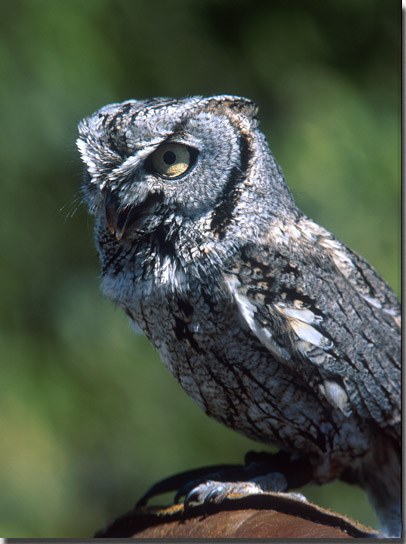
Western Screech Owl
- Habitat
- Deserts, open woodlands, and riparian areas of the western United States
- Size
- Length about 8.5 in (22 cm), wingspan around 20 in (51 cm)
- Lifespan
- Not extensively documented for this species specifically; related screech-owls have wild banding records reaching into the low teens of years
- Diet
- Insects, small mammals, birds, and amphibians
About the Western Screech Owl
The Western Screech-Owl is a small, nocturnal owl with prominent ear tufts, mottled gray or brownish plumage that provides excellent camouflage against bark, and bright yellow eyes. Its overall shape and size closely resemble those of the more familiar Eastern Screech-Owl, and the two species are best distinguished by voice rather than appearance where their ranges might approach one another. Like other small owls relying on camouflage rather than flight to avoid detection, it will often freeze upright against a tree trunk or in a cavity entrance when disturbed during the day, its cryptic plumage and vertical posture making it remarkably easy to overlook even at close range.
This owl is a bird of the western United States, found from desert washes to open woodlands and riparian corridors from the Pacific coast east to roughly the Rocky Mountain region. Oklahoma lies at the very edge of, or just outside, its range, and any occurrence in the state would be limited to the far western panhandle; the ecologically similar Eastern Screech-Owl is the species regularly found across the rest of Oklahoma, occupying much the same ecological niche of small nocturnal cavity-nesting predator across the remainder of the state.
It is an opportunistic nocturnal hunter, taking a wide range of prey including insects, small rodents, birds, and amphibians depending on local availability, and it typically hunts by watching from a perch and dropping onto prey detected by sound or movement. Riparian corridors lined with cottonwoods and willows are especially productive hunting grounds across much of its western range, since these streamside woodlands tend to concentrate both the large insects and small vertebrates the owl depends on, as well as offering the mature trees with natural cavities the species needs for nesting and daytime roosting.
The clearest way to distinguish this species from its eastern counterpart is its call: the Western Screech-Owl gives a series of short hoots that accelerate in tempo, often described as sounding like a bouncing ball coming to rest, while the Eastern Screech-Owl instead gives a descending whinny and a level trill. Like other screech-owls, it nests in natural tree cavities or abandoned woodpecker holes, laying its eggs directly on the cavity floor without added nest material, and both parents help defend the nest site and provision the young once they hatch.
Because natural cavities and old woodpecker holes are a limited resource, Western Screech-Owls sometimes compete for nest sites with other cavity users such as squirrels, other small owls, and various woodpeckers, and the availability of suitable mature trees can be a real constraint on local populations in heavily developed or intensively managed landscapes. As with many small owls, the species is likely more common in suitable habitat than casual observation would suggest, since its strictly nocturnal habits and reliance on camouflage during the day mean most individuals go undetected except when their distinctive call gives them away after dark.
Pairs are generally believed to remain together on the same territory across years wherever a reliable supply of nesting cavities and prey persists, and both members of a pair will vigorously mob and scold a perceived threat near the nest, including much larger owls and hawks that stray too close. Because the species is small enough to fall prey to a range of larger predators, including Great Horned Owls and various hawks, staying hidden and immobile by day is not merely a convenience but a genuine survival strategy, and much of what is understood about its true abundance in a given area comes from targeted nighttime call-response surveys rather than daytime sightings.
Frequently asked questions
Is the Western Screech-Owl common in Oklahoma?
It occurs at most only at the extreme western edge of the state; the related Eastern Screech-Owl is the species regularly found across Oklahoma.
How do you tell Western and Eastern Screech-Owl calls apart?
The Western Screech-Owl gives short hoots that accelerate like a bouncing ball, while the Eastern Screech-Owl gives a descending whinny and a level trill.
What do Western Screech-Owls eat?
A wide variety of prey, including insects, small mammals, birds, and amphibians, depending on what is locally available.
Where do Western Screech-Owls nest?
In natural tree cavities or old woodpecker holes.
Why might Western Screech-Owls be more common than they seem?
Their strictly nocturnal habits and excellent daytime camouflage make them easy to overlook, so most individuals are only detected by their distinctive call after dark.
Where to find it
This species favors wetland habitat. See real Oklahoma locations on the Habitats map.