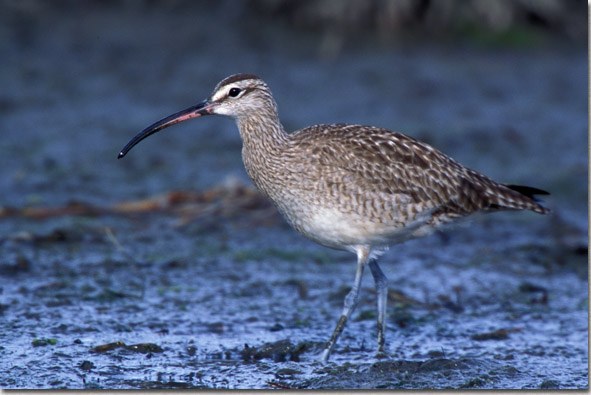
Whimbrel
- Habitat
- Arctic tundra for breeding; coastal mudflats, beaches, and large inland wetlands during migration and winter
- Size
- Length about 15-18 in (38-46 cm), wingspan around 32 in (81 cm)
- Lifespan
- Specific banding-derived figures are limited, though large shorebirds in this genus are generally thought to live a decade or more
- Diet
- Crustaceans, especially fiddler crabs, and other invertebrates on the coast; insects and berries on the breeding grounds
About the Whimbrel
The Whimbrel is a large, brownish shorebird best identified by its long, distinctly down-curved bill and its bold head pattern of dark stripes bordering a pale central crown stripe. Its overall mottled brown plumage provides effective camouflage on both its tundra breeding grounds and the mudflats where it spends much of the rest of the year, and its loud, rapid, whistled call is often heard before the bird itself is seen. Females typically show a somewhat longer bill than males, a difference echoed in several other curlew and godwit species where the sexes divide up feeding niches by bill length.
It breeds on Arctic tundra across northern Canada, Alaska, and parts of Eurasia, then migrates enormous distances to winter along coastlines from the southern United States down through Central and South America. In Oklahoma it does not breed but passes through in modest numbers during migration, generally favoring large wetlands, lake margins, and wet fields rather than the coastal mudflats it prefers elsewhere in its range, so an Oklahoma sighting typically means catching an individual or small group resting and refueling well inland of its usual coastal haunts.
On its wintering and migratory coastal grounds, the Whimbrel uses its long curved bill to probe deep into burrows for fiddler crabs and other invertebrates, a specialized foraging technique well suited to its bill shape; it will grasp a crab, work it free of its burrow, and often knock off or remove the claws before swallowing the rest, a handling technique that reduces the risk of injury from the crab's own defenses. On the breeding grounds, its diet shifts markedly to insects and berries, reflecting the very different food resources available on Arctic tundra.
The species is notable for extraordinary long-distance migratory flights; satellite-tracked individuals have been recorded flying nonstop for thousands of miles over open ocean between breeding grounds and wintering areas, sometimes passing directly through the paths of tropical storms. Remarkably, some tracked birds have been shown to fly through or near the edges of hurricanes rather than around them, apparently adjusting altitude and heading to cope with the extreme winds rather than diverting to avoid the storm entirely, a testament to the raw endurance built into a body plan otherwise adapted for a fairly ordinary shorebird's life of walking and probing on mudflats.
This endurance capability, combined with its wide-ranging migration route, makes the Whimbrel a striking example of the physical demands shorebirds regularly endure, even though the individuals passing through Oklahoma represent only a brief inland stopover in a much longer journey. Because so much of the species' migration depends on a handful of critical staging areas where birds rebuild fat reserves before the next long ocean crossing, the loss or degradation of any one of those sites can have consequences for Whimbrels using flyways thousands of miles away.
On the breeding grounds, Whimbrels are strongly territorial and vocal in defense of their nest, mobbing intruders such as foxes, gulls, or even low-flying aircraft with loud, persistent alarm calls, and a pair will sometimes perform a distraction display, feigning injury to draw a predator away from a nest or newly hatched brood. The nest itself is a simple, shallow scrape on open tundra, often lined sparsely with lichen or moss, relying mainly on the parents' vigilance and the eggs' cryptic coloring for protection in a landscape with almost no other cover, and both parents typically share incubation duties before the precocial chicks are able to leave the nest and begin feeding themselves within a day or two of hatching.
Frequently asked questions
Why does the Whimbrel have a curved bill?
Its long, down-curved bill allows it to probe deep into burrows, especially for fiddler crabs along the coast.
Does the Whimbrel breed in Oklahoma?
No, it breeds on Arctic tundra far to the north and only passes through Oklahoma during migration.
How far do Whimbrels migrate?
Some tracked individuals have flown nonstop for thousands of miles over open ocean between breeding and wintering grounds.
What does a Whimbrel eat on its breeding grounds?
Mostly insects and berries, quite different from the crab-heavy diet it relies on along the coast.
Do Whimbrels avoid storms during migration?
Not always; tracking data show some individuals fly through or near the edges of hurricanes rather than detouring around them, adjusting course and altitude to cope with the winds.
Where to find it
This species favors wetland habitat. See real Oklahoma locations on the Habitats map.