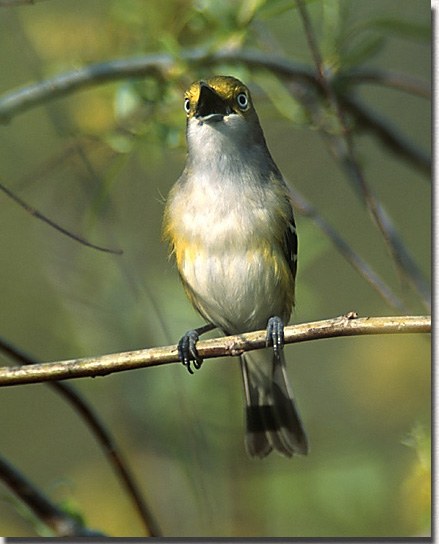
White-eyed Vireo
- Habitat
- Dense shrubby thickets, second-growth habitat, and forest edges
- Size
- Length about 5 in (12.5 cm), wingspan around 7.5 in (19 cm)
- Lifespan
- Banding records for the species have reached roughly 7-9 years
- Diet
- Insects and spiders, with some berries eaten in fall and winter
About the White-eyed Vireo
The White-eyed Vireo is a small, olive-gray songbird best recognized by its striking pale iris, an unusual feature among songbirds that gives the species its name, along with bright yellow "spectacles" formed by a yellow eye-ring and lores, yellowish flanks, and two white wingbars. Its sharp, emphatic, and highly variable song, often rendered as beginning and ending with a hard chick note, is frequently the easiest way to detect the species even when it stays hidden. Juveniles hatch with a dark iris that gradually pales toward the adult's distinctive white or pale gray eye color over their first year, a slow color change shared with a number of other vireo species.
It breeds across the southeastern and eastern United States, including much of Oklahoma, favoring dense low thickets and brushy second growth rather than mature forest interior, and it winters largely in the southern United States, Mexico, and Central America, with some individuals remaining resident in parts of its southern range. Recently cut-over or disturbed ground that has begun growing back into tangled shrub and vine cover is often prime habitat for the species, since it needs exactly the kind of dense, low, thorny growth that many other woodland birds avoid.
The species is a skulking forager, gleaning insects and spiders from dense low vegetation, and it can be maddeningly difficult to see well despite being common, since it tends to stay low and hidden within tangled brush rather than perching in the open. In fall and winter it supplements its diet with berries when available, a seasonal shift that helps it get through periods when insect availability drops.
Pairs build a compact cup nest suspended from a forked branch low in a shrub, and the species is a frequent target of nest parasitism by Brown-headed Cowbirds, which lay their own eggs in vireo nests for the vireo parents to raise at the expense of their own young. Unlike some host species that abandon a parasitized nest outright, White-eyed Vireos will sometimes bury a cowbird egg under a new nest lining rather than reject it directly, effectively building a new nest floor over the unwanted egg, one of several imperfect defenses songbirds have evolved against this kind of brood parasitism.
Despite this pressure, White-eyed Vireos remain a common and widespread breeding bird across their range, their persistent, scolding song a familiar sound of brushy edges and overgrown fields through the summer months. Males are notably aggressive in defending their territory against intruders, sometimes even directing that scolding, chattering vocal energy at human observers who linger too close to an active nest, a boldness that stands in some contrast to how physically hard the bird itself usually is to actually see within its chosen tangle of cover.
Individual males can incorporate an unusually large number of distinct phrases into their singing, and some appear to mimic snippets of other birds' calls within their own otherwise consistent song, adding to the impression of a bold, endlessly chattering voice coming from deep within a thicket. Because it thrives in exactly the kind of scrubby, early-successional habitat that many land managers consider unattractive or in need of clearing, the White-eyed Vireo has, somewhat unusually among songbirds facing habitat pressure, benefited in places from abandoned farmland and cutover forest edges left to grow back wild, even as many other species have lost ground to the same broad patterns of land-use change across the eastern and southern United States.
Frequently asked questions
What's distinctive about the White-eyed Vireo's appearance?
It has a striking pale white iris, unusual among songbirds, along with yellow "spectacles" around the eyes.
Is the White-eyed Vireo easy to see?
Not always; it tends to stay hidden in dense thickets and is often easier to hear than to see.
What does the White-eyed Vireo's song sound like?
A sharp, variable, chattering phrase, often described as starting and ending with a hard chick note.
Is the White-eyed Vireo affected by cowbird parasitism?
Yes, its nests are commonly parasitized by Brown-headed Cowbirds.
How does a White-eyed Vireo's eye color change as it ages?
Juveniles hatch with a dark iris that gradually pales over their first year into the adult's distinctive white or pale gray eye.
Where to find it
This species favors forest habitat. See real Oklahoma locations on the Habitats map.