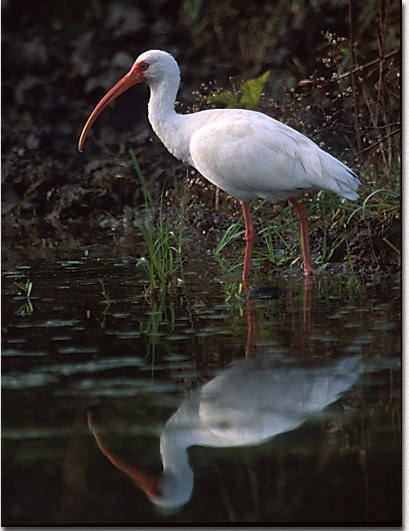
White Ibis
- Habitat
- Coastal salt marshes, estuaries, tidal mudflats, swamps, mangroves, and grassy/plowed fields; often near coast, inland near large water bodies or flooded land
- Lifespan
- Can live well over a decade; the oldest banded individual on record was over 16 years old.
- Diet
- Fish, small vertebrates, especially crabs, crayfish, snails, also snakes, insects; young are fed regurgitant
About the White Ibis
The White Ibis is a striking wading bird of southern wetlands, dressed almost entirely in white apart from black wingtips that are hidden at rest and only revealed in flight. Its most distinctive feature is a long, down-curved bill in a warm reddish-pink, matched by legs of the same color, giving the bird a vivid splash of color against its otherwise snowy plumage. Young birds look quite different from adults, showing brown upperparts and a white belly before gradually molting into full white plumage over their first couple of years, which can make mixed flocks of adults and juveniles look almost like two different species at a glance.
White Ibises favor coastal salt marshes, estuaries, tidal mudflats, swamps, and mangroves, but they also range inland to forage in flooded fields and near large bodies of water, especially after agricultural plowing turns up prey close to the surface. Feeding is largely a tactile affair rather than a visual one: the bird wades through shallow water or soft mud, sweeping and probing with its curved bill until it contacts prey by touch. Crabs and crayfish are particular favorites, along with snails, small fish, other small vertebrates, and even snakes and insects when the opportunity arises; young in the nest are fed regurgitated food brought back by the parents.
Highly social by nature, White Ibises roost and nest in large colonies, often alongside herons and egrets, and travel between feeding and roosting sites in long, straggling lines or loose flocks with necks outstretched — a flight profile that helps distinguish them from herons, which fly with the neck folded. That social, colonial lifestyle appears compatible with real longevity: banding records show White Ibises can live well over a decade, with the oldest known individual surviving more than 16 years.
Because White Ibises forage in such large numbers and depend so heavily on shallow wetland habitat to find their prey by touch, biologists often treat the species as a useful indicator of overall wetland health — when foraging conditions in a marsh or estuary decline, ibis numbers and breeding success tend to reflect that change quickly. Non-breeding birds, including many immatures, often gather into sizable mixed-species foraging flocks with herons and egrets well outside the nesting season, extending the same social pattern seen at breeding colonies into everyday feeding life.
Frequently asked questions
How does a White Ibis find its food?
It feeds mostly by touch, sweeping its long curved bill through shallow water or mud until it contacts prey like crabs, crayfish, or snails.
Do young White Ibises look like adults?
No, juveniles are brown above with a white belly and only reach the fully white adult plumage after a couple of years.
Do White Ibises nest alone or in groups?
They are highly colonial, nesting and roosting in large groups often mixed with herons and egrets.
How long do White Ibises live?
They can live well over a decade; the oldest banded individual on record was over 16 years old.
Where to find it
This species favors wetland habitat. See real Oklahoma locations on the Habitats map.