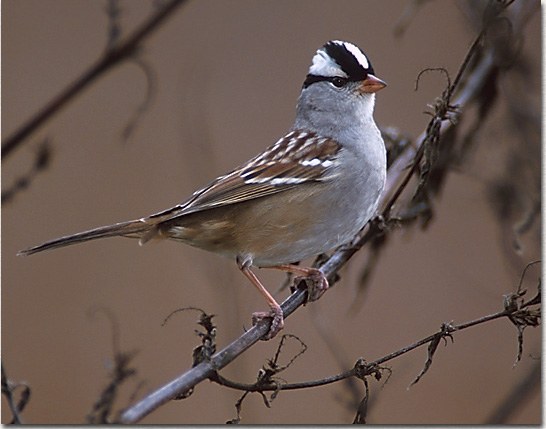
White-crowned Sparrow
- Habitat
- Brushy areas, tangles, open woodlands, willow thickets near streams, shrubby mountain areas, residential areas, roadsides, parks
- Size
- 7 in
- Lifespan
- Notably long-lived for a sparrow; the oldest banded individual on record was over 13 years old.
- Diet
- Spiders, bugs, insects, fruit, fresh leaves
About the White-crowned Sparrow
The White-crowned Sparrow earns its name from a bold, crisp pattern of black-and-white stripes running front to back across the crown, framing a plain gray face and underparts and a streaked brown back. A pink or orange bill and an alert, upright posture give the bird a sharp, tidy appearance that has made it, in the words of many birders, a genuine favorite among sparrows. The striking head pattern is present in adults across the species' wide range, though immature birds show a duller, rust-and-buff version of the same stripes before molting into the full adult pattern, and several recognized subspecies differ subtly in bill color and the precise width and contrast of the crown stripes.
White-crowned Sparrows breed in brushy, shrubby habitat -- willow thickets along streams, tangled undergrowth in open woodlands, and low vegetation in shrubby mountain terrain -- and winter in a broader range of brushy areas, residential yards, roadsides, and parks, often mixing with other sparrows at feeders and forest edges. The species is also one of the most thoroughly studied songbirds for research into song learning, since different regional populations sing distinct local "dialects" that young birds learn by listening to adults nearby, making it a classic subject in the science of bird vocal development.
Pairs form strong, lasting bonds, with many mating for life, and in favorable habitat a single pair can raise as many as four broods across a single breeding season. Males often sing even at night during the breeding period, while females handle the bulk of nest construction, weaving a cup nest low in shrubs or occasionally on the ground. Diet consists mainly of small invertebrates such as spiders and insects, supplemented with fruit and fresh leaves, particularly outside the nesting season. For a sparrow, the species is notably long-lived: the oldest banded individual on record survived more than 13 years, a considerable lifespan for such a small bird.
Because it breeds across such a wide latitudinal range, from Arctic tundra edges to shrubby mountain slopes farther south, and because different populations winter in predictable, well-studied locations, the White-crowned Sparrow has also become one of the most frequently used species in scientific research on migration timing and physiology, alongside its role in song-dialect studies. Some of the classic laboratory work on how migratory birds sense day length and time their seasonal movements and body changes accordingly was conducted using this species, since captive White-crowned Sparrows reliably show the same seasonal shifts in restlessness and physiology that free-living birds display in the wild.
That combination of accessibility, abundance, and distinctive behavior has made it something of a workhorse species for ornithologists studying how songbirds navigate, time their journeys, and communicate. In Oklahoma, White-crowned Sparrows are a familiar and conspicuous winter visitor, often the boldest and most confiding sparrow at a brushy feeding station, its crisp head stripes and upright stance making it one of the easier winter sparrows for a beginner to learn and recognize with confidence.
Immature birds retain their duller rust-and-buff head stripes through their first fall and winter, only molting into the crisp black-and-white adult pattern before their first breeding season, so a flock of wintering birds in Oklahoma often shows a mix of crisply patterned adults and softer-headed young birds feeding side by side. The species typically forages on the ground in loose flocks during winter, scratching at leaf litter and scanning for seeds much like a towhee, and will readily visit platform feeders or scattered seed on the ground beneath a feeder, making it one of the more approachable and easily observed sparrows for anyone watching a well-stocked backyard through the colder months.
Frequently asked questions
How do you identify a White-crowned Sparrow?
Look for its bold black-and-white striped crown, plain gray face and underparts, and pink or orange bill.
Do White-crowned Sparrows mate for life?
Many pairs form lasting bonds and can raise up to four broods in a single season under good conditions.
Why are White-crowned Sparrows important to bird-song research?
Different regional populations sing distinct local dialects, making the species a classic subject for studying how young birds learn song.
How long do White-crowned Sparrows live?
They are notably long-lived for a sparrow, with the oldest banded individual on record surviving more than 13 years.
Has this species been used in other kinds of scientific research?
Yes, it has also been a classic subject in laboratory studies of how migratory birds sense day length and time their seasonal movements and physiology.
Where to find it
This species favors forest habitat. See real Oklahoma locations on the Habitats map.