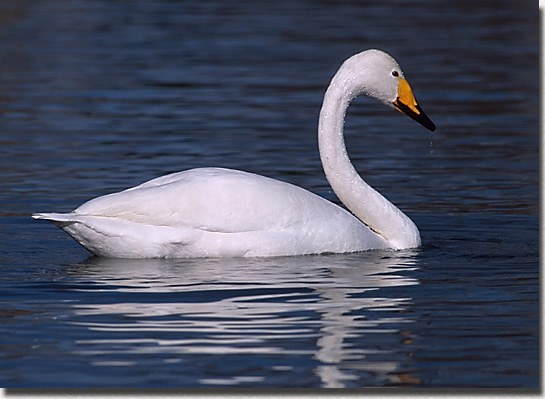
Whooper Swan
- Habitat
- Lakes and wetlands across subarctic and temperate Eurasia; not a naturally occurring species in North America
- Size
- Length about 60 in (150 cm), wingspan up to 8 ft (2.4 m)
- Lifespan
- Wild individuals are often cited as living around a decade on average, with some documented living considerably longer
- Diet
- Aquatic vegetation, grasses, and agricultural grain
About the Whooper Swan
The Whooper Swan is a large, entirely white swan closely resembling North America's Trumpeter Swan, but distinguished by its bill pattern: rather than an all-black bill, it shows yellow extending forward along the sides toward the nostril, with black restricted to the bill tip, and the exact shape of that yellow patch varies enough between individuals that experienced observers can sometimes recognize particular birds by bill pattern alone. Its loud, resonant, bugling call, from which its common name derives, is a familiar sound across its breeding range in northern Eurasia, and paired birds often call together in a duet-like exchange, heads thrown back and wings half-raised, especially after chasing off a rival or reuniting after a brief separation.
This species breeds across subarctic Europe and Asia, including Iceland, Scandinavia, and Russia, favoring shallow tundra lakes, taiga bogs, and slow rivers, and winters in temperate parts of Europe and Asia, shifting to estuaries, farmland, and ice-free lakes as the far north freezes over. It is not a naturally occurring wild bird in North America, and it does not have an established wild range in Oklahoma or anywhere else on the continent; any sighting in the state would almost certainly involve an escaped or released captive individual rather than a genuinely wild vagrant, though a handful of Whooper Swans do occasionally reach far western Alaska and the Aleutians from Siberian populations, well outside Oklahoma's reach.
In its native range, the Whooper Swan feeds by grazing on aquatic plants, grasses, and, particularly in winter, waste grain left in agricultural fields near open water, following a foraging pattern broadly similar to that of the Trumpeter Swan; where the two ranges might otherwise overlap, the species is generally the more inclined of the two toward feeding on farmland well away from water. Like other swans, it can upend in shallow water to reach submerged vegetation with its long neck, and family groups often forage together throughout the winter, with young birds still recognizable by a slightly duller, grayish cast to their plumage into their first spring.
Pairs are monogamous, typically for life, and build substantial nest mounds of vegetation in wetlands, usually on a small island or hummock that offers some protection from ground predators. Cygnets remain with their parents through their first southbound migration in fall and often through the following winter, a behavior that helps young birds learn traditional wintering routes and sites from experienced adults, a pattern shared broadly across swan species. Migrating flocks travel in loose V-formations or lines, and Whooper Swans are counted among the strongest fliers in the swan family, with individuals occasionally reported crossing mountainous terrain at exceptional altitude during long-distance movements. Because the species holds cultural significance across much of its native range, including featuring prominently in Icelandic and Finnish folklore and as Finland's national bird, it is far better known in Europe and Asia than it is in North America, where its presence is limited entirely to captivity, most often on ornamental ponds and private waterfowl collections.
Within the swan family the Whooper is generally considered second only to the Trumpeter Swan in overall bulk, and it should not be confused with the smaller, shorter-necked Bewick's Swan, a related Eurasian species that shares a broadly similar yellow-and-black bill pattern but carries noticeably less yellow near the base. Aggressive encounters between rival birds, or between a pair and an intruder near the nest, are often followed by an elaborate "triumph ceremony," in which the successful pair calls loudly together with necks arched and wings spread, a bonding display thought to reinforce the pair bond after a conflict, much as in other swans and geese. Across much of its European range the species has been generally increasing or stable in recent decades, aided in part by warmer winters that have allowed more birds to shorten their migrations or remain further north year-round.
Frequently asked questions
Is the Whooper Swan a wild species in Oklahoma?
No, this is a Eurasian species that does not occur naturally in North America; any sighting there would likely be an escaped captive bird.
How does the Whooper Swan differ from the Trumpeter Swan?
The Whooper Swan has a yellow-and-black bill, with yellow reaching toward the nostril, rather than the all-black bill of the Trumpeter Swan.
Where does the Whooper Swan naturally live?
Across northern Europe and Asia, including Iceland, Scandinavia, and Russia.
Why is it called the Whooper Swan?
For its loud, resonant, bugling call.
Do young Whooper Swans migrate with their parents?
Yes, cygnets typically stay with their parents through their first fall migration and often the following winter, learning traditional routes and wintering sites in the process.
Where to find it
This species favors wetland habitat. See real Oklahoma locations on the Habitats map.