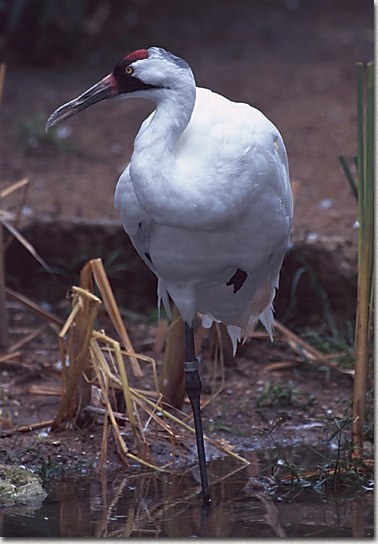
Whooping Crane
- Habitat
- Freshwater marshes of Wood Buffalo National Park, Alberta (breeding); shallow coastal marshes of Aransas Wildlife Refuge, Texas (wintering)
- Size
- 45–50 in, called the tallest flying bird in North America
- Lifespan
- Far outlives typical songbirds, generally living into its 20s in the wild, occasionally approaching 30 years.
- Diet
- Crustaceans, fish, small vertebrates, insects, small mammals; roots, berries, grain
About the Whooping Crane
Standing roughly four feet tall, the Whooping Crane is often described as the tallest flying bird in North America, and its appearance matches its stature: pure white plumage set off by black wingtips visible only in flight, and a patch of bare red skin on the forehead and cheeks that darkens with age. Young birds show a cinnamon-brown wash mixed through their white feathers, gradually whitening as they mature over their first year or so. Its far-carrying, trumpet-like call is one of the most distinctive sounds in North American wetlands, audible for several miles across open marsh, a projection made possible by an unusually elongated windpipe that coils within the bird's breastbone before running up into the throat, functioning much like the tubing of a natural trumpet, a trait shared with other cranes.
The species follows one of the most tightly constrained migratory routes of any North American bird, breeding in the remote freshwater marshes of Wood Buffalo National Park in Alberta and wintering almost entirely along the shallow coastal marshes of Aransas National Wildlife Refuge on the Texas Gulf Coast, with migration generally underway in spring by March and in fall by September or October. Cranes typically migrate by day, riding rising thermals to gain altitude before gliding onward in family groups rather than large flocks, a pattern that keeps parents and their single surviving young together for the full length of the journey. On its wintering grounds it forages opportunistically, favoring crustaceans, especially blue crabs, along with fish, small vertebrates, and insects, while also taking roots, berries, and grain when available.
The Whooping Crane's story is inseparable from one of North America's best-known conservation efforts. Habitat loss and unregulated hunting drove the population down to only a couple dozen wild birds by the early 1940s, a number so low the species came close to extinction. Decades of intensive protection, captive breeding, and reintroduction work -- including techniques like using Sandhill Cranes as foster parents and training young cranes to follow ultralight aircraft along a new migratory route -- have helped rebuild the population and establish additional flocks beyond the original Wood Buffalo-to-Aransas group, including a reintroduced non-migratory population in Louisiana and an eastern migratory flock shuttling between the upper Midwest and the Southeast, though the species remains far below historic numbers and still depends on continued management.
Whooping Cranes live remarkably long lives for a bird of their size, generally surviving into their 20s in the wild and occasionally approaching 30 years, a longevity that has allowed successfully reintroduced birds to establish new breeding traditions over time. Pairs typically mate for life, generally re-pairing only if a mate is lost, and generally lay two eggs, but as in most cranes only one chick usually survives to fledge, since the larger, more aggressive sibling often outcompetes or drives off the other in the nest's first weeks. As in other cranes, pairs frequently perform a duet known as the unison call, standing close together with heads thrown back and calling in an overlapping, coordinated pattern that appears to reinforce the pair bond and signal ownership of a territory to neighboring pairs. At night the birds typically roost standing in shallow open water rather than on dry ground, a habit that lets a resting crane detect the ripples and splashing of an approaching predator well before it draws close. Courtship is one of the species' most memorable behaviors: paired birds perform an elaborate dance of bowing, leaping, and wing-flapping, a display that helps strengthen the pair bond ahead of a breeding season and is often cited as one of the more dramatic courtship rituals among North American birds.
Frequently asked questions
Why is the Whooping Crane famous among conservationists?
Its population fell to only a couple dozen wild birds by the early 1940s, and it has become one of North America's best-known endangered species recovery stories.
Where do Whooping Cranes spend the winter?
Nearly the entire original wild population winters in the shallow coastal marshes of Aransas National Wildlife Refuge in Texas, though reintroduced flocks now winter elsewhere in the Southeast.
What does a Whooping Crane eat?
It forages opportunistically for crustaceans like blue crabs, fish, small vertebrates, insects, and some roots, berries, and grain.
How long do Whooping Cranes live?
They generally live into their 20s in the wild, occasionally approaching 30 years.
Why does a Whooping Crane pair usually raise only one chick?
Although two eggs are typically laid, the first-hatched chick is often larger and more aggressive, and it commonly outcompetes or drives off its sibling within the first weeks after hatching.
Where to find it
This species favors wetland habitat. See real Oklahoma locations on the Habitats map.