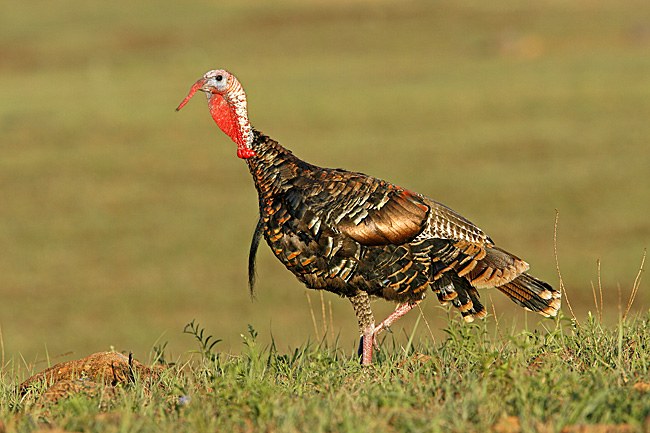
Wild Turkey
- Habitat
- Mixed woodlands with open clearings, often near agricultural land
- Size
- Males up to about 4 ft (120 cm) long with a wingspan around 4-5 ft (1.2-1.5 m) and weight up to roughly 24 lb (11 kg); females notably smaller
- Lifespan
- Typically 3-5 years in the wild, with some individuals living longer
- Diet
- Omnivorous: acorns and other nuts, seeds, berries, insects, and occasionally small vertebrates
About the Wild Turkey
The male Wild Turkey (tom) is a large, unmistakable bird with iridescent bronze-green body plumage, a bare, colorful head that can flush red, white, or blue depending on its mood and level of excitement, and a beard of coarse modified feathers projecting from the chest that lengthens with age. During display, males fan their tail into a broad arc and strut with wings lowered, dragging their primaries against the ground, a performance often accompanied by the familiar gobbling call that can carry for a mile or more on a still morning. Females are considerably smaller and duller brown overall, an appearance that helps camouflage them while nesting on the ground, and most lack a beard, though a small percentage of hens do grow one.
Wild Turkeys occur throughout most of Oklahoma in wooded habitat interspersed with open clearings, particularly where mast-producing trees like oaks grow near agricultural fields; the state is home to both Eastern and Rio Grande subspecies, with the Rio Grande form generally favoring the more open, brush-lined river bottoms of the western and central parts of the state and the Eastern subspecies more typical of the denser woodlands further east. The species is found across most of the United States today, though this broad distribution is itself the result of a substantial recovery: populations collapsed severely by the early twentieth century due to habitat loss and unregulated hunting, and only concentrated restoration efforts, including trapping and relocating wild birds to restore local populations, brought the species back across its historic range and beyond.
Outside the breeding season, Wild Turkeys are highly social, gathering into flocks that are often segregated by sex and age, with hens and young birds forming one group and mature toms sometimes forming loose bachelor groups of their own through the fall and winter. Their vocal repertoire is considerably broader than the gobble alone, including yelps, clucks, purrs, and soft assembly calls used to keep a flock in contact while foraging through dense cover. Wild Turkeys forage on the ground, scratching through leaf litter for acorns and other mast, seeds, berries, and insects, and they roost in trees overnight, flying up to elevated branches for safety from ground predators despite their large size and generally terrestrial habits; their eyesight is exceptionally sharp, giving them an early warning advantage against approaching threats that helps offset a comparatively modest sense of smell.
Breeding is polygynous: males display and gobble, often from traditional strutting grounds used year after year and most intensely through spring, from roughly March into May, to attract as many females as possible, taking no part in nest building, incubation, or chick-rearing afterward, all of which the female handles alone. She builds a simple ground nest, typically well hidden in vegetation, and the precocial chicks, called poults, leave the nest and begin foraging alongside their mother within a day of hatching, though they remain vulnerable to predation during their first weeks of life and cannot fly well enough to reach the safety of a roost until they are several weeks old. Young poults rely heavily on insects for the protein needed to grow quickly, gradually shifting toward the more plant-based, mast-heavy diet of adult birds as the season progresses. On the ground, an adult Wild Turkey can walk and run with surprising speed to outpace a predator, generally preferring to flee on foot over rough terrain rather than take flight, and its keen eyesight and hearing, more than any sense of smell, provide the early warning that keeps a wary flock safe.
Frequently asked questions
Can Wild Turkeys fly?
Yes, despite their size they can fly short distances, especially to escape danger or reach roosting trees at night.
Were Wild Turkeys ever rare in Oklahoma?
Populations declined severely nationwide by the early 1900s due to habitat loss and overhunting, but restoration efforts successfully reestablished them across much of Oklahoma.
Do male and female turkeys look different?
Yes, males are larger with iridescent plumage, a bare colorful head, and a chest beard, while females are smaller and duller for camouflage while nesting.
What do Wild Turkeys eat?
A varied omnivorous diet of acorns, seeds, berries, and insects foraged from the ground.
Are there different kinds of Wild Turkeys in Oklahoma?
Yes, Oklahoma hosts both the Rio Grande subspecies, more common in open western river bottoms, and the Eastern subspecies, more typical of denser woodlands further east.
Where to find it
This species favors forest habitat. See real Oklahoma locations on the Habitats map.