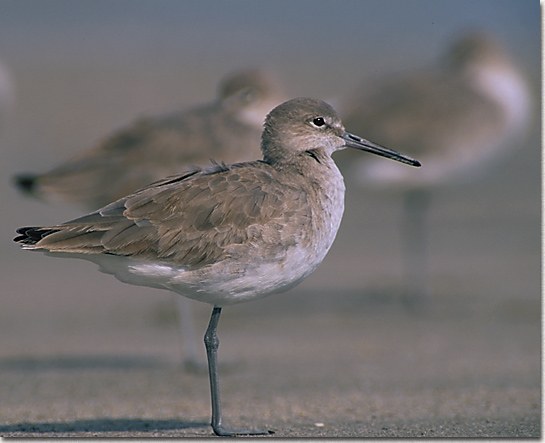
Willet
- Habitat
- Wet grassy areas, moist prairies, salt and brackish marshes, bays, lakeshores, muddy banks of creeks
- Size
- 15 in
- Lifespan
- Banding records show wild Willets can live over a decade; the oldest known was about 10 years 3 months old.
- Diet
- Aquatic insects, worms, crustaceans, mollusks, fish
About the Willet
At rest, the Willet is one of the least remarkable-looking large shorebirds — a plain grayish-brown bird with a long, straight bill and long blue-gray legs, easy to overlook among other waders along a shoreline. The moment it takes flight, though, that plainness disappears: bold black-and-white wing patterns flash into view, making the Willet one of the most striking shorebirds in the air even though it is one of the plainest standing still. Loud, ringing calls usually announce its presence well before it is spotted, and the species has a reputation as a noisy, conspicuous sentinel that alerts other shorebirds to danger.
Willets favor wet grassy areas, moist prairies, salt and brackish marshes, bays, lakeshores, and the muddy banks of creeks, where they wade in shallow water — often up to the belly — and even swim on occasion, a habit not shared by most shorebirds of similar size. Foraging birds probe the mud and shallows for aquatic insects, worms, crustaceans, mollusks, and fish, using their sturdy bill to reach prey that other shorebirds cannot.
Willet breeding behavior includes an unusual division of labor between the sexes: males take on a disproportionate share of nighttime incubation duty, sometimes also covering the eggs at midday, while females typically abandon both mate and brood roughly two to three weeks after the eggs hatch, leaving the male to finish raising the young largely on his own. Despite this apparent lack of long-term parental partnership within a season, pairs often show strong fidelity to the same mate and the same feeding territory from one year to the next, returning to renew the bond during the next breeding season.
Banding records show wild Willets can live over a decade, with the oldest known individual reaching about 10 years and 3 months, a solid lifespan for a shorebird that spends much of its life wading through open, exposed habitat.
Taxonomists now place the Willet within the same genus as several closely related sandpipers rather than in its own separate group, reflecting genetic studies that revealed closer ties to other large shorebirds than its distinctive appearance alone might suggest. Eastern and western populations differ subtly in size and habitat preference, with interior western birds tending toward drier prairie wetlands while eastern birds stay closer to coastal salt marsh, a split that hints at two somewhat different ways of making a living within the same species.
Frequently asked questions
Why does the Willet look so different in flight compared to at rest?
At rest it is plain grayish-brown, but in flight it reveals bold black-and-white wing markings that are hidden when the wings are folded.
Who raises the young in a Willet family?
Males handle much of the incubation, and after about two to three weeks females often leave, leaving the male to finish raising the brood.
Do Willets keep the same mate every year?
Pairs often show strong fidelity to both the same mate and the same feeding territory across years, even though one parent leaves partway through raising each brood.
How long do Willets live?
Wild Willets can live over a decade; the oldest known individual was about 10 years and 3 months old.
Where to find it
This species favors wetland habitat. See real Oklahoma locations on the Habitats map.