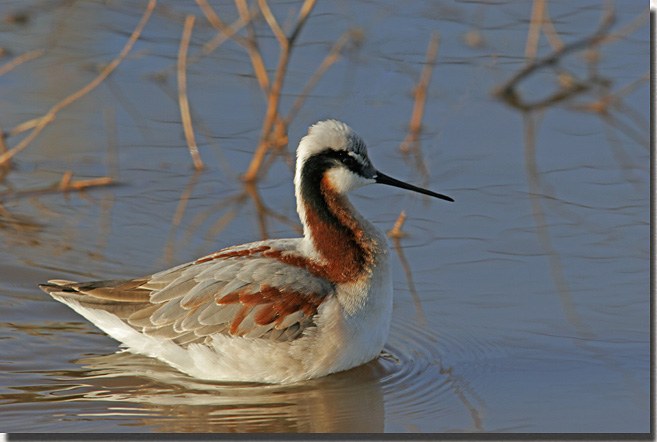
Wilson's Phalarope
- Habitat
- Shallow wetlands, alkaline lakes, and mudflats
- Size
- Length about 9 in (23 cm), wingspan around 17 in (43 cm)
- Lifespan
- Specific figures are not well documented for this species
- Diet
- Aquatic invertebrates such as insect larvae and brine shrimp
About the Wilson's Phalarope
Wilson's Phalarope is a slender shorebird notable for reversed sexual dimorphism: the breeding female is more brightly patterned than the male, showing a bold chestnut stripe down the side of the neck and a gray crown, while the male is duller and more subdued in color. This visual difference reflects the species' reversed breeding roles, in which females compete for mates and leave most parental care to males. Its bill is notably thin and needle-straight, generally longer and finer than that of the Red-necked Phalarope, a useful distinction where the two species might occur together on the same shallow lake.
It breeds in shallow wetlands and prairie marshes across the western United States and southern Canada, and undertakes a long migration to winter on high-altitude alkaline lakes in the Andes of South America. In Oklahoma it is seen mainly as a migrant, stopping at shallow lakes and wetlands as it moves between its more northerly breeding areas and its distant wintering grounds. Farther west, after breeding ends, huge numbers of Wilson's Phalaropes gather to stage for weeks at hypersaline lakes such as Utah's Great Salt Lake and California's Mono Lake, feeding heavily on brine shrimp and brine flies to build fat reserves before continuing south; Oklahoma's shallow lakes serve a similar, if smaller-scale, stopover function during both spring and fall passage.
The species has a distinctive foraging behavior: it swims in tight circles on the water's surface, creating a small vortex that stirs up aquatic invertebrates from below, then picks them off the surface with quick jabs of its thin, needle-like bill. This spinning behavior is conspicuous and often the easiest way to identify a phalarope on open water at a distance. Like other phalaropes, it has partially lobed toes rather than fully webbed feet, an adaptation that provides paddling power in the water while still allowing it to walk easily on mudflats, and dense, well-oiled body feathers give the bird notable buoyancy, letting it sit high on the water in a way many other shorebirds cannot.
Breeding roles in Wilson's Phalarope are reversed relative to most birds: females arrive on the breeding grounds first and compete for access to males, sometimes displaying and even fighting over potential mates, and after laying a clutch of eggs, the female typically departs, sometimes to seek another mate, while the male alone incubates the eggs and cares for the precocial chicks once they hatch. Females also tend to begin their southbound migration well before males and juveniles, so that the birds seen migrating together at a given site can shift markedly in composition over the course of a season, with adult females often the first phalaropes to reappear at a staging lake in early or mid-summer, followed weeks later by males and finally by newly fledged young. This role reversal, paired with the female's brighter plumage, makes the species one of the clearer examples of polyandrous breeding among North American birds.
In flight, Wilson's Phalaropes appear slim and pale, with a plain wing lacking the bold white stripe shown by some related shorebirds, and flocks often wheel and turn together in tight, coordinated formation over open water before dropping down to resume feeding. On its wintering grounds in the high Andes, the species again favors shallow, often saline lakes, a habitat preference that recurs at nearly every stage of its annual cycle, from prairie pothole to hypersaline staging lake to alpine wintering lake, underscoring just how specialized this small shorebird is for life on salty, open water rather than the muddy shorelines favored by most other sandpiper-like species.
Frequently asked questions
Why does Wilson's Phalarope spin in circles on the water?
Spinning creates a small whirlpool that stirs up aquatic invertebrates, making them easier to pick off the surface.
Which sex is more colorful in Wilson's Phalarope?
Unusually, the female is more brightly colored than the male, matching its more active role in competing for mates.
Does Wilson's Phalarope nest in Oklahoma?
It is mainly seen in Oklahoma as a migrant, with breeding concentrated further north and west in prairie wetlands.
Who takes care of the eggs and chicks?
The male alone incubates the eggs and cares for the chicks after the female lays them.
Where do Wilson's Phalaropes go right after breeding?
Many gather in large numbers at hypersaline lakes farther west, such as the Great Salt Lake, to feed heavily on brine shrimp and flies before continuing their migration to South America.
Where to find it
This species favors wetland habitat. See real Oklahoma locations on the Habitats map.