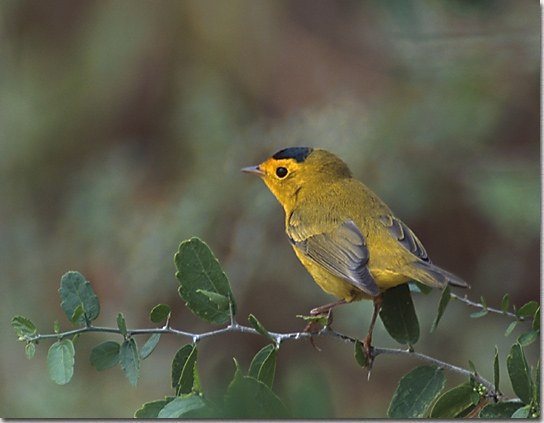
Wilson's Warbler
- Habitat
- Moist woodland edges, willow thickets, spruce-tamarack bogs, alders/birches near streams and ponds, tangles near water; more numerous in the west
- Size
- 4½–5 in
- Lifespan
- Most live only a few years, but the oldest banded individual reached nearly 9 years old.
- Diet
- Insects, occasionally berries
About the Wilson's Warbler
A tiny, restless bird of streamside thickets, the Wilson's Warbler rarely sits still long enough for a leisurely look. Males are olive-green above and bright yellow below, with a neat, solid black cap on the crown that gives the species its most useful field mark; females and immatures show the same basic coloring but usually lack the black cap or show only a faint trace of it, along with no obvious wing bars. Whatever the plumage, the bird's constant motion -- flicking its wings and twitching its tail as it moves -- is often as helpful for identification as its coloring. Its song, a thin, rapid, chattering series of notes that drops in pitch and speed toward the end, carries well through dense low cover and is frequently the first clue to a bird's presence before it is ever seen.
Wilson's Warblers favor moist habitat with dense low vegetation: woodland edges, willow thickets, spruce-tamarack bogs, and streamside stands of alder and birch, with the species notably more numerous across the western part of its range than in the east, where western populations also tend to run slightly larger and brighter than their eastern counterparts. Foraging birds stay close to the ground, usually within about 10 feet of it, gleaning insects from foliage and occasionally darting out to snatch a flying insect in a short aerial sally, sometimes hovering briefly at a leaf tip to pick off a hidden insect; berries make up a small part of the diet as well. Despite their small size, the birds can be surprisingly bold, sometimes approaching quite close to a quiet observer while foraging.
In Oklahoma the species is encountered almost entirely as a migrant, passing through streamside woods and brushy tangles in spring, generally in April and May, and again in fall, roughly August through September, as it travels between breeding grounds well to the north and west and wintering areas farther south; birdwatchers often find it moving through mixed flocks alongside other migrant warblers during these windows rather than holding a single territory. Nests are built low, tucked into mosses, grass tussocks, or other low vegetation at or near ground level, well hidden from the many predators that hunt through the same thickets the birds inhabit.
Most Wilson's Warblers live only a few years in the wild, but banding records show at least one individual reaching nearly 9 years of age. Western populations of the species have drawn particular conservation attention in recent decades, as long-term monitoring has documented meaningful population declines, making a bird once considered simply common now a subject of closer study across its breeding range; suspected causes generally discussed include habitat degradation on the wintering grounds and along migration stopover sites, though as with many long-distance migrants pinning the decline on a single cause has proven difficult. The species was named in honor of the pioneering American ornithologist Alexander Wilson, one of the founding figures of North American bird study, and it undertakes a substantial migration each year between its northern and western breeding grounds and wintering areas that stretch from Mexico into Central America, a journey that carries this diminutive warbler across a remarkable share of the Western Hemisphere twice a year. It belongs to a small genus of warblers, alongside the Red-faced and Canada Warblers, that generally shares a preference for dense understory habitat over the high canopy favored by many other North American wood-warblers, and this consistent affinity for low, tangled cover is likely part of what makes the species so reliably detectable, if not always easy to see, wherever suitable streamside thickets occur along its migration route.
Frequently asked questions
How can you identify a male Wilson's Warbler?
Look for olive-green upperparts, bright yellow underparts, and a solid black cap on the crown.
How does a Wilson's Warbler behave while foraging?
It stays low, usually within about 10 feet of the ground, constantly flicking its wings and tail while gleaning insects from foliage.
Where does the Wilson's Warbler nest?
It builds a nest low to the ground, tucked into mosses or other low vegetation near streams, bogs, or thickets.
How long do Wilson's Warblers live?
Most live only a few years, though the oldest banded individual on record reached nearly 9 years old.
When is the best time to see a Wilson's Warbler in Oklahoma?
Look for it during spring migration, roughly April into May, and again in fall, roughly August into September, as it passes through streamside thickets rather than staying to breed.
Where to find it
This species favors wetland habitat. See real Oklahoma locations on the Habitats map.