Wood Duck
- Habitat
- Wooded swamps, streams, and ponds with nearby tree cavities
- Size
- Length about 19 in (48 cm), wingspan around 26-29 in (66-73 cm)
- Lifespan
- Wild banding records have documented individuals living beyond 15 years, though average lifespan is considerably shorter due to high early mortality
- Diet
- Seeds, acorns, aquatic vegetation, and insects
About the Wood Duck
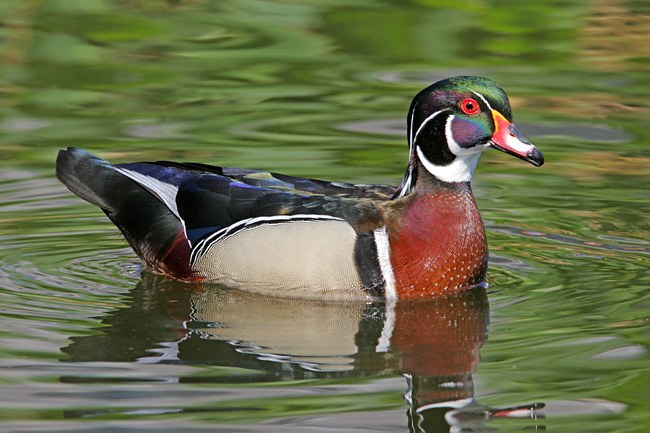
The male Wood Duck is widely considered one of the most colorful waterfowl in North America, with an iridescent green and purple crested head marked by bold white facial stripes, red eyes, a chestnut breast speckled with white, and buffy-tan sides. Females are far more subdued, gray-brown overall, but are readily identified by a distinctive white teardrop-shaped ring around the eye, which stands out even at a distance. After breeding ends, males molt into a drab eclipse plumage that resembles the female's, losing their showy head pattern for several weeks and becoming flightless during this period as they replace their flight feathers all at once, a vulnerable stretch during which the birds retreat into the densest cover available.
The species is found across much of the eastern United States as well as parts of the West Coast, including wooded wetlands throughout Oklahoma, with some populations resident year-round and others migratory depending on regional climate. It favors quiet, wooded water bodies where mature trees stand near the shoreline, since these provide the cavities it depends on for nesting, and pair formation often begins well before spring, with courtship and bonding taking place within loose winter flocks on shared wintering waters.
Wood Ducks feed both on the water and on land, dabbling at the surface and in shallow water for aquatic plants, and walking on land to pick up fallen acorns and other seeds, giving them a more varied foraging style than many dabbling ducks. Sharp, curved claws on their feet, unusual among ducks, let them grip bark and perch securely on tree limbs, an adaptation tied closely to their reliance on wooded habitat for both nesting and loafing.
Unlike most ducks, which nest on the ground, Wood Ducks nest in tree cavities, whether natural hollows or, increasingly, human-provided nest boxes placed near water, a conservation measure credited with supporting the species' recovery after it had been depleted by habitat loss and unregulated hunting in the early twentieth century. Suitable cavities can be scarce, and females sometimes lay eggs in another female's nest rather than starting their own, a form of brood parasitism known as dump nesting that occasionally leaves a single cavity holding an unusually large clutch from more than one hen. In warmer parts of the range, including much of Oklahoma, a female may also raise two broods in a single season if conditions and timing allow, an uncommon trait among North American waterfowl.
In one of the more striking sights in the bird world, day-old ducklings leap from the nest entrance, sometimes many feet above the ground or water, cushioned by their extremely light weight and down, and then follow their mother's call to the nearest water body, where they begin feeding themselves almost immediately, with the mother offering guidance and vigilance against predators but no direct feeding.
Wood Ducks are generally quieter than many other waterfowl, though the female's rising, distressed-sounding "oo-eek" flush call, given as she bursts off the water in alarm, is a familiar and distinctive sound along wooded creeks and sloughs and is often the first clue to the presence of a bird otherwise hidden by overhanging branches. Pairs typically form on the wintering or staging grounds well before the start of nesting, and once nesting begins the male generally abandons the female partway through incubation, gathering instead with other males to molt while the female completes incubation and brood-rearing alone, a pattern that differs from the more prolonged pair bonds seen in some other duck species. Where good nesting cavities are scarce relative to the number of hens seeking them, competition for tree holes and nest boxes can be intense in spring, and this scarcity is thought to be a major driver of the dump-nesting behavior seen in the species.
Frequently asked questions
Why are Wood Ducks called "Wood" Ducks?
Because they nest in tree cavities in wooded wetlands, unlike most ducks, which nest on the ground.
How do Wood Duck ducklings leave a nest high in a tree?
They jump from the cavity entrance, sometimes many feet to the ground or water, cushioned by their light weight, within a day of hatching.
Do Wood Ducks use nest boxes?
Yes, they readily use human-provided nest boxes near water, which has supported population recovery.
What do Wood Ducks eat?
A mix of seeds, acorns, aquatic plants, and insects.
Do male Wood Ducks always look so colorful?
No, after breeding males molt into a drab, female-like eclipse plumage for several weeks and are briefly flightless while they regrow their flight feathers.
Where to find it
This species favors wetland habitat. See real Oklahoma locations on the Habitats map.