Wood Stork
- Habitat
- Freshwater and brackish wetlands, swamps, and marshes
- Size
- Length about 40 in (102 cm), wingspan around 5.5 ft (1.65 m)
- Lifespan
- Wild individuals are generally thought to live into their teens, though precise figures are limited
- Diet
- Primarily fish, caught using a specialized tactile feeding method
About the Wood Stork
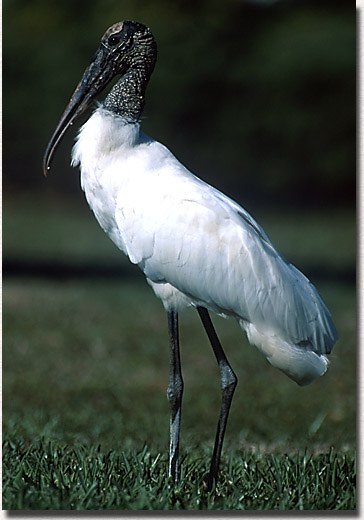
The Wood Stork is a large white wading bird with black flight feathers and tail, a bald, dark, scaly-looking head, and a long, thick, downward-curving bill, giving it a distinctly different silhouette from herons and egrets, to which it is not closely related. Its heavy, somewhat prehistoric appearance and slow, deliberate movements make it one of the more unmistakable large wading birds when encountered. One of the most reliable ways to separate a distant Wood Stork from a similarly large white heron or egret is in flight: true storks fly with their long neck extended straight out rather than folded back into the tight S-curve herons and egrets typically hold, and Wood Storks readily soar on thermals with slow, steady wingbeats alternating with long glides, a flight style closer to that of raptors or pelicans than to most wading birds.
It is primarily a species of the southeastern United States, especially Florida and the Gulf Coast, as well as Central and South America, where it breeds and forages in freshwater and brackish wetlands. It is not an expected bird in Oklahoma, appearing there only rarely, typically as a wandering non-breeding visitor in late summer when southeastern populations disperse widely after the breeding season. This post-breeding dispersal is a well-documented pattern in the species: once young have fledged, both adults and first-year birds may wander hundreds of miles from their natal colonies in search of productive feeding wetlands, and it is this restless wandering, rather than any true migratory movement, that occasionally carries individuals as far inland as Oklahoma's lakes and wetlands.
The Wood Stork employs one of the most specialized foraging techniques among wading birds: it wades through water with its bill open and partly submerged, and upon contact with a fish or other prey item, snaps its bill shut in a reflex reaction estimated at around 25 milliseconds, among the fastest reflexes documented in any vertebrate. Because this method relies on touch rather than sight, it allows the bird to forage effectively even in murky water, and it often forages cooperatively, with several birds wading in a loose group and sometimes stirring the bottom with their feet to flush hidden prey toward one another. Small fish make up the bulk of its diet, though it will also take amphibians, aquatic invertebrates, and occasionally small reptiles when the opportunity arises.
The species nests colonially in cypress swamps and similar wetland forests, and its breeding timing is closely tied to seasonal water level drops that concentrate fish into shrinking pools, making prey easier to catch in the large quantities needed to feed growing chicks. Colonies are often mixed, with Wood Storks nesting alongside herons, egrets, and ibises in the same stands of trees, and like other storks the species is largely voiceless as an adult, lacking the well-developed vocal muscles of songbirds; instead, adults and nestlings communicate at the nest chiefly through bill-clattering displays rather than calls.
Wood Storks were once listed as federally endangered in the United States due to widespread wetland loss and drainage, though their status was later downgraded to threatened as some populations partially recovered, reflecting the strong link between the species' fortunes and wetland conservation. Because its breeding success depends so heavily on the right sequence of flooding and drying in its wetland habitat, the Wood Stork is often regarded as a useful indicator species for the broader health of southeastern wetland systems.
Frequently asked questions
Is the Wood Stork common in Oklahoma?
No, it is a rare visitor, most often seen as a wandering non-breeder in late summer.
How does the Wood Stork catch fish?
It uses one of the fastest reflexes known among vertebrates, snapping its bill shut within milliseconds of touching prey in the water, without needing to see it.
Is the Wood Stork endangered?
It was once federally listed as endangered in the US due to wetland loss, though its status has since been downgraded to threatened as some populations recovered.
What does a Wood Stork look like?
A large white wading bird with black flight feathers, a bald dark head, and a long, thick, down-curved bill.
How can you tell a Wood Stork from a heron or egret in flight?
Wood Storks fly with their neck extended straight out and often soar on thermals, while herons and egrets typically fold their neck back into an S-curve in flight.
Where to find it
This species favors wetland habitat. See real Oklahoma locations on the Habitats map.