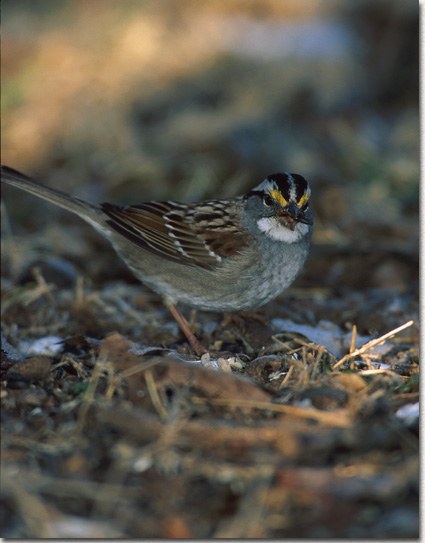
White-throated Sparrow
- Habitat
- Woodland edges, thickets, and brushy areas in winter; breeds in northern coniferous and mixed forests
- Size
- Length about 6.75 in (17 cm), wingspan around 9 in (23 cm)
- Lifespan
- An unusually long-lived sparrow; wild banding records have documented individuals living close to 15 years
- Diet
- Seeds, insects, and berries
About the White-throated Sparrow
The White-throated Sparrow occurs in two distinct color morphs, present in both sexes, distinguished by bold white-and-black versus duller tan-and-brown head stripes; both forms share a crisp white throat patch bordered by dark stripes and a small yellow spot in front of each eye. This plumage difference is tied to a genetic mechanism involving a chromosomal inversion, and it correlates with behavior as well as appearance, making the species a frequently cited example in discussions of alternative mating strategies in birds. Away from the head pattern, the species shares the generally streaked brown-and-gray body plan typical of sparrows in its genus, and its stocky build, relatively large size for a sparrow, and rounded head shape help separate it from the smaller, slimmer sparrows it often flocks with in winter.
It breeds across a broad swath of Canada and the northeastern United States in coniferous and mixed forest, but winters much further south and west, becoming a common winter visitor across the eastern and central United States, including Oklahoma, where it frequents brushy thickets, woodland edges, and backyard feeders from fall through early spring. Most individuals arrive in Oklahoma in October and remain through April, with the exact timing of arrival and departure shifting somewhat from year to year depending on weather patterns farther north, as is typical for many short- to medium-distance migrant sparrows.
On its wintering grounds it forages mostly on the ground, scratching through leaf litter for seeds and insects with a characteristic double-footed backward hop, and it readily takes seed at feeders, often in loose flocks with other sparrows, including juncos and other native sparrow species. These mixed winter flocks likely offer some protection from predators through added numbers of watchful eyes, a common advantage of flocking behavior seen broadly across wintering sparrows, and individual White-throated Sparrows often return to the same general wintering territory in successive years, a form of site fidelity documented through banding studies of the species.
White-striped birds tend to be more aggressive and vocal, while tan-striped birds tend to provide more parental care, and pairs overwhelmingly form between one bird of each morph rather than two of the same type, a pattern called disassortative mating that is rare among birds and is closely tied to the underlying chromosomal difference between the morphs. This near-obligate pairing across morphs means that, in effect, the species behaves almost as if it had four sexes rather than two, a detail that has made it a touchstone species for researchers studying the genetics of behavior. The species' clear, whistled song, often rendered as sounding like Oh-sweet-Canada-Canada or Poor-Sam-Peabody-Peabody, is a distinctive and easily learned sound, though in Oklahoma it is heard only occasionally, since most singing activity peaks on the breeding grounds far to the north; wintering birds are more often heard giving short, sharp chip notes than delivering the full song, though some individuals, particularly on mild late-winter days, will offer fragments of song well before they depart for their northern breeding grounds.
Like other sparrows that winter in mixed flocks, White-throated Sparrows often establish a loose dominance hierarchy within a wintering group, with more assertive individuals gaining preferential access to the best feeding spots near cover, and observers who watch a flock at a feeder for any length of time will usually notice this kind of low-level squabbling and displacement among birds. The species also readily gives a sharp, metallic pink or chink call note year-round, a useful clue to its presence even when it stays hidden in dense brush, and this call, along with its size and head pattern, helps separate it from the smaller, plainer-faced sparrows it frequently associates with in winter cover.
Frequently asked questions
Does the White-throated Sparrow breed in Oklahoma?
No, it is a winter visitor there; it breeds far north in Canada and the northeastern United States.
What's the difference between the two color forms?
White-striped birds have bold black-and-white head stripes while tan-striped birds have brown-and-tan stripes, and the two forms usually pair with the opposite morph.
What does a White-throated Sparrow sound like?
Its song is a clear, whistled phrase often described as Oh-sweet-Canada-Canada or Poor-Sam-Peabody-Peabody.
Where can I see White-throated Sparrows in Oklahoma?
In brushy thickets, woodland edges, and at backyard feeders from fall through spring.
When do White-throated Sparrows typically arrive and leave Oklahoma?
Most arrive around October and depart by April, though exact timing shifts somewhat year to year with weather patterns to the north.
Where to find it
This species favors forest habitat. See real Oklahoma locations on the Habitats map.