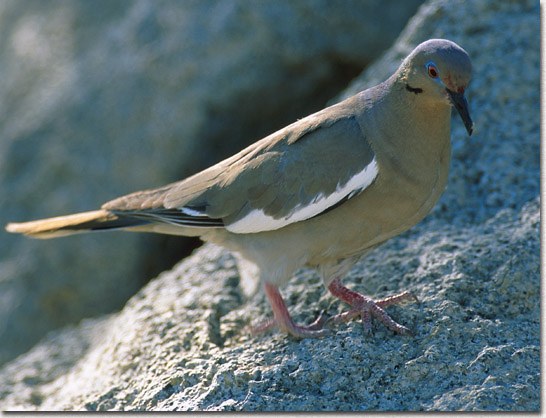
White-winged Dove
- Habitat
- Deserts, desert scrubland, mesquite, dry woodlands, agricultural areas, residential areas, wooded stream areas, citrus groves
- Size
- 12 in
- Lifespan
- Can live two decades or more; the oldest banded individual on record was almost 22 years old.
- Diet
- Fruit, waste grain from cultivated fields, cactus fruit, berries, acorns; young are fed crop milk then seeds after 4 days
About the White-winged Dove
The White-winged Dove is a stocky, brownish-gray dove readily identified by a bold white diagonal bar across each wing, visible even when the bird is perched, and a rounded tail edged in white at the corners that shows clearly in flight. A vivid red eye ringed with blue skin adds a splash of color to an otherwise muted plumage, and the overall build is heavier and more full-chested than the smaller Mourning Dove it is often confused with at a distance.
This species is closely tied to arid landscapes across much of its range, favoring deserts, desert scrubland, mesquite thickets, and dry woodlands, though it also thrives in agricultural areas, wooded stream corridors, citrus groves, and residential neighborhoods where suitable trees and a reliable food supply are available. In the desert Southwest, White-winged Doves have a particularly close relationship with saguaro and other columnar cacti: the birds feed heavily on cactus fruit and nectar, gaining both food and water in a landscape where surface water is scarce, and in the process they act as important pollinators of the very cacti they depend on.
Beyond cactus fruit, the diet includes cultivated fruit, waste grain gleaned from farm fields, berries, and acorns. Nestlings begin life on a diet of crop milk — a nutrient-rich secretion produced in the parents' crop — before transitioning to solid seeds after only about four days, a notably fast switch compared with many other birds. Outside the breeding season the species is highly gregarious, gathering into large flocks to feed and roost together, and populations have expanded their range considerably northward and eastward into cities and suburbs in recent decades.
White-winged Doves are also comparatively long-lived among North American doves: the oldest banded individual on record survived almost 22 years, a lifespan far exceeding what most people would guess for a bird often seen simply cooing from a backyard wire or perched at a bird feeder. Its low, rolling call, sometimes rendered by birders as sounding like "who cooks for you," is a familiar sound of summer mornings across the southern United States and has made the species a recognizable part of desert and borderland soundscapes even for people who never spot the bird itself.
Frequently asked questions
How do you identify a White-winged Dove?
Look for a bold white diagonal wing bar, a rounded tail with white corners, and a red eye ringed in blue skin.
What is the White-winged Dove's connection to cactus?
In the desert Southwest it relies heavily on cactus fruit and nectar for food and water, and in turn helps pollinate the cacti it feeds on.
What do baby White-winged Doves eat?
They start on crop milk produced by their parents before switching to solid seeds after only about four days.
How long do White-winged Doves live?
They can live two decades or more; the oldest banded individual on record was almost 22 years old.
Where to find it
This species favors grassland habitat. See real Oklahoma locations on the Habitats map.