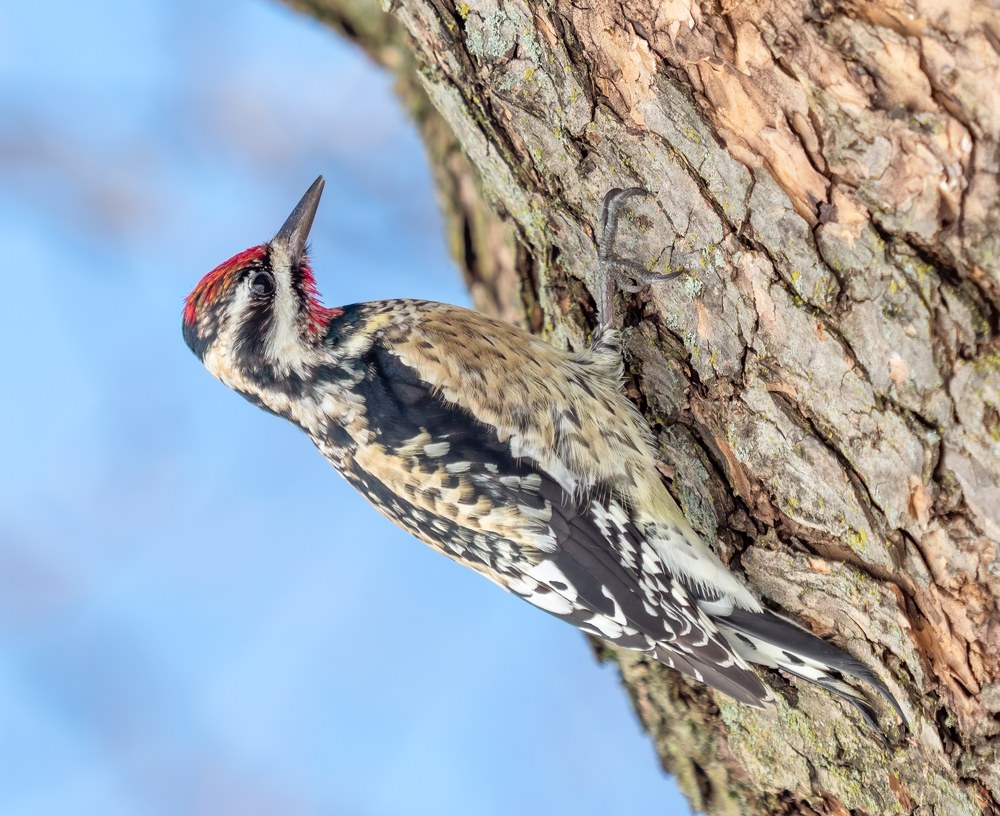
Yellow-bellied Sapsucker
- Habitat
- Deciduous and mixed deciduous-conifer forests; winters in various woodland types, orchards, parks
- Size
- 8½ in
- Lifespan
- Banding recoveries put maximum known wild lifespan at roughly 7 to 8 years.
- Diet
- Sap, fruit, and berries
About the Yellow-bellied Sapsucker
The Yellow-bellied Sapsucker is a furtive, medium-sized woodpecker mottled in black and off-white, with a red patch on the forehead and a pale yellowish wash across the belly that gives the species its name. It is sexually dimorphic in a way many woodpeckers are not: males show a red throat in addition to the red forehead, while females have a white throat, making the sexes readily distinguishable at a glance. A bold white stripe down the folded wing is visible both at rest and in flight, and the species' generally quiet, motionless habits at rest, often clinging low on a trunk rather than actively hitching about, add to its reputation as one of the more easily overlooked woodpeckers despite its distinctive markings.
Unlike most North American woodpeckers, which tend to stay put through the winter, the Yellow-bellied Sapsucker is a true migrant, breeding in deciduous and mixed deciduous-conifer forest and moving south to a wider variety of woodland types, orchards, and parks for the winter months, with Oklahoma lying within its winter range as birds pass through or settle in for the colder months. Its most distinctive behavior is the drilling of neat, evenly spaced rows of shallow holes -- sap wells -- into the bark of a chosen tree. Rather than eating the wood itself, the bird returns to these wells again and again to lap up the flowing sap and to pick off insects that the sap attracts, and it actively defends a productive sap tree from other birds, including other sapsuckers. A single well-chosen tree may be tended for weeks or even returned to across successive winters, and the bird typically maintains several such wells simultaneously, rotating among them as sap flow slows at any one site.
Those sap wells ripple outward through the local food web in a way most people never notice: hummingbirds and a variety of other birds and insects are known to visit active sapsucker wells to feed on the sap themselves, effectively riding on the sapsucker's engineering, and in regions where the two overlap in spring, some hummingbird migration timing has even been linked to the availability of sapsucker wells as an early nectar-like food source. Nestlings are raised mostly on insects gathered near these wells rather than on sap directly. Banding recoveries put the maximum known wild lifespan at roughly 7 to 8 years, and the neat rows of drill holes it leaves behind on tree trunks often remain long after the bird itself has moved on, a lasting signature of its feeding habits.
Like other woodpeckers, the Yellow-bellied Sapsucker drums on resonant surfaces to communicate, but its drumming has a recognizably irregular, stuttering rhythm rather than the steady roll typical of most woodpecker species, making it possible to identify the bird by sound alone even before it comes into view. This distinctive Morse-code-like drumming pattern also functions in territory defense and pair communication on the breeding grounds, much as steady drumming does in other woodpecker species, even though wintering birds in Oklahoma are more often detected by their sap wells or a soft, cat-like mewing call than by drumming itself. Repeated sap-well drilling on the same favored trees, sometimes returned to across multiple seasons, can leave visible scarring that persists on the trunk for years, occasionally forming rings of healed-over holes that mark a tree as a long-term favorite.
Frequently asked questions
What are sap wells and why does the Yellow-bellied Sapsucker drill them?
They are neat rows of shallow holes drilled in bark; the bird returns to feed on the sap and on insects the sap attracts.
How can you tell a male Yellow-bellied Sapsucker from a female?
Males have a red throat in addition to the red forehead patch, while females have a white throat.
Do other animals benefit from sapsucker wells?
Yes, hummingbirds and various other birds and insects are known to feed at active sap wells drilled by sapsuckers.
Is the Yellow-bellied Sapsucker migratory?
Yes, unlike most North American woodpeckers it migrates, breeding in northern forests and wintering farther south.
How do you know a Yellow-bellied Sapsucker is nearby if you don't see it?
Look for neat rows of small drilled holes in tree bark, or listen for its irregular, stuttering drumming and soft mewing call.
Where to find it
This species favors forest habitat. See real Oklahoma locations on the Habitats map.