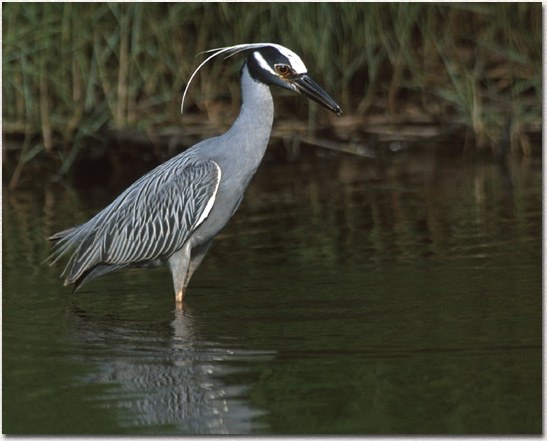
Yellow-crowned Night Heron
- Habitat
- Tidal mudflats, mangrove swamps, cypress swamps, marshes, riverbanks, lakes, lagoons, lush swamps, rocky shores
- Size
- 22–27 in (length only)
- Lifespan
- Longevity data are limited; the oldest banded bird on record was about 6 years old.
- Diet
- Crustaceans mainly (especially crayfish, crabs), also lower vertebrates, fish, insects, leeches, young birds
About the Yellow-crowned Night Heron
A stocky, thick-necked heron of quiet wetlands, the Yellow-crowned Night Heron shows a slate-gray body, a boldly striped black-and-white face, and a pale yellowish crown patch that gives the species its name. Its bill is noticeably heavier than that of most herons its size, an adaptation well suited to handling the hard-shelled prey that makes up much of its diet. Juveniles look quite different from adults, appearing brown overall and heavily marked with pale spots, and it takes a few years of gradual molting before a young bird acquires the clean adult pattern; observers unfamiliar with this immature plumage sometimes mistake young birds for a different species entirely, or confuse them with young Black-crowned Night Herons, which show a similar brown, spotted juvenile plumage.
The species favors a range of wetland habitats often close to salt or brackish water -- tidal mudflats, mangrove swamps, cypress swamps, marshes, riverbanks, lakes, lagoons, and even rocky shores -- reflecting a diet built heavily around crustaceans. Crayfish and crabs in particular make up the bulk of its food, cracked open with that heavier bill, supplemented by other small vertebrates, fish, insects, and leeches. Rather than actively chasing prey through the water, the Yellow-crowned Night Heron typically stands motionless or moves with slow, deliberate steps, waiting for prey to come within striking range before lunging with its bill, a stalking style shared broadly among herons but honed here toward probing crevices and burrows where crayfish and crabs hide during the day.
Despite the "night heron" name, the species is regularly active during daylight hours as well, a detail worth noting since the common name suggests an exclusively nocturnal lifestyle that does not fully match its real habits; it does tend to become noticeably more active around dusk and through the night, particularly in areas with heavier daytime disturbance, shifting its feeding schedule to some degree with the tide cycle in coastal habitats where crustacean prey becomes accessible as mudflats are exposed. It flies with strong, graceful wingbeats between feeding areas and communal tree roosts, where it often gathers with other herons, and it typically forages alone or in loosely spaced groups rather than in the tight feeding flocks sometimes seen in egrets, defending an individual feeding territory against other night herons when prey is concentrated in a good spot.
Longevity data for the species remain limited compared with many other herons, with the oldest banded bird on record reaching only about 6 years, though this may reflect a smaller pool of banding studies rather than a genuinely short natural lifespan. Compared with the more colonial Black-crowned Night Heron, the Yellow-crowned Night Heron tends to hunt more independently and is somewhat more specialized on crustacean prey, a difference that likely reduces direct competition between the two similar-looking species where their ranges and habitats overlap. Its flight, often described as strong and graceful compared with the somewhat heavier wingbeats of other herons, allows it to move efficiently between scattered foraging sites and communal roosts each day.
Because much of its preferred crayfish and crab prey is more active or accessible after dark or around the tide's turn, the species' feeding schedule is probably better described as flexible and prey-driven than as strictly nocturnal or diurnal, shifting with local conditions rather than following a fixed daily pattern. In coastal marshes it is not unusual to see a Yellow-crowned Night Heron standing motionless at a burrow entrance for long stretches, waiting for a crab to emerge, a patient hunting style that rewards stillness over the more active wading and stalking used by many other heron species.
Frequently asked questions
Is the Yellow-crowned Night Heron only active at night?
No, despite the name it is frequently seen hunting during the day as well as at night.
What does a Yellow-crowned Night Heron mainly eat?
Crustaceans, especially crayfish and crabs, which its unusually heavy bill is well suited to crushing.
How does a Yellow-crowned Night Heron hunt?
It typically stands still or moves slowly through shallow water, waiting for prey to come close before striking rather than actively chasing it.
Do young Yellow-crowned Night Herons look like adults?
No, juveniles are brown and heavily spotted, gradually acquiring the adult's gray body and striped face over a few years.
How is the Yellow-crowned Night Heron different from the Black-crowned Night Heron?
It tends to forage more independently, feeds more heavily on crustaceans, and shows a bolder black-and-white face pattern with a heavier bill than its more colonial relative.
Where to find it
This species favors wetland habitat. See real Oklahoma locations on the Habitats map.