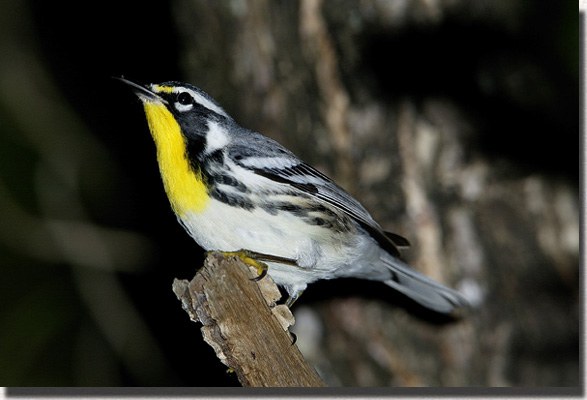
Yellow-throated Warbler
- Habitat
- Mature forests with tall trees, especially pines and sycamores near water
- Size
- Length about 5.25 in (13 cm), wingspan around 8.25 in (21 cm)
- Lifespan
- Specific figures are not well documented for this species
- Diet
- Insects and spiders gleaned from bark and foliage
About the Yellow-throated Warbler
The Yellow-throated Warbler is a gray-backed warbler with a bright yellow throat and upper breast, a bold black-and-white facial pattern, and a distinctive white patch on the side of the neck. Its bill is somewhat longer and slightly down-curved compared to most warblers, an adaptation suited to its preferred foraging method of probing bark crevices rather than gleaning leaves, and its overall shape, with a relatively long bill and a habit of creeping along branches, gives it a slightly more elongated, less delicate look than many of the small, active warblers it shares woodlands with.
It breeds across much of the southeastern United States, including Oklahoma, favoring mature woodlands with tall pines or sycamores, especially in riparian corridors near streams and rivers, and it winters along the Gulf Coast, in the Caribbean, and in parts of Central America. Within Oklahoma, birds are most reliably found in gallery forest along wooded river bottoms, where tall sycamores offer both foraging substrate and, often, nesting sites, and the species' close association with this narrow band of habitat makes it a good deal more local in distribution than many other breeding warblers in the state.
Unlike many warblers that primarily glean insects from leaves, the Yellow-throated Warbler forages methodically along tree trunks and branches, creeping over bark and probing into crevices and clusters of pine needles with its longer bill, a technique that brings it more into resemblance with nuthatches than with typical warblers foraging in the outer foliage. It will also work along horizontal branches high in the canopy, sometimes hanging upside down briefly to reach into a cluster of needles or a curled piece of bark, and it forages more deliberately and less restlessly than many small warblers, spending noticeably longer at each foraging spot before moving on.
The species builds its nest high in trees, often making use of clumps of pine needles, Spanish moss, or similar cover where available to help conceal it, and it is notable as one of the earlier-arriving warbler species each spring within its breeding range, often returning well before many other neotropical migrants, sometimes by several weeks. This early arrival is thought to reflect the fact that some individuals winter closer to their breeding range than many other warblers that travel all the way to South America, shortening the return trip considerably. Males typically begin singing a clear, ringing song of descending whistled notes soon after arrival, often from high in a favored pine or sycamore, well before females have arrived on the breeding grounds, and this early, persistent singing makes the species one of the more identifiable warblers by ear in Oklahoma's river-bottom woodlands each spring, even when the bird itself stays frustratingly high in the canopy. This early arrival, combined with its preference for tall trees near water, makes it a somewhat predictable, if not always easy to spot, presence in suitable Oklahoma woodlands each breeding season.
Pairs typically raise a single brood over the course of the breeding season, with both adults helping to feed nestlings once they hatch, and family groups can sometimes be spotted foraging together along the same stretch of trunk or branch shortly after fledging. Fall migration tends to be similarly compressed, with many birds departing Oklahoma well before the broader wave of warbler migration peaks in the state, so a birder hoping to see one is generally better served by visiting suitable river-bottom woodland in spring or early summer than by searching for a stray migrant later in the season.
Frequently asked questions
What kind of trees does the Yellow-throated Warbler prefer?
It favors tall pines and sycamores, especially near water.
How does the Yellow-throated Warbler forage differently from most warblers?
It creeps along bark and probes crevices with its longer, slightly curved bill, more like a nuthatch than a typical warbler.
Is the Yellow-throated Warbler an early migrant?
Yes, it is among the earlier warblers to return north in spring within its breeding range.
Where does the Yellow-throated Warbler spend winter?
Along the Gulf Coast, in the Caribbean, and in parts of Central America.
How can you find a Yellow-throated Warbler if it's high in the canopy?
Listen for its clear, ringing song of descending whistled notes, often given from high in a pine or sycamore soon after it arrives in spring.
Where to find it
This species favors forest habitat. See real Oklahoma locations on the Habitats map.