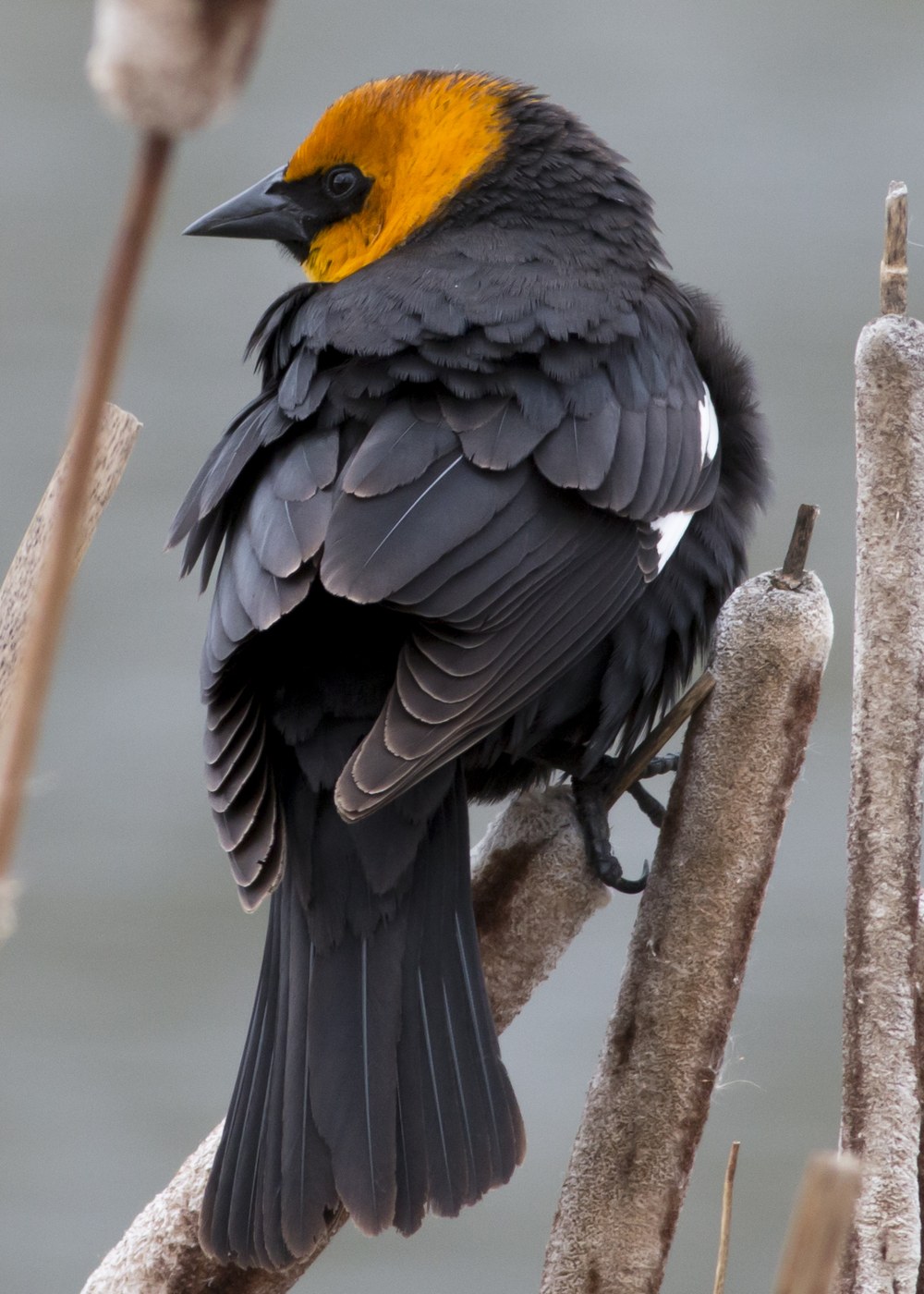
Yellow-headed Blackbird
- Habitat
- Freshwater marshes with cattails or bulrushes
- Size
- Length about 9-10 in (23-25 cm), wingspan around 16-17 in (41-43 cm)
- Lifespan
- Banding records for the species have reached roughly 8-11 years
- Diet
- Insects during the breeding season, seeds and waste grain the rest of the year
About the Yellow-headed Blackbird
The male Yellow-headed Blackbird is a striking marsh bird, black overall except for a bright yellow head and breast and a bold white patch on the wing, visible especially in flight. Females and immature birds are far duller, brownish overall with a muted yellow wash on the throat and breast, lacking the male's bold pattern and making them considerably harder to identify at a glance; young males in their first fall can show a confusing intermediate look, with patchy yellow and black feathering that does not yet match either the full adult male pattern or the female's more uniform brown.
The species breeds in freshwater marshes across the western and central United States and Canada, including scattered wetland sites in Oklahoma, and it winters primarily in Mexico and the southwestern United States. Outside the breeding season it often gathers into large mixed flocks with other blackbird species, sometimes numbering in the thousands, and these flocks can be spectacular to watch as they wheel together over open fields or wetlands at dusk before settling into a communal roost, a behavior widely shared among blackbirds and starlings that likely offers safety in numbers against predators.
Its diet shifts seasonally, from a heavy reliance on insects during the breeding season, when protein is especially important for raising young, to seeds and waste agricultural grain during migration and winter, when it frequently forages in open fields alongside other blackbirds. During the breeding season, males spend considerable time and energy foraging for aquatic insects such as dragonfly and damselfly larvae to provision nestlings, and this dietary shift tracks the broader pattern seen across many blackbird and grackle species, which favor protein-rich food when raising young and shift toward a more grain- and seed-based diet once that demand eases.
Males are strongly polygynous, defending prime territories within marsh vegetation and attempting to attract and mate with multiple females, whose nests are built low over open water, woven onto standing reeds or cattail stalks for support and some protection from ground predators. Because the best marsh territories can support several females each, a male's breeding success depends heavily on securing and holding a productive stretch of cattails or bulrushes, and competition among males for these prime territories can be intense, with older, more experienced males typically holding the best sites. The male's call is often described as one of the harshest and least musical sounds among North American songbirds, frequently compared to a rusty hinge or gate, a stark contrast to its brilliant appearance, and this unmusical, grinding song is delivered from a prominent cattail perch as part of the same territorial display that helps a male advertise and defend his patch of marsh against rival males.
In the mixed post-breeding and winter flocks the species frequently joins, it often associates with Red-winged Blackbirds, cowbirds, grackles, and starlings, foraging together across open agricultural fields and feedlots by day before returning to a shared roost in marsh vegetation at night, a pattern typical of blackbirds generally and one that can make picking a single Yellow-headed Blackbird out of a large, wheeling flock genuinely challenging without the male's unmistakable yellow head to anchor the search. As with many marsh-nesting blackbirds, ongoing loss and drainage of wetland habitat across its breeding range is generally considered the species' most significant long-term conservation concern, since its nesting success depends so directly on the availability of dense, undisturbed cattail and bulrush stands over open water.
Frequently asked questions
Are Yellow-headed Blackbirds common in Oklahoma?
They occur mainly as migrants and local breeders in scattered marsh habitat, generally less widespread than Red-winged Blackbirds.
What does the Yellow-headed Blackbird sound like?
Its call is a harsh, grating sound often compared to a rusty hinge or gate.
Do male and female Yellow-headed Blackbirds look alike?
No, males have a bright yellow head and breast with a black body and white wing patch, while females are duller brown with muted yellow.
Where do Yellow-headed Blackbirds nest?
In dense marsh vegetation such as cattails and bulrushes, with nests woven and attached over open water.
Why do male Yellow-headed Blackbirds compete so intensely for territory?
Because males are polygynous and a productive marsh territory can attract several mates, so holding the best cattail stands greatly increases a male's breeding success.
Where to find it
This species favors wetland habitat. See real Oklahoma locations on the Habitats map.