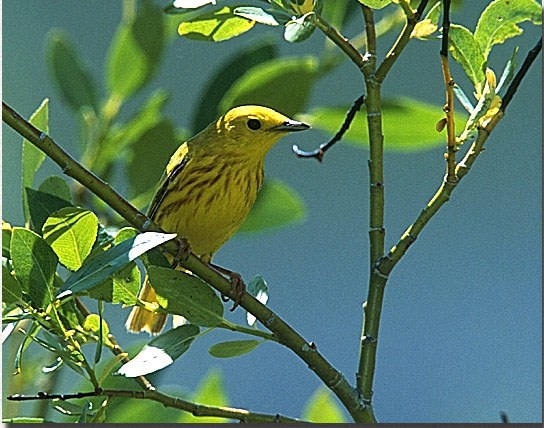
Yellow Warbler
- Habitat
- Marshes, swamps, streamside groves, willow and alder thickets, open woodlands with thickets, orchards, gardens, coastal mangroves
- Size
- 4½–5 in
- Lifespan
- One of the longer-lived warblers on record, with banded individuals reaching about 11 years old.
- Diet
- Insects, worms, and a few berries
About the Yellow Warbler
Among the most recognizable of the wood-warblers, the Yellow Warbler is washed in yellow from head to tail, with males adding fine chestnut streaking across the breast that females typically lack or show only faintly. One detail separates it from every other largely yellow warbler: its tail spots are yellow rather than white, a small but reliable field mark for careful observers. The species also shows considerable geographic variation across its very wide range, with subtle plumage differences distinguishing populations from Alaska to the tropics; in Mexico, Central America, and along the Caribbean and Pacific coasts, resident populations sometimes called "Mangrove Warblers" show males with a full chestnut cap rather than simple breast streaking, a difference striking enough that these tropical forms were once considered by some to be a separate species before their close relationship to the familiar North American breeding birds was better understood.
Yellow Warblers favor wet, shrubby habitat -- marshes, swamps, streamside groves, willow and alder thickets, orchards, gardens, and coastal mangroves -- and forage actively through this vegetation for insects, worms, and occasional berries, typically gleaning prey directly from leaves and stems rather than catching it in flight, though a foraging bird will often hover briefly at a leaf tip or make a short sally to snatch a flying insect when the opportunity arises. This wide habitat tolerance, paired with an equally broad range, has made the Yellow Warbler one of the most widely distributed warblers in the Americas, and in much of its breeding range it is genuinely common rather than merely present, often the most numerous warbler in suitable willow-lined habitat.
The species is best known, however, for its running battle with the Brown-headed Cowbird, a brood parasite that lays its eggs in other birds' nests. The Yellow Warbler is a favorite cowbird target, but rather than simply raising the cowbird chick at the expense of its own young, it has evolved a countermeasure: building a new nest floor directly over a parasitized clutch and starting over, burying the cowbird egg along with its own. Persistent cowbirds sometimes prompt several rounds of this response in a single season, and nests with as many as six stacked layers have been documented, a striking record of repeated parasitism attempts. The nest itself is a tidy, compact cup of grasses, plant down, and bark strips, usually built low in the upright fork of a shrub or small tree and lined with fine plant fibers and animal hair, and females do the great majority of the building, sometimes completing a replacement nest floor in only a day or two when pressed to renest quickly after a cowbird has found the first attempt. Despite these repeated setbacks, Yellow Warblers are comparatively long-lived among warblers, with banded individuals reaching about 11 years of age, and pairs in favorable habitat may raise more than one brood across a single breeding season.
The male's cheerful, rapid song is often rendered by birders with the mnemonic "sweet sweet sweet, I'm so sweet," a simple phrase that captures the bright, upbeat quality of a voice heard throughout its breeding range each spring and summer. Combined with its widespread distribution across nearly every U.S. state and Canadian province at some point in the year, that familiar song has made the Yellow Warbler one of the more approachable warblers for beginning birders to learn by ear. In Oklahoma the species passes through as a migrant and also breeds locally along willow-lined streams and wetland edges, generally arriving in numbers by mid-to-late April, among the earlier wood-warblers to return each spring, and lingering into September during the return trip south. Because so much of its preferred breeding habitat lies along streams, rivers, and wetland margins, the species is considered a good general indicator of riparian habitat health, and the loss or degradation of streamside willow thickets is generally regarded as the main long-term threat to otherwise still-abundant populations.
Frequently asked questions
How can you tell a Yellow Warbler from other yellow warblers?
It is the only largely yellow warbler with yellow, rather than white, tail spots.
How does the Yellow Warbler deal with cowbird eggs in its nest?
It often builds a new nest floor over the parasitized clutch and starts again, sometimes resulting in nests with several stacked layers.
What habitat does the Yellow Warbler prefer?
Wet, shrubby areas such as marshes, streamside thickets, willow and alder groves, and coastal mangroves.
How long do Yellow Warblers live?
They are among the longer-lived warblers, with banded individuals reaching about 11 years old.
Are there different types of Yellow Warblers?
Yes, tropical resident populations sometimes called "Mangrove Warblers" have males with a full chestnut cap rather than simple breast streaking, though they are considered part of the same widespread species.
Where to find it
This species favors wetland habitat. See real Oklahoma locations on the Habitats map.