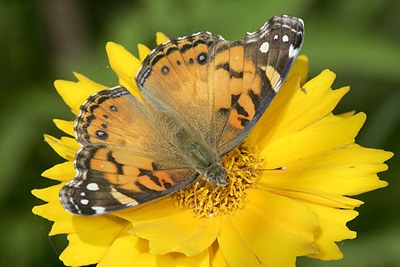
American Lady
- Habitat
- Open areas with low vegetation: dunes, meadows, parks, vacant lots, forest edges
- Size
- 1¾–2⅝ in (4.5–6.7 cm)
- Lifespan
- Adults typically live about 2 to 4 weeks.
- Diet
- Caterpillar: sunflower family — sweet everlasting, pearly everlasting, plantain-leaved pussytoes, wormwood, ironweed, burdock. Adult: nectar almost exclusively — dogbane, aster, goldenrod, marigold, selfheal, common milkweed, vetch
About the American Lady
The American Lady (Vanessa virginiensis) is a mid-sized brushfoot butterfly measuring 1¾ to 2⅝ inches across the wings. Its upperside is a warm orange-brown patchwork broken by black bars and blotches, with a few small white spots set into the black forewing tip. The best field mark, though, is on the underside of the hindwing: two large eyespots ringed in blue and black, compared to the four small eyespots of the very similar Painted Lady. The rest of the underside is a soft, marbled mix of olive, rose, and cream, with fine cobweb-like lines near the wing margins that help a resting butterfly disappear against dry leaves or bark.
This species favors open, low-growing habitats rather than deep woodland: sandy dunes, meadows, city parks, vacant lots, and the sunny edges of forests all suit it well. It ranges across most of North America, from southern Canada down through the United States into Mexico, and is a familiar sight in gardens as long as sunny, flowery patches of open ground are nearby.
Caterpillars are picky feeders, restricted to plants in the sunflower family, especially sweet everlasting and pearly everlasting, along with plantain-leaved pussytoes, wormwood, ironweed, and burdock. Rather than roaming freely, each caterpillar draws leaves together with silk into a loose nest, feeding and resting hidden inside while it grows. Adults, by contrast, are generalist nectar-feeders, visiting dogbane, aster, goldenrod, garden marigold, selfheal, common milkweed, and vetch in search of sugar-rich flowers.
Male American Ladies are territorial in the afternoon, perching on hilltops or atop low vegetation to watch for passing females and chase off rival males, a behavior called hilltopping. Adults typically survive only two to four weeks, but the species overwinters as a hibernating adult rather than migrating away entirely, allowing it to be among the first butterflies seen on warm late-winter days in much of its range.
Older references sometimes call the species the Painted Beauty, a nod to its intricate underwing pattern. Its range stretches from southern Canada through the entire continental United States and into Mexico, and though most individuals overwinter locally as adults, some populations shift southward in autumn much as the closely related Painted Lady does, before returning north again the following year.
Frequently asked questions
How can I tell an American Lady from a Painted Lady?
Check the underside of the hindwing: the American Lady has two large eyespots, while the Painted Lady has four small ones.
What do American Lady caterpillars eat?
They feed on sunflower-family plants such as sweet and pearly everlasting, pussytoes, wormwood, ironweed, and burdock, hiding inside silk-tied leaf nests as they grow.
Where is the best place to spot an American Lady?
Look in open, sunny areas with low vegetation, such as meadows, dunes, parks, vacant lots, and forest edges.
Does the American Lady migrate south for winter?
No, unlike some of its relatives it typically hibernates as an adult through winter rather than migrating away.
Where to find it
This species favors grassland habitat. See real Oklahoma locations on the Habitats map.