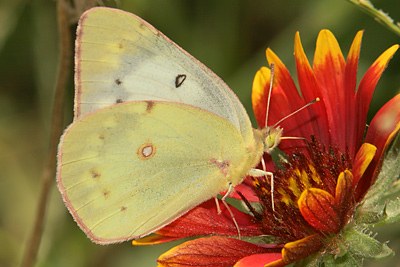
Orange Sulphur
- Habitat
- Clover/alfalfa fields, mowed fields, vacant lots, meadows, road edges
- Size
- 1⅜–2¾ in (3.5–7 cm)
- Lifespan
- Adults typically live 2 to 4 weeks, though a late generation can overwinter as an adult farther south.
- Diet
- Host: pea family — alfalfa, white clover, white sweet clover. Nectar: dandelion, milkweeds, goldenrods, asters
About the Orange Sulphur
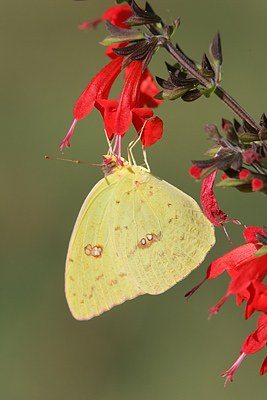
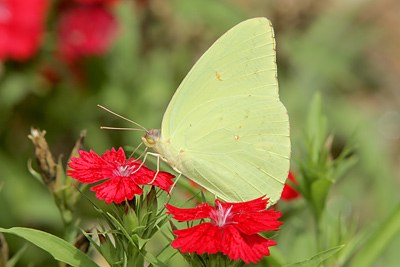
The Orange Sulphur closely parallels its relative the Clouded Sulphur in size and life history but wears warmer colors: males show a bright orange upperside bordered in black, while females come in orange or pale whitish forms, both with the black border interrupted by light spots. A small silvery spot rimmed in pink typically marks the underside of the hindwing, and the two species frequently overlap in range and habitat, sometimes even hybridizing where their populations meet, which can make some individuals difficult to assign confidently to one species or the other in the field.
Orange Sulphurs favor open agricultural and disturbed ground: clover and alfalfa fields, mowed pastures, vacant lots, meadows, and road edges. Like the Clouded Sulphur, this species has spread widely alongside the cultivation of alfalfa and clover as livestock forage, making it one of the most frequently encountered butterflies in farmland and suburban edges across the United States and southern Canada.
Host plants are drawn from the pea family, chiefly alfalfa, white clover, and white sweet clover, and caterpillars feed on the foliage, often resting along the midrib of a leaf where their green coloring blends in closely with the plant tissue. Adults nectar at a noticeably wide range of flowers, including dandelion, milkweeds, goldenrods, and asters, but much of their actual feeding activity happens after dark or in low light, an unusual pattern among day-flying butterflies that may reduce competition with the many other pollinators visiting the same flowers by day.
Males patrol open fields searching for receptive females rather than perching and waiting, covering ground steadily in a low, purposeful flight. Once mated, females lay their eggs singly on host leaves. The chrysalis is the overwintering stage for most of the population, allowing the species to resume flight quickly each spring, though in the warmer parts of its southern range a late-season generation can survive the winter as an adult, giving Orange Sulphurs an unusually flexible life cycle compared to many of their sulphur relatives. Adults generally live two to four weeks, long enough to mate and lay several batches of eggs, and because several overlapping generations fly across the warm season, all life stages, egg, caterpillar, chrysalis, and adult, can often be found simultaneously in a single field by midsummer.
Frequently asked questions
How do you tell an Orange Sulphur from a Clouded Sulphur?
Orange Sulphurs show orange on the upperside where Clouded Sulphurs show yellow, though the two species are close relatives and sometimes hybridize.
What plants do Orange Sulphur caterpillars eat?
They feed on pea-family plants, primarily alfalfa, white clover, and white sweet clover.
Is it true this butterfly feeds mostly at night?
Adults do much of their actual feeding at night or in dim light, even though they fly and mate during the day.
How does the Orange Sulphur survive winter?
Most individuals overwinter as a chrysalis, though a late-season generation in the far south can survive winter as an adult butterfly.
Where to find it
This species favors grassland habitat. See real Oklahoma locations on the Habitats map.