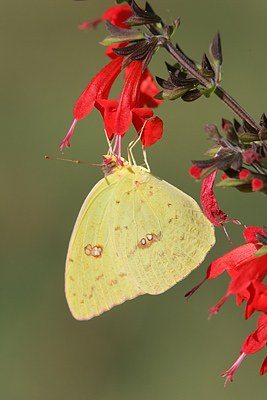
Clouded Sulphur
- Habitat
- Open areas: fields, lawns, alfalfa/clover fields, road edges, meadows
- Size
- 1½–2¾ in (3.8–7 cm)
- Lifespan
- Adults are short-lived, often under a week and rarely past two or three weeks.
- Diet
- Host: legumes — alfalfa, white clover, pea species. Nectar: many plants (not further specified)
About the Clouded Sulphur
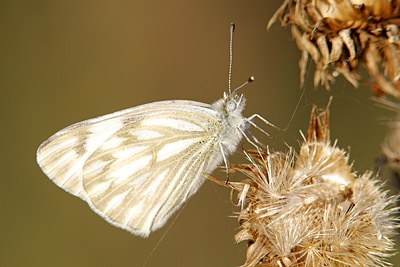
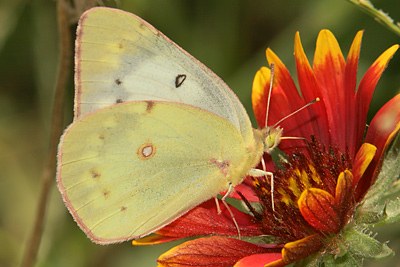
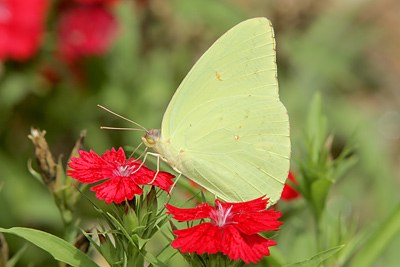
The Clouded Sulphur is one of the most familiar yellow butterflies across North America, a mid-sized species spanning 1½ to 2¾ inches. Males are a clean, clear lemon yellow with a solid black wing border, while females are more variable, appearing either yellow or nearly white (a form entomologists call "alba"), with the black border broken into a row of pale spots. Both sexes typically show a small silvery, pink-rimmed spot on the underside of the hindwing, a helpful field mark when the butterfly rests with wings closed. In flight, the species has a fluttering, somewhat erratic pattern low over the vegetation, quite different from the more purposeful, direct flight of larger butterflies sharing the same fields.
This species thrives in open, sunny, disturbed habitats: hayfields, lawns, alfalfa and clover fields, roadsides, and meadows, essentially anywhere its legume host plants take hold. Because alfalfa and clover are widely cultivated forage crops, the Clouded Sulphur has benefited enormously from agriculture and is now common across most of the continent, often flying alongside its close relative the Orange Sulphur.
Caterpillars feed on legumes, particularly alfalfa, white clover, and various pea species, chewing leaves rather than flowers. Adults are not picky nectar feeders and will visit a broad range of flowering plants, and males can often be seen gathering at damp soil or puddles, a behavior called puddling that supplies them with salts and minerals not available from nectar alone. Females lay their eggs singly on host leaves, spacing out the next generation rather than clustering offspring in one place.
The species overwinters in its third larval instar, a partly grown caterpillar that pauses development through the cold months and resumes feeding once temperatures rise in spring. This strategy allows Clouded Sulphurs to produce multiple generations each year, roughly three flights from May through October in northern parts of its range, and four to five flights stretching from March into November farther south. Adults themselves are short-lived, often surviving less than a week and rarely more than two or three, so the species relies on rapid generational turnover rather than adult longevity to stay abundant through the warm months.
Clouded Sulphurs share much of their range with the closely related Orange Sulphur, and the two species hybridize readily where they overlap, producing intermediate individuals with a faint orange wash that can frustrate even careful observers trying to assign a single field identification. Courtship itself relies heavily on chemical cues: males release pheromones from specialized wing scales that a receptive female can detect at close range, and a female that has already mated typically signals her unavailability by fluttering her wings or lifting her abdomen to reject a pursuing male. At night and during poor weather, adults roost low in grass or weedy cover, wings closed, where their pale undersides blend into the surrounding vegetation. Like most small butterflies, Clouded Sulphurs face heavy predation pressure from birds, crab spiders lying in ambush on flowers, and parasitoid wasps and flies that attack the egg or caterpillar stage, and it is this pressure, more than adult mortality, that shapes population numbers from one generation to the next. Because it visits such a wide range of blooms, the species also functions as a minor but genuine pollinator of the same clover and alfalfa fields that sustain its caterpillars.
Frequently asked questions
How can you tell a male from a female Clouded Sulphur?
Males are solid clear yellow with an unbroken black border, while females are yellow or whitish with the black border broken up by pale spots.
What do Clouded Sulphur caterpillars eat?
They feed on legume leaves, especially alfalfa, white clover, and other pea-family plants.
How does this species survive the winter?
It overwinters as a partly grown, third-instar caterpillar that becomes dormant until spring warmth returns.
How many generations does it produce in a year?
About three flights per year in the north and four to five farther south, spanning spring through fall.
Does the Clouded Sulphur hybridize with other sulphurs?
Yes, it interbreeds with the closely related Orange Sulphur where their ranges overlap, producing intermediate individuals with a faint orange wash that can complicate identification.
Where to find it
This species favors grassland habitat. See real Oklahoma locations on the Habitats map.