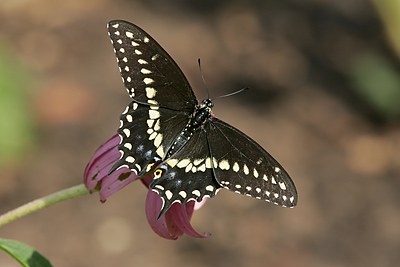
Black Swallowtail
- Habitat
- Variety of open areas: fields, suburbs, marshes, deserts, roadsides
- Size
- 3¼–4¼ in (8–11 cm)
- Lifespan
- Adults usually survive roughly 10 to 12 days, occasionally longer under good conditions.
- Diet
- Host: parsley family — Queen Anne's Lace, carrot, celery, dill; sometimes citrus family. Nectar: red clover, milkweed, thistles
About the Black Swallowtail
The Black Swallowtail is a familiar dark swallowtail marked by two rows of yellow spots running across otherwise black wings, along with a patch of iridescent blue on the hindwing that is more prominent in females, and a single orange eyespot with a black pupil near the tail on each hindwing. That blue patch is thought to do double duty as a form of mimicry: female Black Swallowtails resemble the toxic, foul-tasting Pipevine Swallowtail closely enough that predators which have learned to avoid the unpalatable species may also avoid Black Swallowtail females, a protective strategy known as Batesian mimicry that is thought to benefit females more than males since females spend more time flying slowly near host plants while laying eggs, a period of heightened vulnerability to predators.
Its caterpillars are just as distinctive as the adults, and they change dramatically as they grow: very young caterpillars are mottled black and white, closely resembling a bird dropping, an effective early-instar disguise, before molting into the more familiar green form banded in black with yellow spots that most people recognize. Older caterpillars are equipped with a forked, fleshy orange organ called an osmeterium that they can suddenly extrude from behind the head when disturbed, releasing a sharp, unpleasant odor meant to startle predators -- a defense shared by swallowtail caterpillars generally but especially well known in this species because of how often people encounter it in their own gardens.
That garden connection comes from the caterpillar's food plants: members of the parsley family, including Queen Anne's lace, dill, carrot, and celery, along with occasional citrus-family plants, plus a range of native wild plants in the same family, such as golden alexanders and wild parsnip, that likely served as the species' primary hosts before cultivated crops and roadside weeds became widely available. Because so many of these are common vegetable-garden crops, the Black Swallowtail is one of the more frequently noticed "pest" caterpillars among home gardeners, even though the adult butterfly is a welcome pollinator. Adults range widely across open habitats -- fields, roadsides, suburbs, marshes, and even deserts -- feeding at flowers such as red clover, milkweed, and thistles.
Males establish and defend territory by perching in open areas or on hilltops to intercept passing females, a behavior called hilltopping that concentrates otherwise widely scattered individuals at a shared high point in the landscape, or by patrolling likely habitat directly in search of a mate. Females then lay their eggs singly rather than in clusters, generally on the leaves or stems of a host plant, spreading the risk of predation across many separate locations rather than concentrating it in one spot. The species overwinters as a chrysalis attached to a plant stem or nearby structure, and the pupa itself can form in either a green or a brown color form, a difference thought to be triggered partly by the surrounding substrate and by seasonal cues, with the brown form more typical of chrysalises that will overwinter through the cold months. Adults are relatively short-lived, typically surviving only about 10 to 12 days, though multiple generations occur through the warmer months across most of the butterfly's range, keeping it a common sight from spring through fall. The Black Swallowtail holds official recognition as the state butterfly of Oklahoma, a fitting honor for a species so commonly encountered in the state's fields, roadsides, and gardens throughout the growing season.
Frequently asked questions
How does a Black Swallowtail caterpillar defend itself?
When disturbed it extrudes a forked orange organ called an osmeterium that releases a foul smell to startle predators.
Why do gardeners often see Black Swallowtail caterpillars?
Its caterpillars feed on parsley-family plants like dill, carrot, and celery, which are common in vegetable gardens.
How does a female Black Swallowtail lay her eggs?
She lays them singly on host plant leaves or stems rather than in clusters.
How long does an adult Black Swallowtail live?
Typically about 10 to 12 days, occasionally longer under good conditions.
Why does the female Black Swallowtail have more blue than the male?
Her extra blue coloring likely helps her resemble the toxic Pipevine Swallowtail, offering some protection from predators while she spends time flying slowly near host plants to lay eggs.
Where to find it
This species favors grassland habitat. See real Oklahoma locations on the Habitats map.