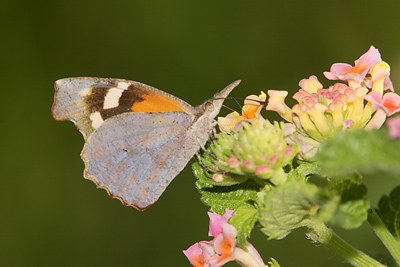
American Snout
- Habitat
- Forest clearings/edges, thorn scrub, brushy fields, roadsides
- Size
- 1⅜–2 in (3.5–5 cm)
- Lifespan
- Adult lifespan isn't well documented for this species, but likely a few weeks as with related nymphalids.
- Diet
- Host: hackberry. Nectar: aster, dogbane, dogwood, goldenrod, sweet pepperbush, others
About the American Snout
The American Snout is instantly recognizable for its long, forward-projecting labial palps, which give the impression of an elongated snout on the front of its head. Its forewings are squared off at the tip rather than rounded, and its mottled brown, orange, and white coloring gives it an overall dead-leaf appearance. At 1 1/8 to 2 inches across, it is a mid-sized butterfly whose camouflage strategy depends as much on posture as on pattern, and the short, stubby forelegs typical of this butterfly family are essentially non-functional for walking, used instead mainly for sensing. The species belongs to a small, distinctive subfamily of snout butterflies found on every continent except Antarctica, and the American Snout is the only representative of this group found north of Mexico, making it something of an isolated curiosity among North American butterflies rather than one of a larger local group of close relatives.
This species occurs in forest clearings and edges, thorn scrub, brushy fields, and roadsides across a wide swath of the United States, with populations concentrated in Texas and other parts of the south where its host plant is abundant. From this core range, it periodically expands outward in dramatic fashion during population booms, with individuals showing up well outside their usual territory in years when conditions favor an especially large generation. Several generations are produced each year across the warmer part of its range, and because development from egg to adult can proceed quickly under good conditions, populations are capable of expanding rapidly whenever a flush of fresh hackberry growth follows good rain, setting the stage for the periodic outbreaks the species is known for.
Caterpillars feed exclusively on hackberry trees, generally favoring young, tender leaves over tougher mature foliage, and adults nectar at a range of flowers including aster, dogbane, dogwood, goldenrod, and sweet pepperbush. The tight dependence on a single host genus means the butterfly's numbers can swing widely based on hackberry growth conditions from year to year, particularly rainfall patterns in its core range; a drought that stresses hackberry trees followed by a soaking rain that triggers a flush of new leaf growth appears to be the classic recipe behind the species' famous population explosions.
When at rest, the American Snout perches on branches and holds its palps and antennae downward, completing a remarkably convincing impression of a dead, curled leaf still attached to a twig, an effective defense against visually hunting predators; even the chrysalis, marked with a leaf-like ridge along one side, continues this same theme of leaf mimicry through the pupal stage. Perhaps the species' most famous behavior, however, is its capacity for enormous migratory movements: under the right conditions, especially following periods of drought broken by heavy rain in Texas, American Snouts can erupt in migrations involving staggeringly large numbers of individuals moving across the landscape together, with these mass flights sometimes numbering in the tens of millions and drawing widespread public and media attention on the rare occasions they occur. In the southern part of its range, adults overwinter directly rather than passing the cold months as an egg, caterpillar, or chrysalis, a strategy shared by only a handful of North American butterflies, allowing it to resume activity on the first warm days of the year well before most other species have emerged from egg, larval, or pupal dormancy. Farther north, including in Oklahoma, the species is generally less predictable from year to year, with numbers in a given season often tracking directly with how favorable conditions were for hackberry growth and snout breeding farther south.
Frequently asked questions
Why does this butterfly have such a long "snout"?
Its elongated labial palps extend forward from the head, creating the snout-like appearance that gives the species its name.
How does it camouflage itself at rest?
It perches on branches holding its palps and antennae downward, mimicking a dead, curled leaf attached to a twig.
Is it true this butterfly can migrate in huge numbers?
Yes, American Snouts are known for occasional massive migratory eruptions, especially in Texas following drought-breaking rains.
What do the caterpillars eat?
They feed exclusively on hackberry trees.
Is the American Snout closely related to many other North American butterflies?
Not really -- it's the only northern representative of a small, mostly tropical subfamily of snout butterflies, making it something of an outlier rather than one of many similar local species.
Where to find it
This species favors grassland habitat. See real Oklahoma locations on the Habitats map.