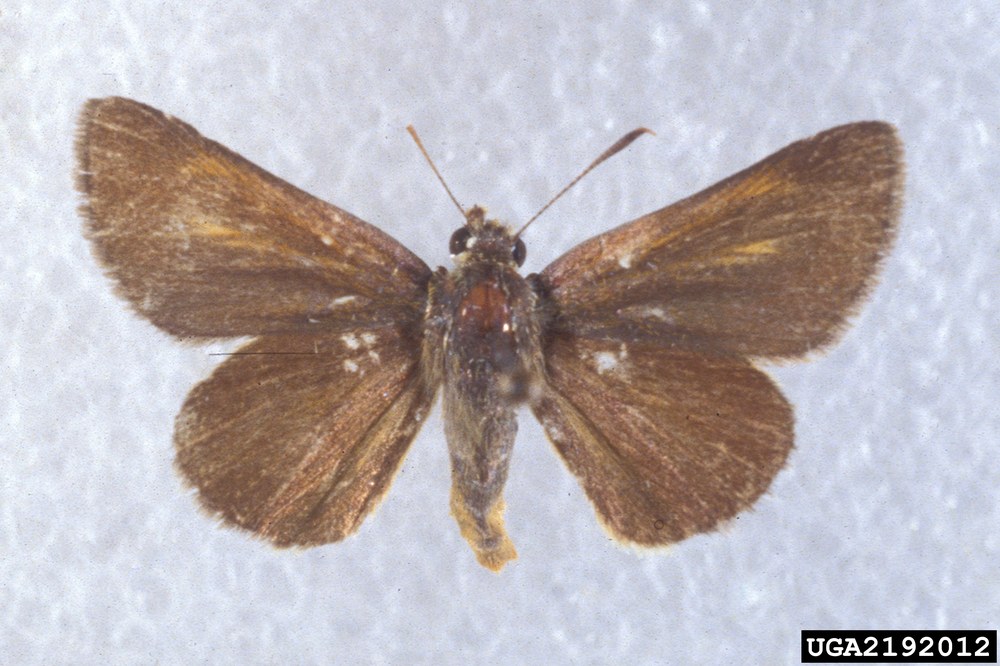
Arogos Skipper
- Habitat
- Relatively undisturbed grasslands, prairies, sand prairies, serpentine barrens
- Size
- 1 1/8–1 7/16 in (2.9–3.7 cm)
- Lifespan
- As a rare, poorly studied prairie species, exact lifespan figures aren't available; likely a few weeks.
- Diet
- Caterpillar: big bluestem, probably other native grasses. Adult: purple vetch, Canada thistle, dogbane, stiff coreopsis, coneflower, green milkweed, ox-eye daisy
About the Arogos Skipper
The Arogos Skipper is a medium-sized butterfly, spanning roughly 1 1/8 to 1 7/16 inches, with a clean yellow-orange upperside crossed by black borders that are noticeably wider and more prominent in females than in males. This sexual difference in border width is a useful field mark where the species can be compared side by side, though because it is uncommon and easily overlooked among the many similar orange-and-black grass skippers sharing its habitat, confirming an identification often benefits from a careful look at wing shape and flight behavior as well as color pattern.
Unlike many of its disturbance-tolerant relatives, the Arogos Skipper is a specialist of relatively undisturbed grasslands, occurring in native prairies, sand prairies, and serpentine barrens, all landscapes that have declined sharply from historical extent and now persist mostly as scattered remnants. This narrow habitat requirement, paired with the species' apparent rarity, makes it one of the more conservation-sensitive skippers in its range, vulnerable to the mowing, plowing, and fire-suppression changes that have altered so much native grassland.
Caterpillars feed on big bluestem and probably other native grasses as well, though the full host range has not been thoroughly documented, consistent with how poorly studied this species is relative to common, weedy skippers. Adults nectar at a broad mix of prairie wildflowers, including purple vetch, Canada thistle, dogbane, stiff coreopsis, coneflower, green milkweed, and ox-eye daisy, a nectar list dominated by native forbs typical of the same intact grassland communities the species depends on for breeding.
The life cycle includes an unusual and well-documented larval shelter-building behavior: caterpillars live in tents formed from two leaves silked together, a construction technique that offers protection from weather and predators while still allowing the caterpillar to reach out and feed on the leaf tissue nearby, a strategy broadly similar to the leaf-tying shelters built by many other grass-feeding skipper larvae. The fourth-stage caterpillar is the overwintering stage, surviving the cold season before completing development and pupating the following year inside a cocoon built from a rolled or folded leaf positioned roughly 3 feet above the ground, a modest elevation that may help the pupa avoid ground-level moisture, flooding, or foraging predators during the vulnerable, immobile pupal stage. As a rare, poorly studied prairie species, exact adult lifespan figures remain unavailable, though a few weeks is the reasonable estimate given typical skipper longevity.
Frequently asked questions
What does the Arogos Skipper look like?
It has a yellow-orange upperside with black borders that are noticeably wider in females than in males.
Where does the Arogos Skipper live?
It is a specialist of relatively undisturbed grasslands, including native prairies, sand prairies, and serpentine barrens.
What is distinctive about Arogos Skipper caterpillars?
They live in tents made of two leaves silked together, and the fourth-stage caterpillar overwinters before pupating.
Where does the Arogos Skipper pupate?
It pupates in a cocoon built from a leaf, positioned roughly 3 feet above the ground.
Where to find it
This species favors grassland habitat. See real Oklahoma locations on the Habitats map.