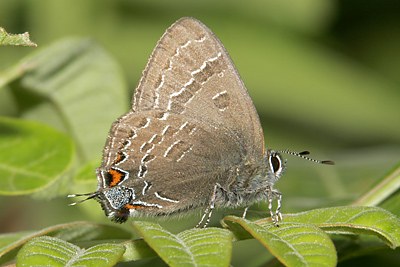
Banded Hairstreak
- Habitat
- Forest areas and adjacent open edges/fields
- Size
- 1–1½ in (2.5–3.8 cm)
- Lifespan
- Adults fly only a few summer weeks and individuals likely live about a week or two.
- Diet
- Host: oak, walnut, hickory. Nectar: dogbane, common milkweed (preferred), chinquapin, small-flowered dogwood, New Jersey tea, meadowsweet, staghorn sumac, white sweet clover, yarrow
About the Banded Hairstreak
The Banded Hairstreak is a small, gray-brown butterfly, 1 to 1 1/2 inches across, distinguished by a postmedian band of dark-edged white markings crossing the underside of the hindwing, the feature that gives the species its common name. A small orange spot sits near the blue-capped tail on the hindwing, a subtle but useful mark for separating this species from several similar-looking hairstreaks that share its range, since several Satyrium species look nearly identical without close inspection of these underside details; the Banded Hairstreak's band tends to run in a fairly straight, evenly spaced line, whereas closely related species such as the Edwards' Hairstreak or Striped Hairstreak show bands that are more jagged, offset, or broken into distinct spots, a distinction that usually requires a good photograph or a look through binoculars at a perched individual to appreciate.
That eyespot-and-tail combination near the hindwing corner is not just decorative: like many hairstreaks, the Banded Hairstreak rubs its hindwings together at rest in a slow, scissoring motion that draws a predator's eye toward the fake "head" formed by the tails and orange spot, rather than the real head at the opposite end of the body, a defensive trick that likely allows the butterfly to escape with only minor wing damage from an attack aimed at the wrong end.
Unlike many of the open-country butterflies in this group, the Banded Hairstreak is closely tied to forested landscapes, occurring in wooded areas and the open edges and fields adjacent to them. This makes it a familiar hairstreak across much of the eastern half of the continent, wherever its tree hosts are established, and it can be found in surprisingly small woodlots as long as at least one mature host tree is present. The species is generally single-brooded, with adults flying for a relatively short window in early to midsummer, typically June into July across most of its range, a pattern shared by many hairstreaks that develop on woody hosts and complete only one generation per year.
Caterpillars feed on oak, walnut, and hickory, all substantial forest trees rather than the low herbaceous plants used by many other small butterflies, which places this species firmly among the relatively small group of hairstreaks that develop on woody hosts. Adults, in contrast, are enthusiastic nectar feeders at a wide range of flowers, with common milkweed noted as a particular favorite, alongside dogbane, chinquapin, small-flowered dogwood, New Jersey tea, meadowsweet, staghorn sumac, white sweet clover, and yarrow; males will also gather at damp soil or gravel to draw minerals and salts, a behavior known as mud-puddling that is common among many butterflies, particularly males of species that mate more than once in a season.
Males take up perches on low shrubs or tree branches, watching for passing females rather than patrolling widely, a strategy well suited to life along forest edges where suitable perches are abundant. Eggs are laid on twigs of the host tree during summer, but rather than hatching right away, they remain dormant through the fall and winter, hatching the following spring in time for the caterpillars to feed on fresh new leaf growth. Adults fly for only a few summer weeks, and individual butterflies likely live no more than a week or two, making the Banded Hairstreak's above-ground presence relatively brief compared to the many months its eggs spend in dormancy, most of that time spent motionless on a bare twig through the coldest part of the year.
Frequently asked questions
Why is it called the Banded Hairstreak?
It shows a postmedian band of dark-edged white markings across the underside of the hindwing.
What trees do the caterpillars feed on?
Oak, walnut, and hickory, all woody hosts rather than the herbaceous plants many small butterflies rely on.
When do the eggs hatch?
Eggs are laid on twigs in summer but remain dormant until the following spring, hatching as the host tree leafs out.
What flower do adults seem to favor most?
Common milkweed is noted as a particular favorite nectar source, among many other flowers they visit.
Why does the Banded Hairstreak have a fake "head" on its hindwing?
The tails and orange eyespot near the wingtip mimic a head, and the butterfly rubs its hindwings together to draw a predator's attack away from its real, more vulnerable head.
Where to find it
This species favors forest habitat. See real Oklahoma locations on the Habitats map.