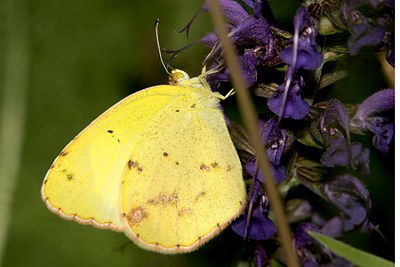
Little Yellow
- Habitat
- Dry, open areas: roadsides, sandy fields, abandoned fields, railroad tracks, occasionally open woods
- Size
- 1¼–1¾ in (3.2–4.4 cm)
- Lifespan
- Adults typically live about a week or two, occasionally longer.
- Diet
- Host: partridge pea, wild sensitive plant (pea family). Nectar: aster family — goldenrods, asters
About the Little Yellow
The Little Yellow lives up to its name as one of the smaller sulphurs found in North America, measuring just 1¼ to 1¾ inches across. Males are typically a bright, clean yellow above, while females tend toward a paler yellowish white, and both sexes show small black spots and a thin dark border along the forewing. Its diminutive size and quick, low flight often make it easy to mistake for a moving flower petal drifting across open ground, and it rarely flies far or high enough to draw much attention unless it is nectaring.
This species favors dry, open habitats: roadsides, sandy fields, abandoned agricultural land, railroad rights-of-way, and occasionally the edges of open woods. It is widespread across the southern and eastern United States, and while it can survive winters only in the warmer parts of its range, it recolonizes areas farther north each year as temperatures rise, making it a familiar late-summer sight well beyond its permanent range, with numbers usually peaking noticeably in August and September as successive generations accumulate.
Caterpillars feed on partridge pea and wild sensitive plant, both low-growing members of the pea family that thrive in the same disturbed, sunny ground the adults prefer. Adults nectar largely on aster-family flowers, particularly goldenrods and asters, which bloom abundantly in the same late-summer and fall fields where the butterfly is most numerous.
Males spend warm daylight hours actively searching for mates rather than perching in one spot, flying low and steadily over open vegetation. Once mated, females lay their eggs singly on the leaves of the host plant, and the resulting caterpillars develop relatively quickly given the short adult lifespan of about one to two weeks. Because individual generations move through so fast, the Little Yellow can produce several broods across a single warm season, with numbers often building noticeably from summer into fall as generations accumulate before cold weather finally ends the flight for the year in its northern range, at which point the population there dies out entirely until it is reestablished by new arrivals the following summer. Because of this yearly cycle of expansion and collapse, a single field can go from having no Little Yellows at all in early summer to hosting dozens by September.
The Little Yellow can be confused with several closely related small yellow sulphurs sharing parts of its southern range, including the Mimosa Yellow and Barred Yellow, and separating them reliably often requires a close look at subtle differences in the black forewing border and the pattern of small dark spots near the wing base. Males search for mates by patrolling low over open ground during the warmest hours of the day, and because the species produces so many overlapping generations each season, individuals of noticeably different sizes and slightly different wear can often be seen flying together in the same field by late summer. Predators of the caterpillars likely include birds, various ants, and parasitoid wasps that specialize on small sulphur larvae, pressures common across this whole group of fast-developing, short-lived butterflies. Because partridge pea and wild sensitive plant are both common colonizers of disturbed, sunny ground, including recently cleared land, roadside cuts, and post-fire habitat, the Little Yellow tends to track disturbance across the landscape almost as closely as its host plants do, appearing in newly favorable patches within a season or two of the ground being opened up.
Frequently asked questions
How big is a Little Yellow butterfly?
It is one of the smaller sulphurs, with a wingspan of only about 1¼ to 1¾ inches.
What plants do the caterpillars rely on?
They feed on partridge pea and wild sensitive plant, both low pea-family plants of open, disturbed ground.
Can Little Yellows survive winter in the north?
Generally not; northern populations are recolonized each year by individuals moving up from warmer southern regions.
How long does an adult Little Yellow live?
Typically about one to two weeks, occasionally a bit longer.
What other butterflies look similar to the Little Yellow?
The Mimosa Yellow and Barred Yellow are close relatives that can be confused with it; separating them usually requires a close look at the forewing border and spotting pattern.
Where to find it
This species favors forest habitat. See real Oklahoma locations on the Habitats map.