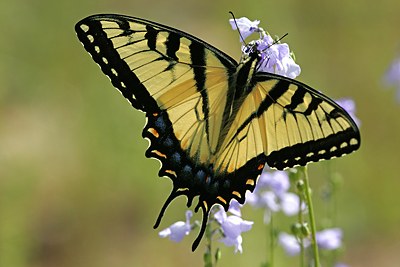
Eastern Tiger Swallowtail
Papilio glaucus
- Habitat
- Deciduous broadleaf woods, forest edges, river valleys, parks, suburbs
- Size
- 3⅝–6½ in (9.2–16.5 cm) wingspan
- Lifespan
- Adults typically fly for about 2 to 3 weeks before dying.
- Diet
- Adults: nectar (wild cherry, lilac); caterpillars: leaves of cherry, magnolia, basswood, tulip tree, birch, ash, cottonwood, mountain ash, willow
About the Eastern Tiger Swallowtail
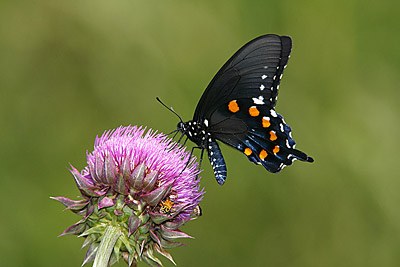
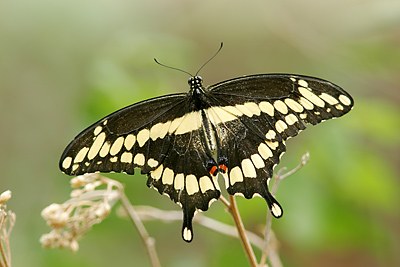
One of the most familiar large butterflies in the eastern United States, the Eastern Tiger Swallowtail is bright yellow marked with bold black tiger-stripe bands across the wings and black wing margins. Males are consistently yellow, but females occur in two distinct forms: a yellow form resembling the male, and a dark form that is largely black overall, believed to have evolved as a mimic of the toxic, unrelated Pipevine Swallowtail, gaining some protection from predators that have learned to avoid that distasteful species.
Caterpillars go through a similar disguise-driven transformation of their own. Early-stage larvae are dark and blotchy, closely resembling a fresh bird dropping on a leaf, before molting into a later stage that turns green with a pair of large, striking eyespots near the head — a combination thought to startle potential predators into hesitating just long enough for the caterpillar to escape. These caterpillars feed on the leaves of a range of trees, including wild cherry, magnolia, basswood, tulip tree, birch, ash, cottonwood, mountain ash, and willow, and shelter by day inside a small enclosure formed by folding over a leaf edge and securing it with silk.
Eastern Tiger Swallowtails are found across deciduous broadleaf woods, forest edges, river valleys, parks, and suburbs, wherever their host trees grow. Adults nectar readily at flowers such as wild cherry blossoms and lilac, and females lay their eggs singly on host leaves rather than in clusters. The species overwinters as a chrysalis and produces two generations per year across most of the north, with as many as three generations possible farther south where the growing season is longer. Individual adults typically fly for about two to three weeks before dying, a short span compensated for by the multiple, overlapping generations that keep the species on the wing from spring through late summer. The Eastern Tiger Swallowtail's popularity extends well beyond the butterfly-watching community, too — it has been named the official state butterfly or state insect in several eastern states, including Georgia, South Carolina, Virginia, and Delaware, a reflection of how widely admired its bold yellow-and-black pattern is across the region it calls home.
Male Eastern Tiger Swallowtails, like many swallowtails, gather at damp puddles, muddy roadsides, and even animal droppings to sip mineral-rich moisture, a behavior called puddling that supplies sodium and other nutrients not readily available from flower nectar and that is rarely seen in females. The hindwing tails, in addition to their visual appeal to human observers, likely serve a defensive purpose similar to the tails of small hairstreaks: fluttering conspicuously in flight, they may draw a predator's strike toward an expendable part of the wing rather than the head and body. The frequency of the dark female form varies geographically and tends to be highest in the southern part of the species' range, where it flies alongside the toxic Pipevine Swallowtail that it mimics, and lowest or absent in northern populations where the model species is scarce or absent, a pattern consistent with the mimicry serving little benefit where predators have no reason to have learned to avoid the pattern. Adult males also engage in a hilltopping mate-locating strategy in some regions, congregating on prominent high points in the landscape where they are more likely to encounter passing females, a strategy that supplements the more general patrol-flight searching typical of the species across open woodland edges.
Frequently asked questions
Why do some female Eastern Tiger Swallowtails look completely different from males?
Some females are dark, nearly all-black, a form believed to mimic the toxic Pipevine Swallowtail for protection from predators.
How does an Eastern Tiger Swallowtail caterpillar avoid predators?
Early on it resembles a bird dropping, and later it turns green with large eyespots that can startle predators.
What trees do Eastern Tiger Swallowtail caterpillars eat?
A range of trees including wild cherry, tulip tree, magnolia, birch, ash, and willow.
How many generations does the Eastern Tiger Swallowtail produce each year?
Typically two generations in the north and as many as three in the south.
Do male Eastern Tiger Swallowtails puddle at mud?
Yes, males regularly gather at damp soil, puddles, and even animal droppings to obtain sodium and other minerals not available from nectar, a behavior rarely seen in females.
Where to find it
This species favors forest habitat. See real Oklahoma locations on the Habitats map.