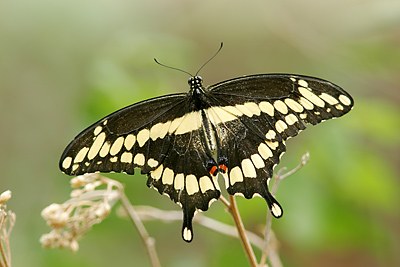
Giant Swallowtail
- Habitat
- Rocky/sandy hillsides near streams/gullies (north); pine flats, towns, citrus groves (south)
- Size
- 4–6¼ in (10.2–16 cm)
- Lifespan
- Adults generally live around 2 to 4 weeks while feeding and mating.
- Diet
- Host: citrus family — Citrus spp., prickly ash, hop tree. Nectar: lantana, azalea, bougainvillea, bouncing Bet, dame's rocket, goldenrod, Japanese honeysuckle, swamp milkweed
About the Giant Swallowtail
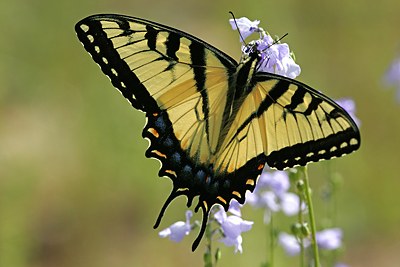
True to its name, the Giant Swallowtail is North America's largest butterfly, with dark brown-black wings crossed by a broad diagonal band of yellow spots and further yellow spotting along the margins; the underside shows an even more extensive yellow patch. Its size alone makes it hard to mistake for any other swallowtail sharing its range, and its wingbeats tend to be slower and more deliberate than those of smaller relatives.
The caterpillar stage of the Giant Swallowtail is one of the more remarkable disguises in the butterfly world: rather than blending into green foliage, the larva is mottled brown and white in a way that closely resembles a bird dropping, an unusual but effective defense that lets it rest in plain sight on a leaf without attracting a predator's attention. That caterpillar feeds on plants in the citrus family, including cultivated citrus, prickly ash, and hop tree, a habit that has earned it the nickname "orange dog" among growers and made it a recognized, if minor, pest in commercial citrus groves in the southern United States.
Habitat varies with region: in the north, adults favor rocky or sandy hillsides near streams and gullies, while in the south they are found in pine flats, towns, and citrus groves. Males patrol in search of females, which then lay single eggs on the leaves or twigs of a host plant. The chrysalis, like the caterpillar before it, relies on camouflage, resembling a broken twig closely enough to overwinter safely through cold months while attached to a branch. Adults live roughly two to four weeks, visiting flowers such as lantana, azalea, bougainvillea, and swamp milkweed for nectar while mating and laying eggs to continue the cycle. In recent decades, observers across parts of its range have noted the Giant Swallowtail expanding gradually northward, a shift many lepidopterists attribute to a warming climate opening up new territory that was previously too cold for the species and its host plants to persist through the winter months, gradually bringing North America's largest butterfly into contact with gardeners and naturalists who had never before seen one locally.
Like other swallowtail caterpillars, the Giant Swallowtail larva carries a hidden defense behind its head: a forked, fleshy organ called an osmeterium that, when the caterpillar feels threatened, suddenly everts and releases a sharp, unpleasant odor meant to startle a predator, such as a bird or a probing ant, long enough for the caterpillar to escape. Adult males search for mates by patrolling likely habitat, sometimes gathering at hilltops or other prominent landscape features where encounter rates with passing females are higher, a mate-locating strategy shared with many other large swallowtails. As the continent's largest butterfly, the Giant Swallowtail's size alone may also deter some smaller predators that would readily take a lesser butterfly, though larger birds and spiders still pose a genuine threat, especially to the more vulnerable egg and early caterpillar stages. Citrus growers who consider the species a minor pest generally control it by hand-picking the conspicuous bird-dropping-mimicking caterpillars rather than resorting to broad insecticide use, since populations in most groves remain too sparse to justify heavier intervention, and many home gardeners growing citrus in the southern United States simply tolerate the occasional caterpillar as one cost of hosting a spectacular native butterfly. Because populations of this species are thought to be gradually expanding into new territory as the climate warms, careful records of first and last sightings each year in previously unoccupied areas can be genuinely useful to researchers tracking that ongoing range shift.
Frequently asked questions
Why is the Giant Swallowtail caterpillar hard to spot?
It is mottled brown and white in a pattern that closely resembles a bird dropping, camouflaging it from predators.
Why is the Giant Swallowtail sometimes considered a pest?
Its caterpillars, nicknamed "orange dogs," feed on citrus family plants and can affect commercial citrus groves.
How does the Giant Swallowtail chrysalis survive winter?
It resembles a broken twig, camouflaging it while it overwinters attached to a branch.
How long does an adult Giant Swallowtail live?
Adults generally live around 2 to 4 weeks while feeding and mating.
How do Giant Swallowtail caterpillars defend themselves from predators?
Like other swallowtail larvae, they can evert a forked, foul-smelling organ called an osmeterium from just behind the head to startle a predator such as a bird or ant.
Where to find it
This species favors forest habitat. See real Oklahoma locations on the Habitats map.