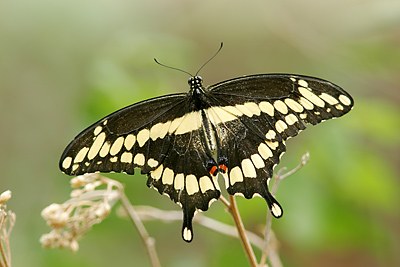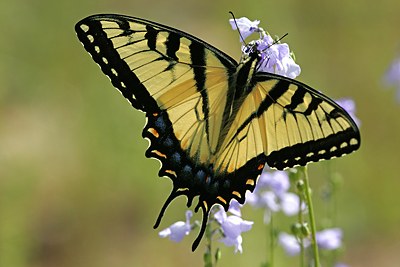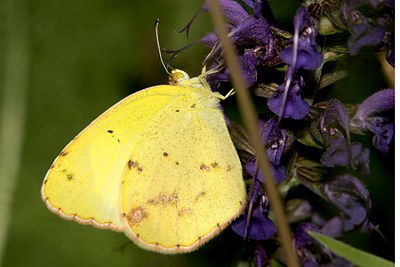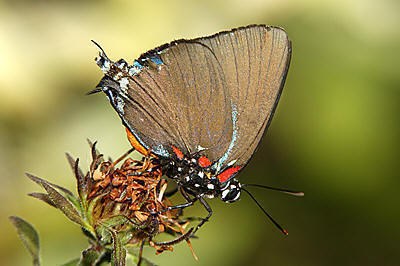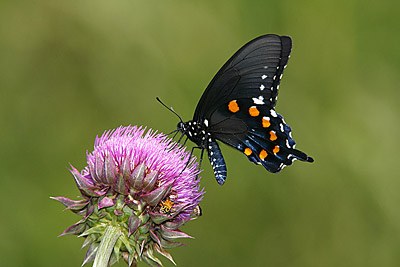
Pipevine Swallowtail
- Habitat
- Wide variety of open habitats, open woodland, woodland edges
- Size
- 2¾–5 in (7–13 cm)
- Lifespan
- Adults typically live only about 1 to 2 weeks after emerging.
- Diet
- Host: pipevines (Aristolochia spp.). Nectar: thistles, bergamot, lilac, viper's bugloss, azaleas, phlox, teasel, dame's-rocket, lantana, petunias, verbenas, lupines, yellow star thistle, California buckeye, yerba santa, brodiaeas, gilias
About the Pipevine Swallowtail
The Pipevine Swallowtail is a striking, mid-to-large swallowtail whose hindwings shimmer with an iridescent blue-green sheen, especially vivid in males, set against wings otherwise black and marked with pale spots along the margins and a row of orange spots visible on the underside of the hindwing. That bold coloring is not just decorative: it functions as a warning, since the butterfly carries toxins acquired during its caterpillar stage that make it distasteful and even poisonous to would-be predators.
Those toxins come directly from the caterpillar's sole food plant, pipevine (Aristolochia species), which contains defensive compounds called aristolochic acids. Rather than being harmed by the chemical, the caterpillar sequesters it in its own tissues, carrying the protection through metamorphosis into the adult butterfly. This toxicity has made the Pipevine Swallowtail one of the most important model species for Batesian mimicry in North America — several unrelated, perfectly edible butterflies, including the dark form of the female Eastern Tiger Swallowtail, the Red-spotted Purple, and the Spicebush Swallowtail, have independently evolved to resemble the Pipevine Swallowtail's color pattern in order to fool predators into avoiding them as well.
Adults range across a wide variety of open habitats, open woodland, and woodland edges, with males patrolling likely territory in search of receptive females rather than waiting at a fixed perch. Females lay their eggs in small clusters on the undersides of pipevine leaves, and the resulting caterpillars start out feeding together in groups before dispersing to feed alone as they grow larger. The species overwinters as a chrysalis, emerging the following season as an adult with a strikingly short lifespan — typically only about one to two weeks — meaning the population depends on producing several overlapping generations across the growing season rather than any single generation living long. The species ranges across a wide swath of the eastern, southern, and southwestern United States wherever pipevine grows, with a related but distinct subspecies found farther west, and its striking coloring makes it one of the more instantly recognizable large swallowtails wherever open habitat and its host plant overlap, particularly when a male's wings catch direct sunlight and flash their full iridescent blue-green sheen.
Male Pipevine Swallowtails, like many swallowtails, are thought to rely partly on visual cues and partly on pheromones released from specialized scent scales to identify and court a receptive female, though the toxicity that protects this species from predators offers it no advantage during courtship itself, where the usual visual and chemical signals of butterfly mate-finding still apply. While adult and late-stage caterpillars are generally well protected from vertebrate predators by their acquired toxins, eggs and very young caterpillars have not yet accumulated enough of the plant's defensive chemicals to be reliably distasteful, and this early vulnerable window is likely where much of the species' natural mortality occurs, mainly to small predators and parasitoid wasps rather than to birds. Because the mimicry complex built around this species is one of the most extensively studied examples of Batesian mimicry in North American butterflies, the Pipevine Swallowtail has served for decades as a reference point in research exploring how predator learning, model abundance, and mimic accuracy interact to determine how well a harmless mimic is protected in a given area. Regional populations across the western part of the range are sometimes treated as a distinct subspecies, reflecting modest differences in appearance and host plant use compared with eastern populations, though both share the same fundamental toxic-model biology built around Aristolochia.
Frequently asked questions
Why is the Pipevine Swallowtail toxic to predators?
Its caterpillars feed exclusively on pipevine plants and absorb toxic aristolochic acids from them, carrying that protection into adulthood.
What other butterflies mimic the Pipevine Swallowtail?
The dark form of the female Eastern Tiger Swallowtail, the Red-spotted Purple, and the Spicebush Swallowtail have all evolved similar coloring to gain the same protection from predators.
How social are Pipevine Swallowtail caterpillars?
Young caterpillars feed together in groups, but older caterpillars disperse and feed alone.
How long does an adult Pipevine Swallowtail live?
Typically only about one to two weeks after emerging from the chrysalis.
Are young Pipevine Swallowtail caterpillars just as well protected as adults?
Not entirely; eggs and very young caterpillars haven't yet accumulated enough toxin from the host plant to be reliably distasteful, making this early stage more vulnerable to small predators and parasitoids.
Where to find it
This species favors forest habitat. See real Oklahoma locations on the Habitats map.