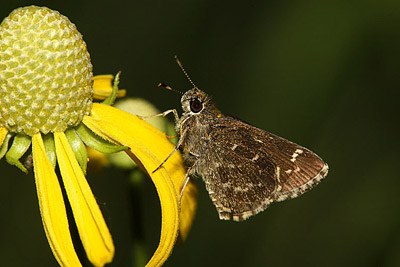
Bell's Roadside-Skipper
- Habitat
- Grassy areas near creeks, woodland openings/edges, city gardens
- Size
- 1 3/16–1 1/4 in (3–3.2 cm)
- Lifespan
- Lifespan hasn't been specifically studied; expect a short one-to-two-week adult stage typical of the genus.
- Diet
- Caterpillar: Indian woodoats grass
About the Bell's Roadside-Skipper
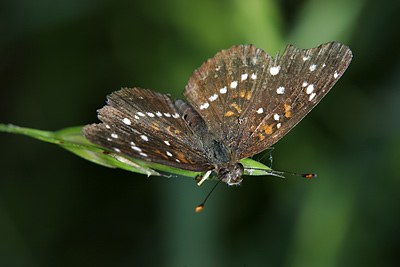
Bell's Roadside-Skipper is a small skipper, measuring about 1 3/16 to 1 1/4 inches (3-3.2 cm) across the wings, placing it among the more diminutive butterflies found in its habitat. The upperside is dark brown, marked with pale spots, notably lacking any spot within the wing cell -- a detail that helps separate it from similar roadside-skippers where a cell spot is present. The underside is gray-black and patterned with two rows of pale gray spots, a subdued, low-contrast look that likely aids camouflage against bark, leaf litter, or shaded ground when the butterfly is at rest. As with other roadside-skippers, the wing fringes are strongly checkered in alternating dark and light bands, a feature often more conspicuous than the wing pattern itself and a quick way to confirm identification in the field. At rest, the wings are typically held in the tilted, forewings-up posture common to grass-skippers, which likely assists in basking during the brief sunny intervals available in its shaded, semi-open haunts; like other small skippers, it likely orients its body to maximize sun exposure on cool mornings, then withdraws into shade as temperatures climb through the day.
This species is found in grassy areas near creeks, in woodland openings and along woodland edges, and even in city gardens, indicating some tolerance for landscapes modified by people as long as pockets of grass and shade persist. Its association with woodland edges rather than deep forest or wide-open prairie suggests a preference for the transitional zone where grass cover meets tree cover, likely for both larval host access and adult shelter from wind and strong sun. The species belongs to a genus of small, similarly patterned roadside-skippers found across the southern and eastern United States, several of which overlap in range and can be difficult to separate from Bell's Roadside-Skipper without close attention to the underside spotting and the presence or absence of a cell spot on the forewing.
Caterpillars feed on Indian woodoats grass, a broad-leaved woodland grass that grows in the shaded, semi-open sites the species favors, and this appears to be its only documented host. As with related grass-feeding skippers, larvae likely construct a shelter from a folded or tied leaf blade, feeding within it and reducing exposure while resting. Documentation of adult nectar sources is sparse for this species, though roadside-skippers as a group typically visit small, low-growing flowers found along the same woodland edges and grassy openings where they breed, rather than ranging far in search of food. In the warmer, southern parts of its range, including much of Texas and Oklahoma, the species likely produces more than one generation per year, with adults on the wing across a broader stretch of the warm season than would be possible farther north, though the precise number and timing of broods has not been closely documented.
Lifespan hasn't been specifically studied in Bell's Roadside-Skipper, but a short one-to-two-week adult stage is typical of the genus, consistent with a life strategy weighted toward rapid reproduction rather than adult longevity. Little else about its life cycle has been documented in detail; based on general patterns among grass-feeding skippers, eggs are likely laid singly on the host grass, and caterpillars probably overwinter as partly grown larvae in a shelter near ground level, though this has not been confirmed specifically. Because so much about this species' precise life history remains undocumented compared with more thoroughly studied skippers, much of what can be said about its biology is necessarily drawn from patterns typical of related roadside-skippers rather than from observations of Bell's Roadside-Skipper itself.
Frequently asked questions
What does Bell's Roadside-Skipper look like?
Dark brown above with pale spots (none in the wing cell) and strongly checkered fringes.
Where is Bell's Roadside-Skipper found?
Grassy areas near creeks, woodland openings and edges, and city gardens.
What is the host plant for Bell's Roadside-Skipper caterpillars?
Indian woodoats grass is its only documented host plant.
What does the underside of Bell's Roadside-Skipper look like?
Gray-black with two rows of pale gray spots.
Are there other roadside-skippers that look similar to Bell's Roadside-Skipper?
Yes, several similarly patterned roadside-skippers occur in the same region, and telling them apart usually requires a close look at the underside spotting and whether a spot is present in the forewing cell.
Where to find it
This species favors city / backyard habitat. See real Oklahoma locations on the Habitats map.