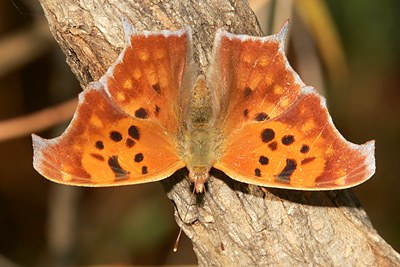
Question Mark
- Habitat
- Wooded areas with some open space, city parks, suburbs, fencerows
- Size
- 2¼–3 in (5.7–7.6 cm)
- Lifespan
- Overwinters as an adult in bark crevices, letting some individuals live several months total, unusually long for a butterfly.
- Diet
- Caterpillar: American elm, red elm, hackberry, Japanese hop, nettles, false nettle. Adult: rotting fruit, tree sap, dung, carrion — visits flowers only when preferred foods are scarce
About the Question Mark
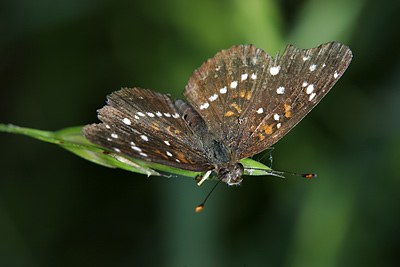
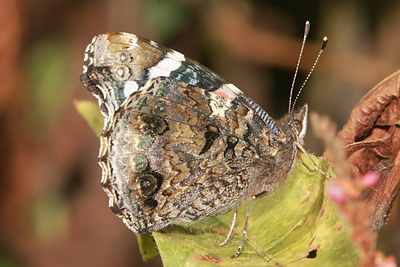
The Question Mark (Polygonia interrogationis) is a large anglewing butterfly, measuring 2¼ to 3 inches (5.7–7.6 cm) across the wings — among the biggest of its group. Its ragged, angular wing margins are a hallmark of the genus, and the orange-brown upperside is patterned with scattered dark spots. The underside tells a different story: a mottled, bark-like brown that camouflages the resting butterfly against tree trunks and dead leaves. Look closely at that underside hindwing and you'll find the silver mark that gives the species its name — a short curved line paired with a separate dot, together forming a tiny punctuation mark.
Question Marks favor wooded areas that retain some open space nearby — forest edges, city parks, suburban yards, and fencerows — rather than deep unbroken woodland. Caterpillars feed on American elm, red elm, hackberry, Japanese hop, and various nettles including false nettle, all common trees and weeds of exactly the semi-open, human-adjacent habitats the adults prefer. Adults, however, largely bypass flowers: their preferred foods are rotting fruit, tree sap, dung, and carrion, and they turn to nectar only when these richer, more nutrient-dense sources are scarce.
Males establish afternoon territories, perching on leaves or tree trunks to watch for passing females rather than patrolling widely. Females lay their eggs singly or in small vertical stacks on the undersides of host leaves, an unusual habit compared to many other butterflies that scatter eggs individually across many plants.
What truly sets the Question Mark apart is how it spends the winter: rather than passing the cold months as an egg, caterpillar, or chrysalis, it overwinters as a full adult, tucked into bark crevices and other sheltered nooks. This lets some individuals live for several months in total — unusually long for a butterfly — with these overwintered adults emerging to fly and lay eggs again as late as May. That extended adult lifespan, paired with its taste for fermenting fruit and sap over nectar, makes the Question Mark one of the more unusual life histories among North American butterflies.
The species ranges across most of the eastern United States and into southern Canada, generally following the distribution of its elm and hackberry host trees. Its tolerance for semi-open, tree-lined habitat near people means it often turns up unexpectedly in backyards and city parks, especially where fallen fruit or sap-weeping trees provide the concentrated food sources adults favor over nectar.
Frequently asked questions
Where does the Question Mark get its name?
From a tiny silver marking on the underside of the hindwing that forms a curved line plus a separate dot, resembling a question mark.
What do adult Question Marks eat?
They prefer rotting fruit, tree sap, dung, and carrion, and only visit flowers when these preferred foods are scarce.
How long do Question Marks live?
Because they overwinter as adults sheltering in bark crevices, some individuals live several months in total, unusually long for a butterfly.
What plants do the caterpillars eat?
They feed on American elm, red elm, hackberry, Japanese hop, and nettles including false nettle.
Where to find it
This species favors city / backyard habitat. See real Oklahoma locations on the Habitats map.