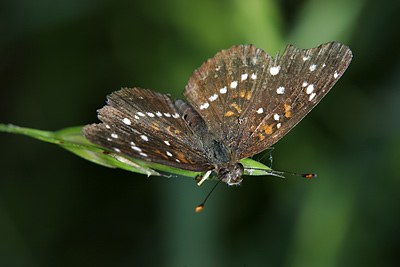
Texan Crescent
- Habitat
- Deserts, dry gulches, open areas, streamsides, road edges, city parks
- Size
- 1¼–1⅞ in (3.2–4.8 cm)
- Lifespan
- Adult lifespan isn't well documented, likely one to two weeks as with other crescents.
- Diet
- Caterpillar: acanthus family — Ruellia, Jacobina, Beloperone, Siphonoglossa
About the Texan Crescent
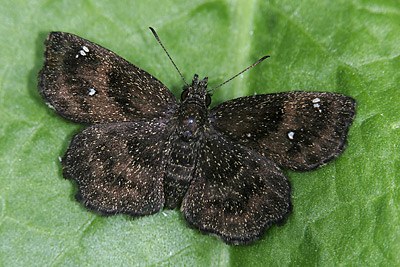
The Texan Crescent (Anthanassa texana) is a small, dark butterfly measuring 1¼ to 1⅞ inches (3.2–4.8 cm) across the wings. Unlike many of its crescent relatives, which lean orange, this species shows blackish-brown wings patterned with cream and tan crescent-shaped markings, giving it a more subdued, almost smoky appearance. The scalloped wing margins and checkered fringe are shared traits within the crescent group, but the darker overall tone makes the Texan Crescent distinctive once you know to look for it.
True to its name, this butterfly is closely associated with the arid Southwest, ranging through Texas and neighboring states into Mexico. It thrives in dry, open country — deserts, dry gulches, and sun-baked open ground — but it is also remarkably adaptable, turning up along streamsides, road edges, and even in city parks where its host plants can gain a foothold. Caterpillars feed on members of the acanthus family, including Ruellia, Jacobina, Beloperone, and Siphonoglossa, low-growing plants that often persist in disturbed or urban ground as readily as in wild desert washes.
Male Texan Crescents stake out dry gulches and washes as their preferred meeting grounds, perching and watching for females passing through rather than ranging widely to find them. Once mated, females lay their eggs in groups on the undersides of host-plant leaves, a strategy shared with several related crescent species that gives newly hatched caterpillars the safety of numbers in their earliest, most vulnerable instars.
Because the Texan Crescent lives in warm climates with a long growing season, it is capable of producing multiple generations across the year rather than being restricted to a single emergence. This flexibility, combined with its tolerance of both wild desert habitat and human-altered landscapes, helps explain why it remains one of the more frequently encountered small butterflies across its southwestern range, often appearing in places where other, more habitat-specific species cannot persist.
The species ranges from Texas, New Mexico, and Arizona south through Mexico into Central America, with occasional strays turning up as far north as Kansas and Colorado during warm-weather dispersals. In the milder parts of its range, particularly deep South Texas, adults can be found on the wing in nearly every month of the year, reflecting the multiple, overlapping generations that the warm climate allows. Careful observers separate it from other similarly patterned crescents mainly by its darker overall tone and the shape of the cream crescents along the wing margin.
Frequently asked questions
What does a Texan Crescent look like?
It is a small, darker-toned crescent with blackish-brown wings marked by cream and tan crescent-shaped patterns, unlike the more orange coloring of many related crescents.
Where does the Texan Crescent live?
It favors deserts, dry gulches, and open ground in the Southwest, but also adapts well to streamsides, road edges, and city parks.
What plants do the caterpillars need?
They feed on acanthus-family plants such as Ruellia, Jacobina, Beloperone, and Siphonoglossa.
How do males find females?
Males perch in dry gulches and washes, watching for females to pass by rather than actively searching for them.
Where to find it
This species favors city / backyard habitat. See real Oklahoma locations on the Habitats map.