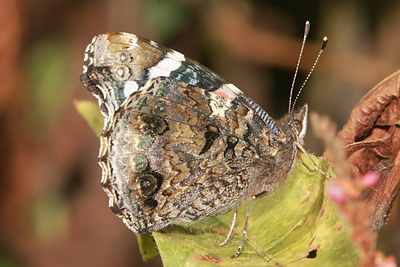
Red Admiral
- Habitat
- Moist woods, yards, parks, marshes, seeps, moist fields; nearly any habitat while migrating
- Size
- 1¾–3 in (4.5–7.6 cm)
- Lifespan
- Adults typically live several weeks, roughly 2 to 4 weeks after emerging.
- Diet
- Caterpillar: nettle family — stinging nettle, tall wild nettle, wood nettle, false nettle, pellitory, possibly hops. Adult: prefers sap flows, fermenting fruit, bird droppings; nectars at common milkweed, red clover, aster, alfalfa when unavailable
About the Red Admiral
The Red Admiral (Vanessa atalanta) is a striking, easily recognized butterfly, 1¾ to 3 inches across, with velvety blackish-brown wings crossed by a bold band of orange-red on the forewing and along the edge of the hindwing. White spots dot the black forewing tip, and the hindwing margin carries a row of small blue spots. The underside is more subdued, a mottled brown and black on the hindwing that provides camouflage, contrasting sharply with the bright, flag-like pattern shown in flight.
Red Admirals favor moist habitats, including damp woods, yards, parks, marshes, seeps, and wet fields, though during migration they can turn up in almost any setting. The species is found throughout most of North America and is also widespread in Europe and parts of Asia, making it one of the most familiar butterflies across the Northern Hemisphere.
Caterpillars feed exclusively on plants in the nettle family, chiefly stinging nettle, along with tall wild nettle, wood nettle, false nettle, pellitory, and possibly hops. Young caterpillars shelter inside a single folded-over leaf, while older ones construct more elaborate nests by tying several leaves together with silk. Adult Red Admirals are unusual among butterflies in their strong preference for non-floral food: they favor tree sap flows, fermenting fallen fruit, and even bird droppings, turning to nectar at common milkweed, red clover, and aster mainly when these richer sources are unavailable.
Male Red Admirals defend territory on ridgetops during the afternoon, and their flight is famously erratic and fast, described as a rapid, unpredictable dash rather than a leisurely flutter, which makes them satisfying but tricky to follow with the eye. Adults typically live a few weeks, roughly two to four, and the species overwinters as a hibernating adult in milder parts of its range, supplementing resident populations with northward migrants each spring.
Its common name is thought to derive from "the Admirable," an older name for the species that was gradually shortened over time. Red Admirals are also known for periodically irrupting in unusually large numbers in some years, likely tied to favorable breeding conditions farther south, producing springs when the species seems unusually abundant before settling back to more typical numbers the following season.
Frequently asked questions
What does a Red Admiral look like in flight?
It shows dark wings crossed with bold orange-red bands and white-spotted black tips, and it flies in a notably erratic, rapid pattern.
What do Red Admiral caterpillars eat?
They feed almost exclusively on plants in the nettle family, especially stinging nettle, sheltering inside folded or silk-tied leaf nests.
Do Red Admirals visit flowers for nectar?
They prefer sap flows, fermenting fruit, and even bird droppings, and only turn to nectar plants like milkweed, red clover, and aster when those are unavailable.
Where are Red Admirals typically found?
They favor moist habitats such as damp woods, marshes, and parks, but can appear almost anywhere while migrating.
Where to find it
This species favors city / backyard habitat. See real Oklahoma locations on the Habitats map.