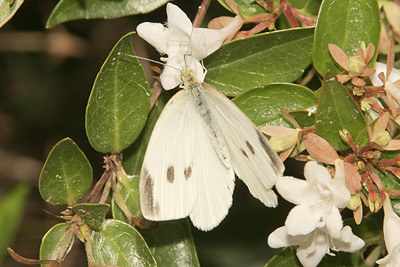
Cabbage White
- Habitat
- Almost any open space: weedy areas, gardens, roadsides, cities, suburbs
- Size
- 1¾–2¼ in (4.5–5.8 cm)
- Lifespan
- Adults commonly live around 3 weeks, sometimes stretching closer to a month.
- Diet
- Host: mustard family, occasionally caper family. Nectar: mustards, dandelion, red clover, asters, mints, among others
About the Cabbage White
The Cabbage White is likely the most frequently seen butterfly across much of North America, a plain white insect with one black spot on each forewing in males and two in females, plus dusky black wingtips. It is not, however, a native species: it was accidentally introduced from Europe in the 1860s, most likely arriving in Quebec, and from that initial foothold it spread across virtually the entire continent within a matter of decades, a rate of expansion few introduced insects have matched, reaching the Pacific coast within about twenty to thirty years of its first detection.
Part of that success comes from an extraordinary tolerance for disturbed, human-altered landscapes: gardens, roadsides, vacant lots, cities, and suburbs all support thriving populations, and the species needs little more than a patch of open ground and a host plant to establish itself. That host plant is almost always something in the mustard family, which routinely brings the butterfly into direct conflict with gardeners, since its caterpillar -- often called the "cabbageworm" -- feeds readily on cabbage, broccoli, kale, and other cultivated brassicas, making it one of the most persistent pests in home vegetable gardens. Beyond the garden, its rapid spread and reliance on many of the same mustard-family plants used by some native white butterflies has raised concern in parts of its range that it may compete with and displace native species, including localized pressure on the West Virginia White in parts of the eastern forests it now shares.
Males patrol open areas searching for mates, flying in quick, fluttering zigzags low over vegetation, and a receptive female that has already mated will often signal her unavailability to a pursuing male by raising her abdomen in a distinctive rejection posture rather than allowing him to approach, a behavior documented across many Pieris species. Females lay their eggs singly on the undersides of host leaves, where the resulting caterpillars go to work on the foliage largely unnoticed until damage becomes obvious.
The species overwinters as a chrysalis, with the decision to enter this resting diapause rather than continue developing generally triggered by the shortening day length and cooling temperatures of late summer and fall, and it is typically the very first butterfly to appear each spring across much of its range, often flying while snow patches still linger nearby. Adults live around three weeks, sometimes stretching closer to a month, and because multiple generations are produced every year, the Cabbage White remains active from very early spring through late fall -- a small, unassuming butterfly that, through sheer adaptability, has become one of the most successful introduced insects in North America. Its success has not been limited to this continent, either -- since its original spread from Europe, the Cabbage White has also been introduced to other regions of the world, and today it ranks among the most widely distributed butterfly species on the planet, a remarkable legacy for an insect that arrived in North America almost entirely by accident. Few other introduced insects illustrate quite so clearly how thoroughly a species tied to a widely cultivated plant family can piggyback on human agriculture to colonize an entire continent. Even experienced butterfly watchers sometimes overlook it entirely, precisely because it is so ubiquitous and unassuming compared with the many boldly patterned native butterflies sharing the same weedy roadsides and garden beds, and in much of its range it is also one of the last butterflies still on the wing in late fall, continuing to fly on mild days well after most native species have already entered diapause for the winter.
Frequently asked questions
Is the Cabbage White native to North America?
No, it was introduced from Europe in the 1860s and spread across most of the continent within decades.
Why do gardeners consider the Cabbage White a pest?
Its caterpillar, the "cabbageworm," feeds on cabbage, broccoli, kale, and other mustard-family garden crops.
How can you tell a male Cabbage White from a female?
Males have one black spot on each forewing, while females have two.
When does the Cabbage White typically appear each year?
It is usually the first butterfly to emerge in spring across much of its range and remains active into late fall.
Has the Cabbage White's spread affected any native butterflies?
In parts of the eastern United States, its abundance and shared use of mustard-family host plants has been linked to added competitive pressure on the native, and now much less common, West Virginia White.
Where to find it
This species favors city / backyard habitat. See real Oklahoma locations on the Habitats map.