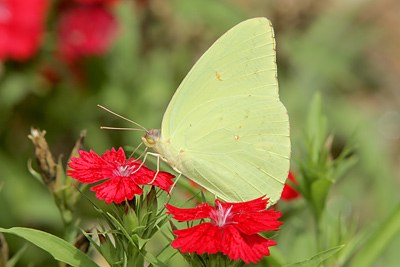
Cloudless Sulphur
- Habitat
- Disturbed open areas: parks, yards, gardens, beaches, road edges, abandoned fields, scrub
- Size
- 2¼–3⅛ in (5.7–8 cm)
- Lifespan
- Adults live roughly 2 to 4 weeks, with fall migrants covering long distances southward during that span.
- Diet
- Host: Cassia spp. (pea family). Nectar: cordia, bougainvillea, cardinal flower, hibiscus, lantana, wild morning glory
About the Cloudless Sulphur
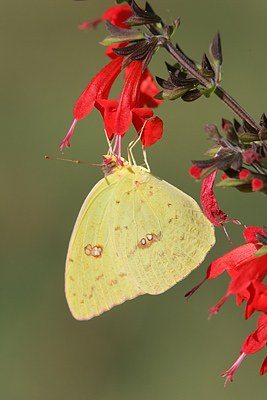
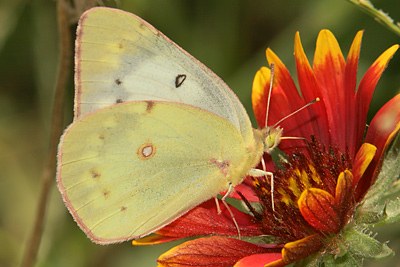
The Cloudless Sulphur is a notably large member of its family, spanning 2¼ to 3⅛ inches, and is named for the largely unmarked, clear lemon-yellow wings of the male. Females are more variable, ranging from yellow to nearly white, marked with scattered dark spots along the wing margins that males lack entirely. In flight, its size and strong, direct wingbeats often distinguish it from smaller sulphurs sharing the same fields, and its habit of flying high and fast when disturbed can make it hard to follow for more than a few seconds at a time.
This species is a butterfly of disturbed and open ground, turning up in parks, yards, gardens, beach dunes, roadsides, abandoned fields, and scrubby edges, particularly across the southern United States, though it strays and migrates much farther north during summer months. It is a strong, sustained flier, and every autumn large numbers move southward, sometimes traveling considerable distances ahead of cooler weather. Populations expand and contract noticeably with the seasons, thinning out across the northern part of its temporary range as soon as the first hard frosts arrive.
Caterpillars feed on Cassia species in the pea family, and their body color often shifts to match the part of the plant they are eating, appearing yellow when consuming flowers and green when feeding on leaves, an adaptation that helps conceal them from predators. Adults are generous nectar feeders that visit a striking variety of flowers, including cordia, bougainvillea, cardinal flower, hibiscus, lantana, and wild morning glory, often favoring red and orange tubular blossoms suited to their long proboscis.
Males patrol rapidly through open habitat searching for mates, covering ground more aggressively than species that simply perch and wait. After mating, females lay their eggs singly on the young leaves and flower buds of the host plant, giving the emerging caterpillars immediate access to tender growth. The caterpillars themselves tend to rest on the undersides of leaves during the day, reducing exposure to birds while they are not actively feeding. Adults typically live two to four weeks, and the fall generation is responsible for the species' well-documented long-distance migratory movements toward warmer regions, with individuals sometimes turning up in gardens and parks far outside the areas where the species can successfully breed year-round.
Adults regularly gather at dusk in loose communal roosts, clinging to the undersides of leaves or twigs on shrubs and small trees, a habit that may reduce individual risk of predation compared with roosting alone. Female Cloudless Sulphurs occasionally appear in a rare pale pinkish-white form, sometimes called "rosa," in addition to the more typical yellow-and-white variation, adding a further layer to the species' already variable female pattern. Botanists now generally classify the caterpillar's host plants in the genus Senna rather than the older name Cassia, though both names still appear in field guides and older references describing the same group of pea-family shrubs and herbs. In the Deep South and immediate Gulf Coast, mild winters allow a resident population to persist and breed nearly continuously, while the large seasonal influx seen farther north each summer and fall represents genuine northward colonization rather than local overwintering success. Because the species flies fast, high, and often in a straight line when moving between patches of habitat, it is also thought to cover considerably more ground per day than many of the small blues and hairstreaks that share its fields, helping explain how quickly it can turn up in gardens well outside its normal breeding range.
Frequently asked questions
Why is it called the Cloudless Sulphur?
Males have essentially unmarked, clear yellow wings without the dark borders or spotting seen in many related sulphur species.
What color are the caterpillars?
They can be yellow or green depending on whether they are feeding on flowers or leaves of their Cassia host plant, which helps camouflage them.
Does the Cloudless Sulphur migrate?
Yes, fall generations migrate southward over long distances, a behavior well documented in this species.
What flowers do adults prefer to nectar at?
They favor tubular, often red or orange flowers such as cardinal flower, hibiscus, and lantana, suited to their long proboscis.
Is the yellow color of Cloudless Sulphurs always the same?
No, females occasionally show a rare pale pinkish-white form in addition to the more typical yellow or white variation, adding further variability to an already changeable sex.
Where to find it
This species favors grassland habitat. See real Oklahoma locations on the Habitats map.