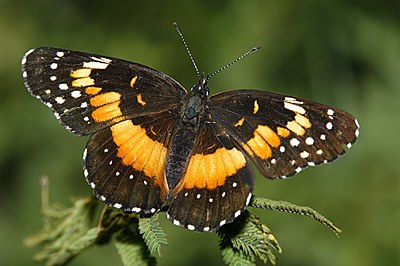
Bordered Patch
- Habitat
- Pinyon/oak woodlands, thorn forest, desert hills, fields, road edges, fencerows
- Size
- 1⅜–2 in (3.5–5.1 cm)
- Lifespan
- Adult lifespan isn't well documented, but likely just a couple of weeks like related checkerspots.
- Diet
- Caterpillar: sunflower-family plants — sunflowers, ragweed, crownbeard, cocklebur
About the Bordered Patch
The Bordered Patch is an unusually variable checkerspot, typically showing a black base color crossed by a band of yellow, orange, or white patches, though the exact pattern differs considerably even among individuals from the same local population. This variability, more extreme than in most North American butterflies, makes the species somewhat unpredictable to identify at a glance, though its overall checkerspot shape and size of 1 3/8 to 2 inches remain consistent, and experienced observers often rely on habitat and host plant association as much as wing pattern to confirm an identification. The bold, high-contrast patterning is thought to function as a warning signal to predators, since caterpillars that feed on sunflower-family plants can sequester bitter or mildly unpalatable compounds from their host, a chemical defense strategy documented in a number of other checkerspots and fritillaries that also rely on toxic or bitter host plants.
This species occupies pinyon and oak woodlands, thorn forest, desert hills, fields, road edges, and fencerows, largely across the southwestern United States and into Mexico, favoring warm, dry habitats that experience unpredictable rainfall from year to year, with local abundance often varying considerably depending on how recently the area has received rain. In Oklahoma the species is found mainly toward the western and southern parts of the state, at the edge of its broader range, where its numbers likely track the same boom-and-bust rainfall pattern seen more dramatically farther southwest.
Caterpillars feed on sunflower-family plants, including sunflowers, ragweed, crownbeard, and cocklebur, host plants that themselves tend to appear opportunistically after rain in the arid landscapes this butterfly occupies. Young caterpillars often spin a loose communal silk web over the foliage of their host plant, feeding together within its shelter, a structure that likely offers some protection from small predators and helps the group stay together as they move from leaf to leaf.
Males patrol host plant patches and hillsides searching for mates, and the caterpillars display an interesting shift in social behavior as they mature: young caterpillars are gregarious, feeding together in groups that may offer some protection from predators, while older caterpillars become solitary as they grow larger and less vulnerable. Third-instar caterpillars are capable of entering a hibernation-like dormancy, and in some populations they can also enter a separate summer diapause, effectively allowing the species to pause development during whichever season turns hot, dry, or otherwise unfavorable for continued growth. This flexible dormancy strategy suits the boom-and-bust conditions of desert and semi-arid habitat well, letting the Bordered Patch resume rapid breeding whenever rain triggers fresh host plant growth.
Adult lifespan is not well documented for this species, but is likely similar to the couple of weeks typical of related checkerspots, with multiple generations able to pass through in a single year wherever rainfall keeps host plants growing. Adults commonly bask with wings spread flat to absorb heat during cooler mornings, a typical checkerspot habit, and visit a range of small flowers for nectar, generally favoring the same sunflower-family blooms that support their caterpillars, along with other low-growing wildflowers found along the roadsides and field edges the species frequents. This flexible, weather-driven breeding schedule is a common trait among butterflies of arid and semi-arid country, where a rigid single-brood strategy would leave a species unable to capitalize on unpredictable good years. Because it belongs to a genus with many similarly patterned relatives across the Southwest, patient observers sometimes find several look-alike checkerspots sharing the very same roadside patch of host plants, each pursuing this same flexible, rain-driven strategy in its own way.
Frequently asked questions
Why is the Bordered Patch hard to identify by pattern alone?
It is extremely variable, with the color and shape of its patch markings differing considerably even among individuals from the same population.
Do Bordered Patch caterpillars stay together?
Young caterpillars are gregarious and feed in groups, often within a shared silk web, but they become solitary as they grow older.
How does this species cope with unpredictable desert weather?
Third-instar caterpillars can enter dormancy during both winter and, in some populations, summer, pausing development until conditions improve.
What do the caterpillars eat?
Sunflower-family plants such as sunflowers, ragweed, crownbeard, and cocklebur.
Why is the Bordered Patch's bold pattern thought to serve as a warning?
Because its caterpillars feed on sunflower-family plants and may pick up bitter or mildly unpalatable compounds from them, the high-contrast pattern likely signals to predators that the butterfly is not a good meal, a strategy seen in several other checkerspots.
Where to find it
This species favors forest habitat. See real Oklahoma locations on the Habitats map.